Commentary: The cost of the Iran war isn't just measured in bombs
Published in Op Eds
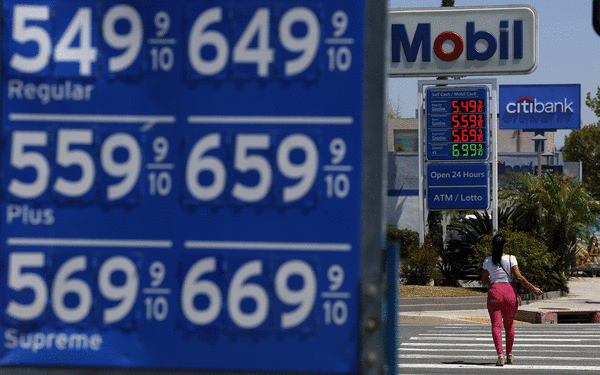
A farmer in Ames, Iowa, pulls up to a gas station and stares in shock at the numbers on the pump. The price of fuel has jumped sharply since the outbreak of war with Iran. His next thought is simple: every extra dollar spent on diesel is a dollar he cannot spend elsewhere. Before long, those higher costs will show up in the price of food, shipping, and countless other goods Americans buy every day.
Most Americans experience the costs of war not on a battlefield thousands of miles away, but at the gas pump. But higher fuel prices are only the most visible expense. The true cost of war extends far beyond oil markets. It includes billions spent on military operations, the interest on borrowed money, and the opportunities lost when scarce public resources are diverted from schools, housing, infrastructure, and other urgent social needs.
The cost of the Iran war isn't just measured in how much we spend on bombs. It is also measured in what those bombs prevent us from doing at home.
The costs we rarely see
Americans typically measure wars in military terms: targets destroyed, territory gained, governments toppled, and ceasefires negotiated. But a more important question is: What else could we have done with the money?
That question matters because the cost of military action does not end when the missiles stop. The United States has spent roughly $8 trillion on wars and related military operations since 2001, according to estimates from Brown University's Costs of War Project, with a substantial share of that spending tied to conflicts and military activities in the Middle East, including Afghanistan, Iraq, Syria, and broader regional operations. Much of that spending was financed through borrowing, meaning taxpayers continue to pay interest on wars long after the battles themselves have faded from memory.
The current conflict with Iran follows a familiar pattern. Public debate focuses on military objectives and geopolitical risks. Yet every missile launched, aircraft deployed, and naval task force sent overseas represents a choice about how public resources will be used.
Every dollar spent on one thing is a dollar unavailable for something else. In economics, this is the classic "guns versus butter" dilemma: resources devoted to military spending cannot be devoted to civilian needs and public investment. The resources devoted to war cannot simultaneously be used to build affordable housing, modernize aging infrastructure, hire teachers, expand healthcare access, or strengthen Social Security. In a world of finite resources, every budget decision carries tradeoffs.
This is not to say that national defense needs are unimportant. The real question is whether Americans fully understand what they are giving up when military expenditures continue to grow while many urgent domestic needs remain unmet.
What could we have bought instead?
The $8 trillion spent on post-9/11 wars is so large that it's almost meaningless to most Americans. A trillion is not a number people encounter in everyday life. Because it's too big to picture and too abstract to feel, it helps to translate it into things people understand.
That money could have helped make housing more affordable, expanded access to childcare, and strengthened Social Security and Medicare as the population ages.
The United States continues to struggle with aging infrastructure. Bridges need repair, water systems require modernization, and public transit systems in many cities are badly outdated. Trillions of dollars could have transformed the nation's infrastructure while creating millions of well-paying jobs in the process.
Education offers another striking comparison. School districts across the country face teacher shortages, aging facilities, and other rising costs. Resources devoted to war could have funded generations of teachers, expanded Pell Grants for college students, reduced student debt, and strengthened public schools at every level.
Healthcare presents a similar story. Millions of Americans struggle with rising medical costs while mental health services remain inadequate and rural hospitals continue to close. The resources devoted to military operations could have dramatically expanded access to care while improving health outcomes across the country.
These comparisons are not meant to suggest that every dollar spent on national defense should instead be spent on domestic programs. Governments must provide for both security and public welfare. But they do reveal the scale of the tradeoffs. The United States did not lack the resources to invest more deeply in its people. It chose to spend a substantial portion of those resources elsewhere.
That is the hidden cost of war. It is not only what appears in the defense budget. It is the affordable home that was never built, the bridge that was never repaired, the teacher who was never hired, the hospital that closed its doors, and the opportunities that never materialized because the money was spent somewhere else.
The bill has yet to arrive
The full cost of the conflict with Iran remains unknown. History suggests that military engagements almost always end up costing more than their advocates initially predict. The missiles and bombs used today must be replaced tomorrow. Interest on borrowed funds will continue long after the headlines fade.
What makes this conflict particularly troubling is that the decision to launch military action was made without meaningful congressional debate or authorization. The Constitution gives Congress the power to declare war because the framers wanted decisions involving lives, treasure, and national commitment to be subject to public scrutiny and democratic accountability.
Instead, Congress largely stood on the sidelines. A Republican-led Congress that has repeatedly failed to assert its institutional authority once again deferred to the executive branch. The result is another example of the steady concentration of power in the presidency.
Americans deserve an honest debate not only about the strategic objectives of this conflict but also about its costs. The price of war is not measured solely in bombs dropped overseas. It is measured in the opportunities forgone at home, the debt passed to future generations, and the constitutional safeguards weakened when Congress abandons its responsibility to check executive power.
____
Robert Cropf is a Professor of Political Science at Saint Louis University.
____
©2026 The Fulcrum. Visit at thefulcrum.us. Distributed by Tribune Content Agency, LLC.

















































Comments