Editorial: How the media can earn back America's trust
Published in Op Eds
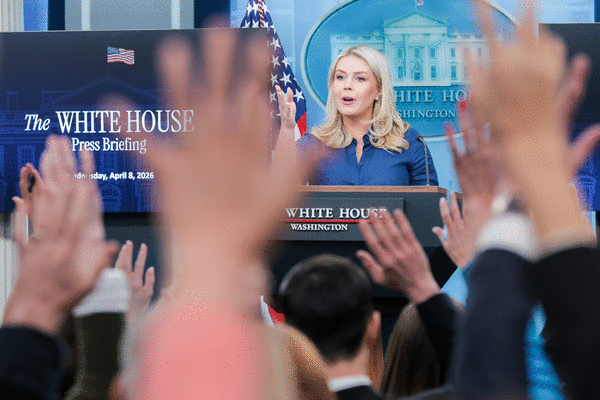
The freedom of the press is one of America’s greatest protections against unchecked power. But freedom carries responsibility, and journalism cannot demand the public’s trust simply because the Constitution protects our right to publish.
We must earn it.
That responsibility has become more urgent as confidence in journalism has collapsed. Gallup reported last year that only 28% of Americans had a great deal or fair amount of confidence that newspapers, television and radio report the news fully, accurately and fairly, the lowest level since Gallup began asking the question in 1972.
Those numbers should trouble every journalist, editor, publisher and media owner in America.
The Fourth Estate was never intended to become an extension of the Republican Party, the Democratic Party, corporate America or any ideological movement. Our obligation is not to protect politicians we admire or destroy those we dislike. It is not to tell readers what they should think.
Our responsibility is to pursue the truth and give citizens the information necessary to think for themselves.
That means questioning presidents regardless of party. It means scrutinizing prosecutors and defendants, corporations and unions, activists and institutions. It means being willing to investigate our friends with the same determination we investigate our adversaries.
The Society of Professional Journalists summarizes the obligation through four principles: seek truth and report it; minimize harm; act independently; and be accountable and transparent. It also reminds journalists that their highest obligation is serving the public.
Those principles matter enormously in this era of instantaneous information.
Social media rewards outrage. Algorithms reward engagement. Political audiences reward confirmation. Being first can become more valuable than being right. And opinion can easily masquerade as reporting.
Journalists must resist those temptations.
We must also resist another temptation: believing that because we possess a platform, we possess superior wisdom.
Journalism requires humility. Facts change. Sources mislead. Institutions fail. Reporters make mistakes. When we are wrong, we should correct the record prominently and without defensiveness.
There is also an important distinction between journalism and advocacy. Editorial pages, including this one, exist to express opinions and make arguments. News pages have a different responsibility: reporting, verification, context and fairness. Readers deserve to know which they are receiving.
The press is sometimes called democracy’s watchdog. But a watchdog that only barks at one political party eventually becomes somebody’s pet.
At The Baltimore Sun, our responsibility must be larger than ideology and larger than ourselves. We should challenge Democrats and Republicans, government and business, conventional wisdom and fashionable dissent.
And we should welcome readers who challenge us.
The Fourth Estate does not derive its authority from popularity. It derives its authority from credibility.
America needs courageous journalism. But courage is not measured by how aggressively we investigate people we oppose.
The true test comes when the facts challenge our friends, our assumptions and ourselves.
That is when journalism earns its freedom.
And that is how we begin earning back America’s trust.
_____
©2026 The Baltimore Sun. Visit at baltimoresun.com. Distributed by Tribune Content Agency, LLC.

















































Comments