Commentary: How to prevent future US attorneys general from being subservient attack dogs
Published in Op Eds
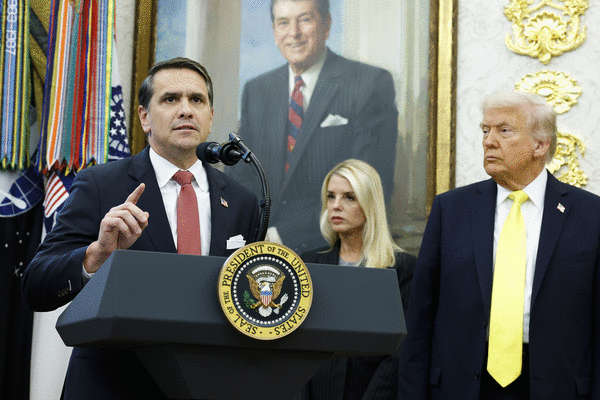
Todd Blanche, a onetime personal lawyer for the president, squeaked through Senate confirmation recently by a single vote. Asked Sunday on NBC’s “Meet the Press” whether the Justice Department he now leads will always act independently of the White House, Blanche declared flatly, “No, I’m not going to pledge that.”
His demonstrated readiness to act as the president’s enforcer, launching criminal charges against perceived foes, demands revision of how we choose our future attorneys general — and of how presidents may dismiss them.
That the president has weaponized the Justice Department is plain. No target has proved too great, whether a former FBI chief, the New York attorney general or three sitting senators. And no target has proved too small, from a sandwich-wielding assailant to an alleged Reflecting Pool vandal. It seems anyone who defies or annoys the president risks criminal prosecution.
When the last attorney general, Pam Bondi, lagged in hauling such pesky nuisances before the courts, the president promptly sacked her and installed a more eager and compliant chief prosecutor. The new attorney general not only has scourged the president’s enemies but also tried to exempt the president and his family from investigation or prosecution for any past tax offenses.
The Supreme Court’s end-of-term rulings defining and expanding the president’s power to fire federal agency heads foreclosed any legislative fix for the process of confirming attorneys general. Trump vs. Slaughter and Trump vs. Cook made it dead clear Congress has no power to protect the attorney general, the nation’s chief law enforcement officer, from presidential pressure to prosecute political foes. Absent a constitutional amendment shielding the attorney general from termination without cause, the president can keep weaponizing federal prosecutorial power against perceived enemies.
Though the president must seek the Senate’s advice and consent in appointing an attorney general, the president can fire the officeholder for any reason or no reason at all. Politicians and commentators often tout the attorney general’s traditional independence in exercising prosecutorial power. But as we saw with President Donald Trump’s unexplained dismissal of Bondi, the office is independent only so long as the president permits it to be.
Even in historical terms, the attorney general’s vaunted independence has proved more of an ideal than a reality. Since the presidency of Woodrow Wilson, most attorneys general have been politicos or presidential cronies (or both) and not seasoned and respected legal professionals. As Boston University law professor Jed Shugerman has shown, one of the surest ways to snag the Justice Department’s top job is to serve first as the president’s campaign manager.
The irony of the Supreme Court’s recent rulings is that the justices defended the president’s unbounded power to fire subordinates as a hedge against tyranny. The “buck stops” with the president, the majority wrote. The president must have the power to dismiss underlings so the people know “whom to fire” when something goes wrong in the executive branch.
The problem with this reasoning is that the president answers to the electorate only every four years. In the interim, people targeted by the attorney general at the president’s directive can be indicted, tried and imprisoned. And even if voters disapprove of the use of prosecutorial power, they can’t chastise a second-term president disqualified from running again.
A constitutional amendment allotting a measure of independence to the attorney general may be the only way to tether the president’s power to order prosecutions of political enemies. Such an amendment could be brief:
The power to institute and direct federal criminal prosecutions shall reside in an Attorney General appointed by the President with the consent of two-thirds of the Senators. The Attorney General shall hold office during the President’s term unless removed by the President for neglect, ineffectiveness, or malfeasance with the consent of two-thirds of the Senators or by impeachment. The Attorney General shall have the power to appoint principal deputies and the chief prosecutor of each judicial district with the advice and consent of the Senate and may remove those officers only for neglect, ineffectiveness, or malfeasance.
Requiring concurrence of two-thirds of sitting senators should ensure that a political hack or presidential crony cannot win confirmation as the nation’s chief prosecutor — unlike the simple majority now needed for someone such as Blanche to get past the Senate. And permitting dismissal of the attorney general only by the same supermajority should protect the position from presidential pressure while still ensuring accountability if there are abuses of power.
Skeptics of this proposal might argue that a semi-independent attorney general is alien to our tripartite system of government, as the office no longer would fit squarely within the executive branch. But in 43 states, voters already elect their attorney general. State attorneys general command a degree of independence even greater than this proposed amendment would confer on the federal attorney general. These states’ governments function perfectly well with a chief prosecutor neither appointed nor removable by the governor.
And skeptics might raise another objection: that this proposed amendment, whatever its merits, can’t be ratified. The Constitution is notoriously hard to amend. Two-thirds of both houses of Congress and the legislatures of three-quarters of the states typically must concur on a proposed amendment. But even in today’s harshly polarized climate, granting the attorney general some measure of protection from political pressure is a mission on which warring factions ought to be able to agree. After all, Trump and his most stalwart supporters complain bitterly that President Biden weaponized his Justice Department against them.
Rather than quarreling about who started it, let’s come together on a plan to ensure the next attorney general does not become the next president’s political cudgel.
_____
George Fisher is a professor at Stanford Law School and author of “Letter to a Young Prosecutor: Guidance on Ethics.”
_____
©2026 Los Angeles Times. Visit at latimes.com. Distributed by Tribune Content Agency, LLC.



















































Comments