Mary Ellen Klas: Florida Democrats aren't in disarray. They're in disagreement
Published in Op Eds
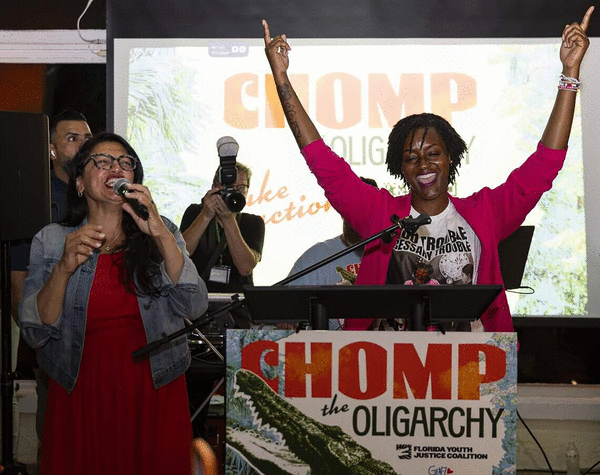
Florida demonstrated on Tuesday that the Democratic Party’s identity crisis is alive and well. It’s the latest signal that while the midterm election will be a referendum on the president’s performance, it’s also a major test of the Democratic Party’s ability to bridge its growing divide.
David Jolly, the moderate former Republican congressman, will top Florida’s Democratic ticket in November in the race for governor. Angie Nixon, a state representative from the progressive left, will be the party’s nominee for U.S. Senate. Shortly after Nixon was declared the winner, Sabato’s Crystal Ball, an election analysis newsletter, shifted its handicapping of Florida’s U.S. Senate race from “likely Republican” to “safe Republican.”
Although today Florida is seen as solid MAGA country, not that long ago, it was a swing state considered essential in a presidential race. (President Barack Obama won it twice.) But Democrats face an uphill battle in making it competitive again.
Tuesday’s primary results tell a tale of two extremes. Jolly, who left the Republican Party after President Donald Trump’s first election, will face off against Trump-endorsed Republican Congressman Byron Donalds in the governor’s race.
Nixon, a Jacksonville union organizer who became a member of the Democratic Socialists of America in June, will challenge incumbent Senator Ashley Moody. Moody is the Trump loyalist and former state attorney general whom DeSantis appointed last year to replace Marco Rubio, now secretary of state.
Jolly coasted to an easy victory over his lesser-known rivals. But the surprise of the night was Nixon’s double-digit victory over Alex Vindman, the national security whistleblower and key witness in Trump’s first impeachment trial.
Vindman raised $16 million to Nixon’s $1 million but squandered it with a lackluster campaign. Nixon, a longtime community activist and three-term lawmaker from Jacksonville, ran a better operation. She capitalized on the national momentum of the Democratic Party’s progressive movement and tapped into the DSA’s local chapters, embracing much of the organization’s platform.
Nixon emphasized, however, that her membership in the DSA was not central to her political identity. She campaigned on universal childcare, affordable housing, single-payer healthcare and more taxes on billionaires and corporations. She wants to see the federal minimum wage raised to $25 an hour and has called for a federal law requiring paid family and sick leave.
For his part, Jolly has embraced an economic agenda focused on addressing many of the same affordability issues as Nixon, but with less sweeping government intervention. He wants state-backed housing assistance and healthcare access, a state-backed property insurance fund, new taxes on insurance industry profits and caps on the profits of investor-owned utility companies.
Reporters quickly began asking Jolly how Democrats planned to bridge their differences.
“Look, I reject the DSA. I reject socialism,” he told MS NOW. “I’m a capitalist, and I think capitalism provides the greatest amount of economic mobility.”
But he also called Nixon “a fighter” whom he watched on the campaign trail. “She goes into every room talking about what I talk about,” he said. “Can we improve your access to affordable housing? To healthcare? Do you know where to educate your kids? And what is it that government can do when the private sector is unable to do to improve your life?”
Nixon also hedged when asked a similar question on CNN: “It’s not about people’s labels for me,” she said. “It’s about what the people need.”
It’s the same kind of rhetorical distancing that’s come from national Democratic leaders like House Speaker Hakeem Jeffries even as progressive Democrats have defeated moderates in several states. Because Republicans have 1.5 million more registered voters than Democrats in Florida, Jolly and Nixon need independent voters to win in November. That’s where a DSA-adjacent candidate could complicate matters.
In Florida, the term “socialist” carries a toxic association with communist Latin American dictators, particularly for older voters. And if you’re explaining, you’re losing.
Donalds and Moody quickly pounced. Jolly’s insurance plan is “government-run socialism,” Donalds said. Moody was more hyperbolic, proclaiming that Nixon and “her comrades want to destroy this country and everything that it is built on.”
Republicans want to turn the election into a choice between the DSA and the status quo. But defending the status quo won’t be easy, either. Although Republicans have controlled the state for nearly 30 years, more than half of all Florida households are living paycheck to paycheck, saddled by some of the highest housing, childcare and insurance costs in the country.
Wealthy newcomers streamed into the state during the pandemic, driving up home and insurance prices. They were greeted with lower taxes by the GOP legislature, which in turn pulled back healthcare and education spending for the middle class.
These conditions, along with Trump’s tanking approval numbers, have helped Jolly emerge as competitive against Donalds in early polls. Meanwhile, Donalds, despite having Trump’s endorsement and a $100 million war chest, didn’t clear 50% of the vote on Tuesday.
Democrats point to the shifting political dynamics in the state as a signal that Republicans are losing support. Trump won Florida by 13 percentage points in 2024, but since he took office, there have been nine special elections in the state that saw double-digit swings away from Republicans. Democrats flipped two seats in the state Legislature, and a Democrat won the Miami race for mayor for the first time in three decades.
Florida has always been a more exaggerated version of the rest of the country. Its aging, multiracial and economically stressed population is a reliable bellwether for what’s ahead everywhere else. If Democrats can’t figure out how to mend the rifts between centrists and progressives to win statewide in Florida, they are likely to struggle to find a recipe for success in 2028.
_____
This column reflects the personal views of the author and does not necessarily reflect the opinion of the editorial board or Bloomberg LP and its owners.
Mary Ellen Klas is a politics and policy columnist for Bloomberg Opinion. A former capital bureau chief for the Miami Herald, she has covered politics and government for more than three decades.
_____
©2026 Bloomberg L.P. Visit bloomberg.com/opinion. Distributed by Tribune Content Agency, LLC.




















































Comments