Javier Blas: Choking Iran's economy is the least bad way to end the war
Published in Op Eds
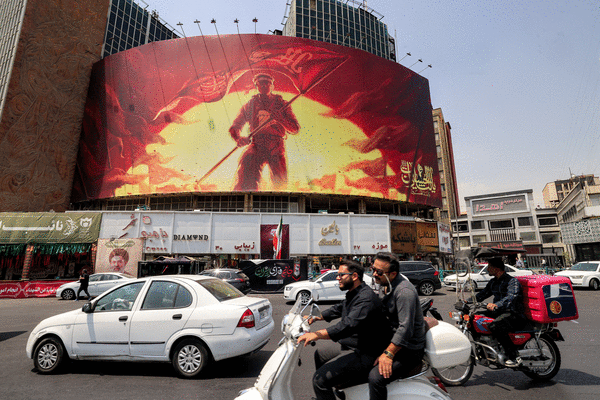
Over the years, I’ve witnessed first-hand countries going literally broke under U.S. economic pressure: Iraq, Venezuela and Cuba. The scenes I saw in Baghdad, Caracas and Havana were all very similar. The national currency became worthless, inflation skyrocketed and unemployment spiraled higher. And yet, American economic sanctions alone failed to force political change.
U.S. President Donald Trump is betting he can break Iran economically and, in the process, achieve the political concessions he wants — all in record time.
But historical precedent suggests he’s wrong. The Islamic Republic has demonstrated many times before its deep capacity to endure financial suffering, and its pain threshold is likely even higher now that the threat is existential. With Trump and his brother-in-arms, Israeli Prime Minister Benjamin Netanyahu, running short of options to end the war they started without much of a plan, the route of economic asphyxiation is probably the least bad plan. Needless to say, “least bad” is far from “good.”
What’s the alternative? Trump could admit defeat and accept Iran’s terms; he can opt for more bombing, hoping for a miraculously different outcome; or he can put boots on the ground, embarking on the sort of forever Middle Eastern war he promised to avoid.
Put yourself in the shoes of anyone inside the White House, then look dispassionately at the gameboard, and it feels like choking Iran financially is worth a try. Sure, it would have been better if the war hadn’t started, or at least had been planned better. But we are where we are.
Will a financial stranglehold succeed? Maybe. The amount of economic pressure on Iran is, certainly, unprecedented. Yes, the U.S. has imposed sanctions on Tehran since the Islamic Revolution of 1979. But it had never stopped the country selling its oil completely, as it’s doing now, and has never bombed the country so heavily as it did from late February until early April. And Trump doesn’t need the regime to collapse; he just needs sufficient leverage at the negotiating table, hurting Iran enough for Tehran to soften its demands for ending the conflict.
To work, however, Trump needs to outlast Iran economically — and oil is the key. If the White House can keep crude below $100 a barrel or thereabouts, it has a chance. Right now, West Texas Intermediate, the U.S. oil benchmark, is changing hands at around $85 a barrel. For that to continue, enough barrels need to keep flowing via the Strait of Hormuz. China needs to help too, by keeping its oil imports well below prewar levels. So far in August, both elements are working in Trump’s favor; there’s no guarantee, however, that the situation will persist.
Iran is, undeniably, hurt, but is it “broke” as Trump claims? It surely feels like it. Its economy is on track to suffer the biggest annual contraction since the nadir of the Iran-Iraq War in the mid-1980s. Inflation is running well above 50%, the highest annual rate since records start nearly 70 years ago. Worse, the cost of food and other necessities has already doubled from a year ago. Its currency, the rial, is worthless. In the black market, the exchange rate has collapsed to a record low of about 1.85 million rials to the dollar; five years ago, roughly 50,000 rials were enough to buy a greenback.
“This level of economic change must be taken very seriously,” Masoud Nili, a former government economic advisor, wrote earlier this month in the Donya-e-Eqtesad liberal newspaper.
The U.S. blockade is exacerbating the penury as Iranian oil exports have fallen to virtually zero, leaving the government with little income to pay salaries. Instead, Tehran is printing money, fueling the inflation crisis. But the encirclement isn’t the wall of steel Trump talks about.
Geography is a powerful ally of the Islamic Republic. Over 5,500 kilometers (3,418 miles) long and neighboring seven countries — Pakistan, Afghanistan, Turkmenistan, Azerbaijan, Armenia, Turkey and Iraq — the Iranian border significantly exceeds the distance from New York City to Los Angeles, and is too extensive and too porous to be closed completely. Rail links are burgeoning. Via the Caspian Sea, Iran shares a maritime border with Russia and Kazakhstan, too. Moscow has already helped Tehran to stay afloat via that route.
Washington plans to apply yet more economic pressure; the United Arab Emirates has already severed its economic and financial links, depriving Iran of a key route to launder its oil proceeds, and Iraq is likely to follow suit.
Tehran knows this war of economic attrition will only get worse. Earlier this week, Mohammad Bagher Ghalibaf, the Iranian parliament speaker and top negotiator, said on social media that while the White House thinks that “squeezing Iran harder” will force concessions, US Treasury Secretary Scott Bessent lacks the competence to succeed: “Stop waiting for the clown crew to pull a rabbit out of their hat.”
Bravado aside, the regime seems worried – and it should. When Iranian President Masoud Pezeshkian met face-to-face with Supreme Leader Mojtaba Khamenei for the first time earlier this month, the encounter focused on people’s livelihoods and employment, as well as "the problems caused by sanctions.”
Iran is a huge country, with nearly 90 million people who’ve endured decades of hardship. On a per-capita basis, it’s poorer than it was 40 years ago. Unsurprisingly, the population has revolved against its leaders multiple times over the years. The best hope for Trump is that the economic pressure creates fear in Tehran that domestic social unrest is approaching the melting point once again. Hope, though, rarely works as a strategy.
_____
This column reflects the personal views of the author and does not necessarily reflect the opinion of the editorial board or Bloomberg LP and its owners.
Javier Blas is a Bloomberg Opinion columnist covering energy and commodities. He is coauthor of “The World for Sale: Money, Power and the Traders Who Barter the Earth’s Resources.”
_____
©2026 Bloomberg News. Visit at bloomberg.com. Distributed by Tribune Content Agency, LLC.


















































Comments