Marc Champion: Peace is more dangerous than war for Iran's new leaders
Published in Op Eds
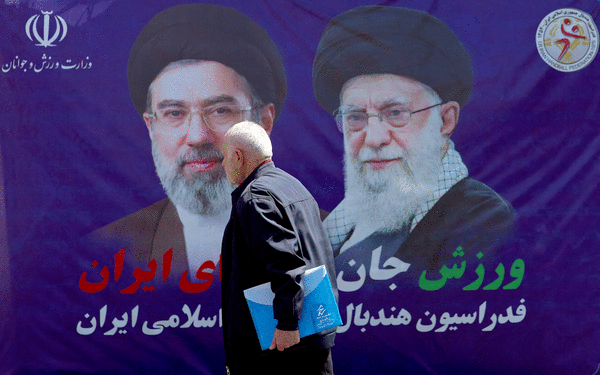
Earlier this year, as the Islamic Republic of Iran was busy crushing the largest protests since those in the aftermath of the 1979 revolution, President Donald Trump promised that help was on its way. He meant, of course, that the U.S. would ride to the rescue of the ordinary Iranians being slaughtered in the streets. Instead, he launched a war that’s given a new lease on life to the regime that was killing them.
This may seem an implausible claim, given that the U.S. and Israel decapitated Iran’s top leadership in the first hours of the conflict, before going on to destroy its conventional navy, factories and swathes of the economy. But it’s becoming clear that even as Washington searches for an off-ramp from the fighting, Tehran’s leaders want to continue or even expand it, because for them, peace is more dangerous than war.
Trump’s motivations are as clear as his messaging is inconsistent. He expected the regime to collapse within days or weeks, making him the heroic U.S. leader who finally had the courage to solve America’s 47-year-old Iran problem. None of that happened and American voters don’t want another Middle Eastern “forever war.” Now he hopes to escape the consequences of his mistake by returning to the pre-war U.S. policy of pressuring Iran through economic sanctions. But Iran has other ideas, as does Israel, which this weekend hit Lebanon hard at the risk of provoking an Iranian response.
From the point of view of the increasingly powerful generals who run Iran’s Islamic Revolutionary Guard Corps, or IRGC, this war is existential and — as the Wall Street Journal reported on Monday — they’re convinced it has only just begun. The bigger backdrop to this Iranian stance is the fact that it isn’t just the U.S. and Israel that want the regime gone; so does a majority of its own population. The Islamic Republic’s new Supreme Leader Mojtaba Khamenei has no better solutions for the soaring inflation and still deeper economic failures that sparked January’s protests than did his father — and the economy is in even worse shape today.
There has been a debate within the regime about how best to ensure its survival in the face of these dual foreign and domestic threats. Pragmatists, such as President Masoud Pezeshkian, saw the priority as ensuring economic recovery, which would require ending the fighting, but he lost that argument. Iran has instead sent Washington a list of demands for reopening the Strait of Hormuz that’s so uncompromising it seems designed for rejection.
An overhaul of Tehran’s top security personnel last week aims to consolidate around a long-war strategy. On Sunday, Yadollah Javani, deputy IRGC commander for political affairs, became just the latest senior officer to announce that the military was shifting to offense from defense. The regular army, known as the Artesh, has been put under IRGC control. Its commander, Major General Amir Hatami, has announced a $30,000 reward for the killing or capture of any U.S. soldier. Tehran’s new public message on Hormuz is that it controls the flow of shipping through the strait and will under no circumstances give up the geopolitical leverage and deterrent power that this provides.
Meanwhile, repression is accelerating under cover of war. Legislation ostensibly aimed at espionage and collaboration with the enemy, introduced late last year, has turned crimes that once carried jail terms into capital offenses. The number of people executed hasn’t necessarily increased (last year saw the highest number killed since 1989, averaging four to five executions per day), but the proportion of political prisoners among them has.
I spoke about this with Mahmood Amiry-Moghaddam, a professor of neuroscience who also founded a Norway-based nonprofit called Iran Human Rights, to track Iran’s use of the death penalty. So far this year, he said, the regime has executed 28 political prisoners, up from two in 2025. Of the 26 who were protesters, at least two have been hanged in public at the scene of their alleged crime. With another 70 protesters on death row in the city of Isfahan’s main prison alone, Amiry-Moghaddam is very concerned that this officially sanctioned carnage will grow.
Now the Basij, a militia of ideologically driven thugs that the IRGC uses to put down protests, has been given a new head who led previous crackdowns and has been tasked with turning the group into an intelligence network. A law “to curb foreign influence” is wending its way through the Iranian Majlis, or parliament. This will criminalize any communication with media from countries considered hostile to the Islamic Republic, while interviews with all other foreign media would require prior permission from the intelligence ministry. Long a police state, Iran is becoming a prison.
This suits the IRGC and other hardliners. If left to face their own people with no state of war to cow them into quiescence, this regime simply would not be able to answer their complaints. It is too invested in the corrupt economic system it has developed and its officials lack the skills needed for effective reform and economic management.
On top of this, Iran’s leaders believe — again, not without reason — that they are winning this war in ways they were unable to do before, and they want to press the advantage. They see in Trump’s Feb. 28 overreach an opportunity for the Islamic Republic to press for the U.S. retreat from the Middle East that it has sought since the day it took 52 American diplomats and other citizens hostage in November 1979.
This doesn’t mean that as the 60-day ceasefire negotiated between the U.S. and Iran expired yesterday, the IRGC now wants to return to full-scale warfare. That would carry its own risks and is not required to keep the U.S. and its allies under pressure in the Gulf, while maintaining a state of emergency and paranoid repression at home.
What the IRGC’s preference for continued conflict does mean, though, is that while Trump would like to pivot back to economic from military warfare, the regime won’t necessarily let him make that transition. It has used the 60-day ceasefire to restructure its command and rebuild missile and drone stocks in preparation for a longer war, and it now feels ready.
Khamenei and his generals may be overplaying their hand. Enough Gulf state oil still flows through Hormuz to prevent a global oil-price crisis and while the U.S. and its allies have run down their stocks of air defense missiles, they could yet choose to expend the rest against Iran. But so long as the IRGC has the capacity to fire on tankers, U.S. military bases and critical energy and water infrastructure in the Gulf, Tehran will have a veto on peace.
_____
This column reflects the personal views of the author and does not necessarily reflect the opinion of the editorial board or Bloomberg LP and its owners.
Marc Champion is a Bloomberg Opinion columnist covering Europe, Russia and the Middle East. He was previously Istanbul bureau chief for the Wall Street Journal.
_____
©2026 Bloomberg News. Visit at bloomberg.com. Distributed by Tribune Content Agency, LLC.



















































Comments