David M. Drucker: Democrats' greatest divide isn't race or money
Published in Op Eds
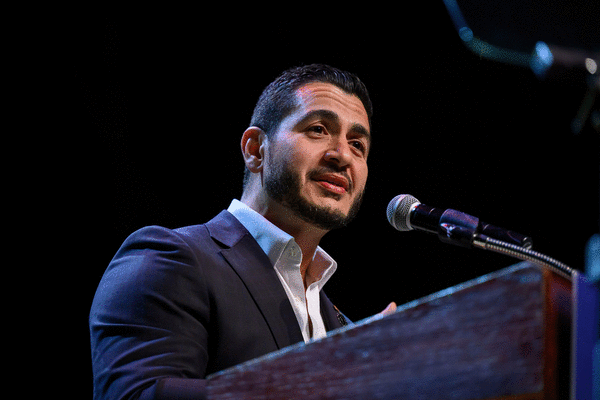
Overeducated and underpaid: Welcome to the rising faction of voters pushing the Democratic Party to the socialist left and foreshadowing a clash with mainstream liberals in 2028.
Strong support from these voters, both young and middle-aged, has advanced several populist progressives and candidates affiliated with the Democratic Socialists of America in primaries this year. If you look at the exit polling and geographic patterns, they live in urban areas and university towns and feel inadequately compensated and financially squeezed. But rural and working-class voters — sometimes one and the same — and those nearing or in retirement are holding the line against the party’s leftward drift.
These intramural skirmishes played out in 2025 with blue bastion New York City — where Democratic Socialist Mayor Zohran Mamdani triumphed over the state’s former longtime governor Andrew Cuomo — and just this month for a Senate seat in purple battleground Michigan. There, voters nominated progressive populist Abdul El-Sayed over traditionally center-left Representative Haley Stevens.
Age, class, gender and ethnicity have all played a role in Democratic primaries over the past decade, but education has been the main driver, especially this year, according to Joshua Zingher, a professor of political science and geography at Old Dominion University in Norfolk, Virginia, who studies this phenomenon. “That’s where the divide really is,” he told me. “I’m not so sure it’s class as traditionally defined. I think the big cleavage is education because education maps onto things like social and cultural values.”
This growing rift among Democratic voters portends a potentially bitter battle for the party’s presidential nomination: insurgent leftists on one side and political pragmatists on the other. And it begins sooner than most think — the day after midterm elections end this fall.
“The lane on the left is going to get crowded really quickly because that’s where all the noise is online, that’s where you’re raising money online,” Steve Schale, a veteran Democratic operative in Florida, told me. Schale, who previously advised Presidents Barack Obama and Joe Biden, emphasized that there is “definitely” room in the 2028 primary for a center-right candidate “who can go sit in a space of normalcy.”
The Democratic Party’s base is socioeconomically diverse, multicultural and multiracial — more so than the Republican Party. That can make for contentious presidential primaries. But the backing for left-wing progressives remains limited in swing states, as proven last week in the Democratic gubernatorial primary in Wisconsin, where Milwaukee County Executive David Crowley defeated socialist state legislator Francesca Hong.
White House contenders, however, usually cater to the wings of their parties in presidential primaries. That dynamic has only intensified since the advent of social media, which has increased the reach and influence of committed activists and become a lucrative source of small-dollar campaign cash. Yet it’s the more moderate candidate, who demonstrates general election appeal, that usually wins the nomination. That was true in 2020 when Biden dominated the mainstream lane in his primary (and in 2016 for President Donald Trump, whose crucial advantage, like Obama eight years before him, was being a political outsider).
If the 2028 Democratic primary turns out to be particularly bruising, blame the sharp ideological — and demographic — divisions that have emerged in this midterm cycle.
Many socialists and progressive populists are running on disruptive, longshot proposals: federalizing healthcare, often referred to as “Medicare for All;” abolishing Immigration and Customs Enforcement without offering a replacement blueprint for border security; implementing a wealth tax; and severing U.S. ties with Israel, often refusing to support its right to exist as a Jewish state.
Most mainstream liberals are focused on politically viable but ambitious plans to expand the Affordable Care Act (aka Obamacare); overhaul ICE; raise income taxes on the wealthy; and place limits on U.S. military aid to Israel, while reinforcing support for the Washington-Jerusalem alliance.
Some Democratic strategists have viewed progressive populism as the party’s best hope for recovering the support of blue-collar voters without college degrees lost to Trump and other Republicans over the past decade. But as some party insiders have been quick to point out to me, it’s those voters — and Black voters, often regardless of class — who are typically the most skeptical of progressive populists (and their socialist-infused agenda.)
According to Zingher, the political scientist at Old Dominion University, what’s been unfolding in Democratic primaries in 2026 is rooted in the 2016 presidential election. At the time, socialist Senator Bernie Sanders, a Vermont independent, ran a competitive campaign against then-New York Senator Hillary Clinton. The same was true in 2020, when Sanders’ bid for the nomination was derailed at the eleventh hour by Black voters’ support for Biden in South Carolina.
“There was definitely an educational split between Sanders supporters and Clinton supporters in ’16 and then Sanders supporters and supporters of the other candidates in ’20,” Zingher told me. “Certainly, you’ve seen the places where the Democratic Socialists have been most successful are in places where the cost of living is high and the Democratic establishment has not been particularly effective in adapting to the times.”
But there’s still the matter of socialists’ and populist progressives’ overall performance. Even in Democratic primaries where they have finished on top, they haven’t exactly bulldozed the mainstream liberal competition. And if that’s the best they can do in congressional primaries, their prospects aren’t going to get any better in a presidential election — especially with independents and swing voters being so decisive in November.
_____
This column reflects the personal views of the author and does not necessarily reflect the opinion of the editorial board or Bloomberg LP and its owners.
David M. Drucker is a columnist covering politics and policy. He is also a senior writer for The Dispatch and the author of "In Trump's Shadow: The Battle for 2024 and the Future of the GOP."
_____
©2026 Bloomberg L.P. Visit bloomberg.com/opinion. Distributed by Tribune Content Agency, LLC.


















































Comments