Commentary: Stop fearing AI like the Luddites feared the loom
Published in Op Eds
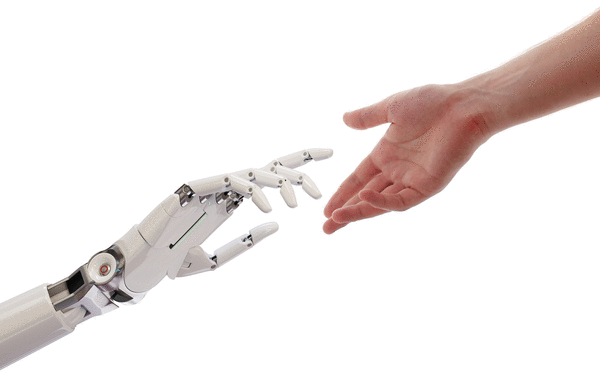
Every transformative technology has its prophets of doom. AI is just the latest to draw them out.
In the early 1800s, the “Luddites,” followers of the possibly mythical Ned Ludd, smashed textile machinery, convinced that destroying the new technology would save their livelihoods.
They weren’t entirely misguided: Mechanized looms did largely displace artisans. But they were wrong about everything else. History doesn’t remember the Luddites for foreseeing the future; it remembers them for mistaking sabotage for a strategy.
A century later, critics of the automobile made the same bet. The horseless carriage would ravage entire industries, they warned. It did: Blacksmiths, carriage makers, stable hands, harness makers — gutted or gone. Yet nobody today wishes we’d banned cars to save the buggy-whip business. The automobile didn’t just destroy jobs; it built a bigger economy on top of the wreckage — mechanics, highway engineers, truckers, suburbs, whole industries nobody in 1900 could have foreseen.
Sound familiar? It should. We’re having the same argument about AI.
Last year, a Pew poll found that half of Americans are concerned about the increasing use of AI in daily life. Uber drivers fear Waymo. Doctors fear patients Googling their way to a diagnosis and treatment. Coders fear the coding assistant. Artists and cartoonists fear the image generator. These concerns aren’t unfounded — technological transitions do hurt real people, and society owes displaced workers real help, not empty reassurance.
Here’s the distinction that keeps getting lost: Disruption is not a reason to stop a technology.
Technology seldom eliminates work entirely; rather, it redefines it. Chatbots haven’t replaced doctors — for patients with rare maladies, they’ve suggested tests and treatments doctors didn’t know about. Spreadsheets didn’t replace accountants. The internet didn’t kill libraries, universities or newspapers; it forced them to get better or get out of the way.
AI will do the same thing, just faster than anything before it.
Here’s what the doom narrative always misses: AI doesn’t just replace human effort — it multiplies it. Doctors can now scan more research in minutes than any human could read in a lifetime. Engineers and drug developers can test a thousand design ideas instead of five. A two-person startup can operate like it has a department behind it. Researchers can crunch in an afternoon what used to take months. This isn’t hypothetical. It’s already happening in clinics, labs and small and large businesses.
None of this means we should adopt AI without questions. Misinformation, privacy, bias, national security, the concentration of power in a handful of tech giants — these are real problems that deserve real scrutiny and, where it makes sense, real regulation. However, there’s a world of difference between governing a powerful tool and trying to stop it. One is responsible; the other is Ned Ludd with better PR.
The real danger isn’t AI. It’s us repeating history's recurrent mistake: assuming that today’s jobs matter more than tomorrow’s opportunities.
Picture what the world would look like if every generation before us had won that fight. We’d still be protecting candle makers from light bulbs, elevator operators from automatic elevators, travel agents from Expedia, typesetters from desktop publishing. Every one of those jobs felt essential right up until it wasn’t — and something better replaced it every time.
To be fair, AI isn’t just another automobile. It moves faster, reaches further and does more sophisticated cognitive work than any technology before it. That’s a real argument for helping workers transition — better education, faster retraining, real investment in lifelong learning — not for pretending the market will magically sort it out on its own.
That's a plan for adapting to the future. It’s not a case for stopping it.
Ned Ludd smashed the looms. The horse-and-buggy defenders tried to legislate the automobile away. Both fought to freeze the world as it was instead of preparing for the one already arriving.
We’re at the same fork in the road. We can let fear write our AI policy, or we can confront the risks clear-eyed while still reaching for the miracles this technology can achieve. The societies that won the future were never the ones that barricaded the door. They were the ones that opened it.
____
ABOUT THE WRITER
Henry I. Miller, a physician and molecular biologist, is the Glenn Swogger Distinguished Fellow at the Science Literacy Project. He wrote this for InsideSources.com.
____
©2026 Tribune Content Agency, LLC.


















































Comments