Editorial: A deficit of answers about debt
Published in Op Eds
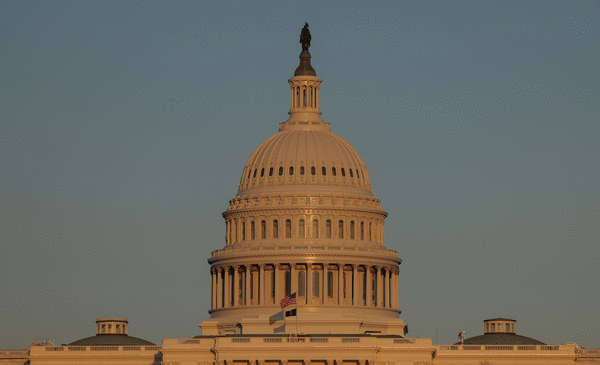
The midterm election season is in full swing, and candidates for Congress are doing what politicians often do: promising voters something in return for sending them to Washington or keeping them there.
Quite often, those promises involve tax cuts.
Proposed cuts often aren’t sweeping, across-the-board reductions, but narrowly targeted breaks designed to appeal to particular groups: homeowners, farmers, workers or business owners. Democrats have joined the tax-cut conversation as well, with Maryland U.S. Sen. Chris Van Hollen championing a “Working Americans’ Tax Cut Act” that would eliminate federal income taxes for individuals earning less than $46,000.
Promising voters such benefits is a time-tested political strategy. Tax cuts are easy to understand and, at least in theory, leave more money in people’s pockets.
Consider proposals to expand the capital gains exclusion on home sales. If you’re sitting on substantial home equity, raising the exclusion sounds attractive. Even younger homeowners might reasonably imagine benefiting from it someday. And how many candidates want to stand before voters and explain why they oppose a tax break specifically aimed at them?
But there is an enormous problem hovering over all these promises: the federal government’s deteriorating fiscal condition.
The federal deficit has continued to widen, while the national debt has climbed beyond $40 trillion. The consequences are not abstract accounting exercises. As debt grows, so does the cost of servicing it. More federal revenue must go toward interest payments rather than defense, infrastructure, health programs, Social Security or other national priorities.
Eventually, arithmetic wins.
Candidates for Congress ought to be talking about this specifically and seriously. They should be explaining what they would cut, what revenues they would raise, what programs they would protect and what tradeoffs they believe Americans should accept.
Instead, voters too often hear the political equivalent of dessert before dinner.
That is understandable. Talking about fiscal discipline is like telling your children about hard work, exercise and a sensible diet when they would rather hear about vacations, parties and new clothes. One conversation requires sacrifice. The other promises immediate gratification.
That leaves voters with an important responsibility.
Americans should demand more from the people they intend to send to Washington. At candidate forums, town halls and community events, through surveys, constituent outreach and, yes, letters to the editor, voters should insist on hearing credible plans for addressing deficits and debt.
And those plans should be grounded in arithmetic rather than political fantasy.
There are no painless solutions. Meaningful deficit reduction ultimately requires some combination of greater revenue, slower spending growth and, potentially, reductions in existing expenditures. The precise mixture is legitimately open to political debate. What should no longer be debatable is whether the problem can simply be ignored.
Nor should voters accept the convenient claim that every tax cut will generate so much additional economic activity that it will automatically pay for itself. Economic growth matters enormously, and well-designed tax policy can encourage investment and productivity. But growth alone cannot be treated as a substitute for fiscal discipline.
The same scrutiny should apply to spending proposals. Every new federal benefit, subsidy or program eventually has to be financed by taxes, borrowing, reductions elsewhere or some combination of the three.
That is how budgets work.
The uncomfortable reality is that responsible fiscal policy often involves short-term sacrifice for long-term stability. And the longer Washington postpones difficult choices, the narrower and more painful those choices are likely to become.
Politicians will naturally try to avoid that conversation. Some will retreat to familiar promises of greater federal spending. Others will offer increasingly specific tax exemptions on tips, overtime, home sales or whichever constituency happens to be politically important at the moment.
Each proposal may have merits worthy of debate. But none should be considered in isolation from the nation’s overall fiscal condition.
Every candidate who proposes a tax cut should therefore answer a simple question: How will you pay for it?
Every candidate proposing billions in new spending should face the same question.
And voters should stop accepting answers that amount to “someone else will eventually figure it out.”
America’s fiscal challenges did not develop overnight, and they will not be solved in one election cycle. Republicans and Democrats alike have contributed to deficits through combinations of spending increases, tax reductions and an unwillingness to confront politically sensitive programs.
The country can survive another election filled with promises.
What it cannot afford indefinitely is another Congress unwilling to confront the bill.
The national debt is not somebody else’s problem, and it is not merely a problem for future generations. Interest costs are already competing with today’s priorities.
Washington does not suffer from a deficit of political promises.
It suffers from a deficit of answers.
_____
©2026 The Baltimore Sun. Visit at baltimoresun.com. Distributed by Tribune Content Agency, LLC.



















































Comments