Editorial: Evidence over politics when it comes to childhood vaccines
Published in Op Eds
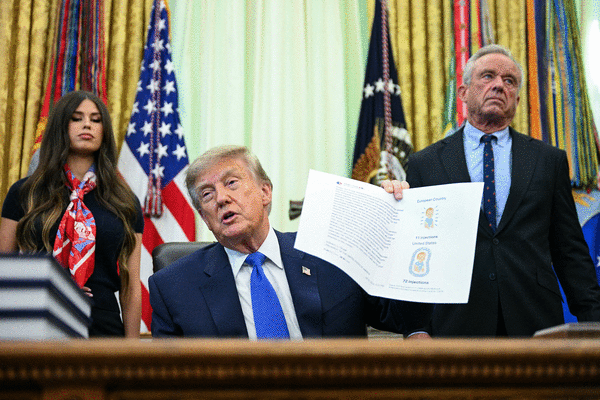
Parents deserve clarity when making decisions about childhood vaccines. They should not have to choose between political pronouncements and public-health institutions whose credibility has itself been tested in recent years.
The White House’s decision to reduce the number of recommended childhood vaccines has reignited an important debate over who should make these decisions, what evidence should guide them and whether Washington, regardless of who occupies the Oval Office, should dictate medical choices best made by parents in consultation with physicians.
One of the strongest objections came not from a partisan opponent of President Donald Trump but from a Republican physician in Congress. U.S. Sen. Bill Cassidy, chairman of the Senate health committee, argued that vaccines remain safe and that the evidence does not establish childhood vaccination as a cause of autism.
“The President does not have the expertise to make these changes,” Cassidy wrote on social media.
That criticism is valid. But so is the distrust that has led many Americans to question public-health authorities in the first place.
The COVID-19 pandemic damaged confidence in institutions that once expected their recommendations to be accepted with little hesitation. Guidance changed. Officials sometimes spoke with greater certainty than the evidence justified. Legitimate questions were too often treated as misinformation rather than opportunities for explanation. Americans remember those failures.
That history should make medical institutions more transparent and humble, but it also doesn’t justify dismissing established scientific evidence on issues such as autism.
The evidence accumulated over decades has not established a causal connection between routine childhood vaccines and autism spectrum disorder. Researchers believe most of the increase in autism diagnoses reflects improved screening, broader diagnostic criteria and greater awareness. Mild cases that might once have gone unidentified are now more likely to be recognized.
That answer will understandably not satisfy every family searching for an explanation. Research into autism, including possible genetic, biological and environmental contributors, should continue aggressively. Parents deserve answers, not slogans.
But unanswered questions about autism do not themselves constitute evidence that vaccines cause autism.
The same principle should apply to proposals for changing vaccination schedules. If there is compelling evidence that fewer doses, different timing or separating combination vaccines would produce better outcomes, that evidence should be presented publicly, debated openly and subjected to rigorous scientific scrutiny. Medical policy should be capable of changing when evidence changes.
What it should not do is change simply because political leadership changes.
Parents should consult pediatricians who know their children’s medical histories and weigh recommendations from credible medical organizations. They should be free to ask difficult questions about risks, benefits, timing and side effects without being dismissed or shamed.
That includes questions about the MMR vaccine. The American Academy of Pediatrics recommends the combined measles, mumps and rubella vaccine rather than separating it into three individual shots. Those recommendations should be judged on the evidence supporting them, not on whether they agree or disagree with the White House.
The renewed debate comes as the United States confronts serious measles outbreaks, a reminder that diseases largely pushed from public consciousness can return when vaccination rates decline. Vaccine hesitancy has consequences not merely for individual families but for communities, particularly infants and people medically unable to receive certain vaccines.
States continue to exercise substantial authority over vaccination requirements for school attendance, with medical exemptions available when physicians determine vaccination would be unsafe for a particular child. That balance recognizes both the public-health interest in preventing infectious disease and the reality that medicine must account for individual circumstances.
Parents should not be forced into a false choice between unquestioning obedience and wholesale rejection of modern medicine.
They should demand something better: evidence, transparency, informed consent and physicians willing to listen.
Public-health authorities must earn trust rather than demand it. Political leaders should resist substituting presidential authority for medical expertise. And doctors should be candid about both what science knows and what it does not.
The gold standard for childhood vaccination policy should not belong to the White House, a political party or even a medical organization simply because of its title.
The gold standard should be evidence — tested rigorously, communicated honestly and applied by physicians in partnership with parents.
____
©2026 The Baltimore Sun. Visit at baltimoresun.com. Distributed by Tribune Content Agency, LLC.















































Comments