Commentary: A Paramount-Warner merger will hurt Hollywood and people of color
Published in Op Eds
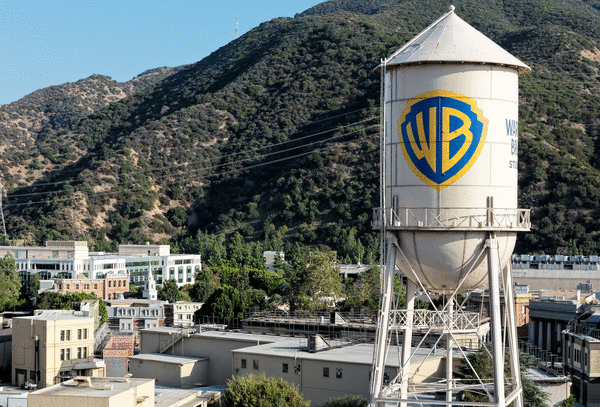
Two of the five biggest studios in America want to become one. If Paramount is allowed to absorb Warner Bros. Discovery, a single company will control roughly a third of the movies that reach theaters and roughly a third of basic cable programming, along with two of the largest streaming services and two national news organizations, CBS News and CNN, under the same roof.
That outcome moved closer on Monday, as reports emerged that Paramount had reached a settlement deal with California Attorney General Rob Bonta, who leads the 12 states suing to block the deal. The Ellisons, the family that controls Paramount, had been pressing for a settlement without serious structural reforms — one that would allow the merger to progress based mostly on empty, unenforceable promises.
Before that happens, someone should account for who has been paying for all of it. Latinos are 19% of the U.S. population and bought 29% of all movie tickets sold in 2020. We attend theaters more often than any other group, and Latino households command more than $4 trillion in purchasing power.
Black Americans are about 14% of the population and delivered 21% of the opening weekend box office revenue for major theatrical releases in 2024. They accounted for 22% of all minutes viewed across major streaming platforms. They consumed an average of 84 hours of media a week that year, against roughly 72 hours for the country as a whole, and their buying power is on pace to pass $2 trillion.
Those are not diversity statistics. They are customer statistics, and they describe the two audiences that carry this industry’s margins.
Now look at what those customers receive in return. In 2025, Black actors held 6.5% of lead roles in top theatrical films. Latino actors held less than 3%. White actors took 76.9%. Across 1,300 top-grossing films, Latino characters filled 5% of speaking roles, and nearly 44% of those films contained no Latino speaking character at all. People of color are 45.2% of this country and 23.1% of its film leaders, and in 2025 they lost ground in streaming in every single employment category the industry measures.
Here is the part that should interest anyone who cares about how markets are supposed to work. In that same year, films with casts between 41% and 50% people of color earned the highest median box office of any group.
A company operating in a competitive market cannot neglect its highest-earning market for long. Leaving money on the table is how you lose to the competitor who picks it up. But a company that controls a third of theatrical distribution and a third of cable programming does not face that discipline. It can misread its own customers indefinitely, because those customers have few alternatives for their entertainment dollars.
That is the economic case against this merger, and it is the same case the attorneys general should have made in court. Every studio absorbed by a rival is one fewer buyer for a script, one fewer employer for a crew, one fewer distributor willing to bet on a story that does not fit in somebody’s franchise plan. Fewer buyers means lower pay, fewer projects and less leverage for everyone selling into that market.
That economic mechanism does not check anyone’s background before it operates. It simply affects the people with the least leverage first, and they are the last to recover. In Los Angeles County, where nearly half of the population is Latino, that means the grips, electricians, drivers, set builders and caterers, and the small vendors who supply them.
This is not a forecast. Warner Bros. Discovery already ran the experiment after its 2022 merger, shelving a finished $90 million film with an Afro-Latino lead, canceling a comedy about a Dominican immigrant family five weeks into its run despite strong viewership, and clearing out Black-led series across the following two years. Paramount won federal approval for its own merger partly by dismantling its diversity programs, then laid off roughly 2,000 people within months of closing the deal.
Approval first, erasure second. Every time.
So when Paramount offers commitments to attorneys general and the public, weigh them against the record. Comcast made commitments to win NBCUniversal and negotiated in good faith with national civil rights organizations, and independent channels launched as a result. The investment that real ownership requires did not follow. Paper outlasts everyone who signed the agreement.
A dozen state attorneys general sued to stop the Paramount deal, and they were right to do so. In July a federal judge froze the merger, writing that on market share alone she could presume it likely violates antitrust law. The companies then agreed to stand still until the court rules or until June 1, 2027. With a trial set to begin on March 2, Paramount demanded a settlement by Oct. 1 and threatened to move its operations out of California if it did not get one, a move California’s attorney general accurately called blackmail.
If the reports are accurate, the Ellisons used that pressure to push for a settlement built on behavioral concessions that are not worth the paper on which they are written — and now there may be a consent decree as a result that includes no protections for Black and Latino constituents of Hollywood.
Concessions that depend on the future goodwill of the merged company will not protect the workers and audiences the attorneys general sought to protect. Bonta has said publicly that pledges like releasing a set number of films each year are precisely the type of behavioral remedies that are “typically not enforceable in the way that we like.” He was correct.
I am not asking these companies for a seat at the table. I am asking that the table not be cut in half.
Fewer buyers means fewer stories, fewer jobs and fewer of us in the rooms where both get decided. The law already provides the remedy. The merger should not proceed.
____
Juan Proaño is the chief executive of the League of United Latin American Citizens, the nation’s oldest and largest Latino civil rights organization.
©2026 Los Angeles Times. Visit at latimes.com. Distributed by Tribune Content Agency, LLC.
















































Comments