Martin Schram: A reverse-Watergate Q&A reveals all on Iran
Published in Op Eds
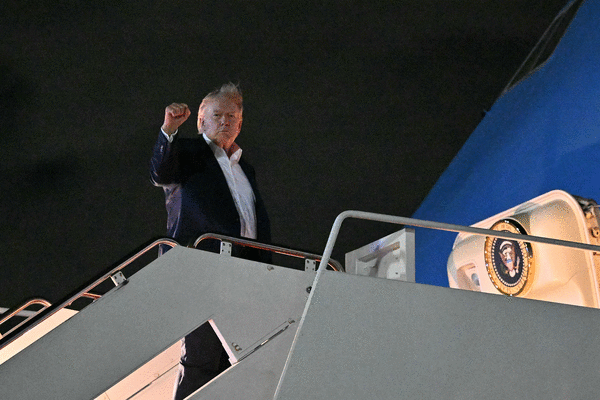
Today we’re going to become investigative historians and re-purpose one of history’s most successful fact-finding moments.
Our mission is to find out why our commander-in-chief failed to better serve our chief executive – both of whom are, of course, our president, Donald J. Trump.
We are seeking to discover just how and why Trump chose to start the joint U.S.-Israeli massive bombing war in Iran. It was a war he believed America won on Day One, as he once told a rally in Hebron, Kentucky. In the end, Iran ended up looking like a winner – when it proved – to itself and the world – that it could close the Strait of Hormuz and devastate the global economy.
Today, Trump’s team is trying to buy a peace deal. America is willing to make mega-billions of dollars available to Iran. (It sounds like the thing he has long attacked former President Barack Obama for doing.) In exchange, Iran has to agree to make another no-nukes/international inspection deal that so far seems much like the deal Iran made with Obama – and was killed back in Trump1.0.
On the night of February 28, Trump seemed overflowing with superpower superconfidence when he went on TV and told the world about the war he just started. U.S. and Israeli bombs had assassinated Iran’s frail and ill 86-year-old Ayatollah Ali Khamenei and other top tier leaders, and were in the process of sinking Iran’s navy and smashing much of its air force.
Trump told Iran’s military: “You must lay down your weapons … (or) in the alternative, face certain death.” He told Iran’s people: “America is backing you with overwhelming strength and devastating force” (but zero troops on the ground) and to “seize control of your destiny.” And he proclaimed on Truth Social: “There will be no deal with Iran except UNCONDITIONAL SURRENDER!”
Today, Trump’s team is in Switzerland, trying to make a deal with Iran based on their joint Memorandum of Understanding (MoU). But they are operating under a great handicap that they inflicted upon themselves – when Trump’s demand of unconditional surrender pushed Iran into discovering it now had the power to close and effectively control the Strait of Hormuz, any time it wants (as we’ll soon explain).
Indeed, the fifth paragraph of the MoU that Trump signed says Iran agrees to “safe passage of commercial vessels with no charge for 60 days only.” After that, Iran thinks it can charge vessels money – a toll, an insurance fee or whatever – to sail through the strait. Moreover it says Iran and Oman (on the narrow strait’s other shoreline) will “define the future administration and maritime services in the Strait of Hormuz.” That’s outrageous. It reads like a Hollywood script about a Mafia protection racket. The world would never permit Morocco and Spain to control entrance to the Mediterranean and demand money to sail the Strait of Gibraltar. What was Trump thinking?
That’s why we need to pause and start thinking like investigative historians. Remember the classic Watergate scandal question that focused minds a mere half century ago? During the 1973 Senate Watergate Committee hearings into the scandal that forced President Richard Nixon to resign, Sen. Howard Baker, R-Tenn., began asking witnesses his classic Watergate question: “What did the president know – and when did he know it?”
Today, we ought to be asking a reverse twist of Baker’s historic question: “What didn’t the president know – and why didn’t he know it?”
Here’s why: In several prewar briefings, Trump was cautioned by his Joint Chiefs of Staff chairman, Gen. Dan Caine, that Iran could use mines, missiles and drones to close the Strait of Hormuz – through which 20 percent of the world’s oil is shipped from Iran and other gulf states. Closing the strait would send world oil prices soaring.
But Trump was always confident that things he really wanted would always work out. So he dismissed his military chiefs’ concerns. Trump “told his team that Tehran would likely capitulate before closing the strait – and even if Iran tried, the U.S. military could handle it,” the Wall Street Journal reported on March 13. Trump officials knew Iran desperately needed income by selling oil to China, but assumed Iran’s tankers couldn’t sail if Iran closed the strait.
But what Trump didn’t seem to know or understand was the possibility that Iran might not use mines extensively to block the entire strait. It might threaten to use its inexpensive drones (the ones Iran supplied to Russia that worked well against Ukraine) to sink other nation’s tankers or at least threaten them. Iran could then allow its own tankers to sail to its main buyer – China.
Trump gave no sign that he was briefed about Iran’s heightened drone threat, or grasped the significance of it, if indeed he ever was briefed on it. But you didn’t need a top secret intel briefing to learn about it. Iran was hardly keeping it a secret.
On Feb. 16 – two weeks before Trump started his war – Iran’s Fars News Agency reported Iran and Russia were conducting a major drill: practicing closing the Strait of Hormuz. Iran’s Islamic Revolution Guards Corps code-named their operation "Smart Control of the Strait of Hormuz.”
Two days later, Fars News Agency reported that Iran planned an extensive exercise using missiles and drones. Iranian news carried a photo depicting thousands of Iran’s highly regarded Shahed-class drones. And IRGC Navy Commander Rear Adm Alireza Tangsiri was quoted as saying Tehran achieved “complete command” over the Strait. Another Iranian report said that Iran’s military was “destroying the targets with the highest precision.”
Iran’s strait control exercise was covered extensively by European news agencies. But it wasn’t big news in the United States. Trump had recently sent warships, including aircraft carriers, into the nearby waters, a response to Iran’s tension after massive civilian protests led to the government’s murder of an estimated 40,000 protesters.
Just a year earlier, America’s navy briefers were briefing Congress on their efforts on how to prevent Iran from mining the strait – and drones weren’t even a part of that discussion. But after the Trump-Netanyahu bombing assassination of Iran’s supreme leader and others, plus the smashing of Iran’s military – yep, Iran closed the strait by threatening other nation’s tankers. And America responded by closing the strait to Iran’s tankers. The strait had become a de facto Quicksand of Hormuz.
So let’s ask again: What else didn’t the president know before he chose to start his war?
Q: Why didn’t Trump know that he needed to ask his military officials if they were prepared to defeat Iran’s drones and prevent Iran from closing the strait?
A: We don’t know why he didn’t know enough to ask. But America’s superpower military seemed unable to ensure that they could protect tankers against attacks by Iranian drones.
Trump appeared unaware of his superpower’s super-weak-spot before he started the Iran war that will be his 2.0 legacy.
_____
_____
©2026 Tribune Content Agency, LLC.



















































Comments