George Skelton: California pushes for affordable housing while Trump plays games
Published in Op Eds
SACRAMENTO, Calif. — President Donald Trump was handed a golden opportunity to upstage Gov. Gavin Newsom in Newsom’s own state on an issue of critical importance to Americans everywhere. But Trump naturally blew it.
The governor and the Democratic-led state Legislature shined.
Trump was victimized by his own self-centered obstinance and inhumanity. And Republican congressional leaders were left looking embarrassed and wimpy.
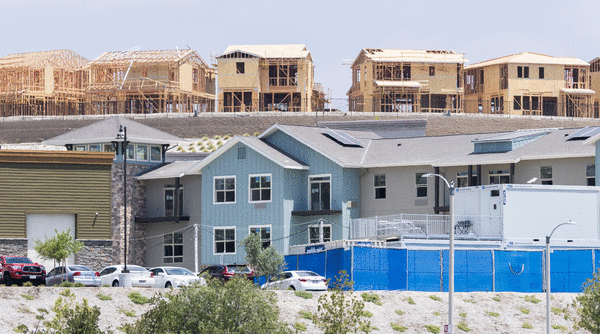
The issue was housing affordability — the lack of it that is stifling the American dream of homeownership everywhere, not just in California.
In Sacramento, the Legislature lopsidedly passed an $11.25 billion bond proposal aimed primarily at providing government subsidies for building affordable housing. Newsom immediately signed the measure last week, just beating the deadline for getting it on the Nov. 3 election ballot.
“In California, we don’t turn away from the needs of our people,” Newsom boasted in a prepared statement, taking a veiled shot at Trump, his favorite political target.
This came just after both houses of Congress, with members working collaboratively in a rare bipartisan manner, overwhelmingly passed a landmark bill aimed at boosting housing supply. The measure removed regulatory barriers, upgraded federal programs and incentivized new home building.
A Trump “promise kept,” the White House proclaimed.
Whoops! The president then suddenly flip-flopped. He canceled a planned bill-signing ceremony, torpedoing the legislation, an opportunity to gain sorely-needed points for the GOP heading into the fall elections and a chance to outboast Newsom, arguably his most annoying political antagonist.
Trump said he wouldn’t sign the housing bill unless Congress approved his unrelated voter ID legislation, which has practically no chance of passage. The least of his concerns seemed to be struggling homebuyers and renters.
As of this writing, it wasn’t clear what Trump would ultimately do. Nothing ever is certain with him. Shocked and confused GOP congressional leaders even held back sending the president the bill, then ducked out on holiday recess.
At the California state Capitol, by contrast, the governor and legislative leaders were united, working off the same page and successfully negotiating a final agreement on housing help.
As icing on the cake for voters,$1.25 billion was added for the popular CalVet loan program for military veterans. Their home loans are repaid through mortgages, costing the state nothing.
But the remaining $10 billion would need to be paid off by taxpayers over 30 years — at an estimated $580 million annually, bringing the total bond cost to about $17.4 billion, including interest.
Putting this in perspective, the Legislature just passed a $352-billion state budget for the fiscal year starting July 1. Of that, $7.5 billion will go for retiring debt on $73 billion in bonds. And the state has voter authorization to sell $38 billion more in bonds.
During legislative floor debates, some Republicans objected to the additional borrowing.
“We’ve got record revenue, why do we need to borrow money?” asked Assemblyman David Tangipa (R-Fresno).
That was answered during the Senate debate by Sen. Christopher Cabaldon (D-West Sacramento), one of the measure’s principal jockeys.
Building affordable housing “simply is impossible, it can’t be done without this bond” to finance government subsidies, Cabaldon told colleagues.
Developers are subsidized so they can build at a cost that will result in affordable consumer prices, mainly rents in this case.
Some Republicans also objected to inserting the CalVet money for voter appeal. Assemblyman Carl DeMaio called it “window dressing.”
CalVet funds normally are acquired through very small, separate bond measures.
But in the end, only a few Republicans voted against the big bond, which was officially authored by the Assembly Speaker and the Senate leader to display political muscle.
To their credit, the Legislature and governor in recent years have been whittling away at regulatory obstacles to home building. But many cities still balk at rezoning residential neighborhoods to make room for new multifamily dwellings.
The bond proposal is mainly designed to generate affordable rentals for poor people. More money was added at the end for affordable student and farmworker housing.
There’ll be a separate bond proposal on the November ballot that goes in a different direction but doesn’t conflict. It would help middle class homebuyers. And that measure wouldn’t cost taxpayers a cent.
“Housing supply is not just about poor people. It’s not just about homelessness,” says the middle class initiative’s originator, former legislative leader Bob Hertzberg, a Los Angeles County Democrat.
His proposal would authorize $25 billion in revenue bonds. Like the CalVet program, those bonds would be repaid by homebuyers through mortgages — not costing the state anything.
Under the plan, a homebuyer could borrow most of the money needed for a down payment on a newly constructed single-family home or condo. Typically, a 20% down payment is required. Under Hertzberg’s proposal, 17% could be borrowed. Regular lending institutions would arrange the second mortgage.
To be eligible, a homebuyer’s income could not exceed 200% of the area’s median income. In L.A. County, that would be around $213,000 for a family of four, Hertzberg figures. The home would need to be the owner’s primary residence.
The November ballot will be bursting with state propositions — 14 in all, mostly very complex, running the gamut. Besides housing, there’ll be proposals for a billionaires tax, voter ID requirement, local tax limitations and fast-tracking of public works.
Voters could just throw up their hands and reject everything.
“At some point, voters are just gonna say, ‘I don’t know about all this stuff. There’s a lot of stuff,’” says Dan Dunmoyer, who heads the California Building Industry Assn.
California’s housing affordability crunch won’t be solved by just two bond packages. But they’d help.
We and all of America could also use some help from our seemingly unconcerned president, who enjoys free public housing.
©2026 Los Angeles Times. Visit at latimes.com. Distributed by Tribune Content Agency, LLC.




















































Comments