Commentary: The rise of Democrats' left wing will hurt democracy
Published in Op Eds
New York City Mayor Zohran Mamdani emerged as something of a kingmaker this past week, as the Democratic primary candidates he endorsed swept their races in the Empire State.
The problem for Democrats is that what sounds electrifying in Brooklyn coffee shops sounds wildly out of touch to the rest of the country. Republicans have now been gifted a fresh crop of candidates they can plaster across campaign ads from Bangor to Bakersfield, turning what might otherwise be local urban politics into a national cautionary tale — just in time for the midterms.
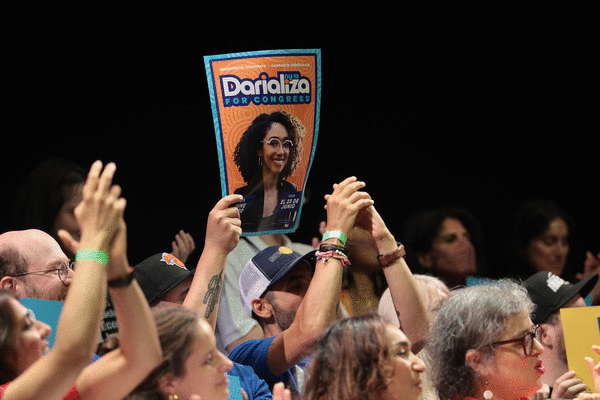
Leading the renegade parade is Darializa Avila Chevalier, the 32-year-old daughter of Dominican immigrants who is now the Democratic nominee in New York’s 13th Congressional District. Her résumé includes her help in leading pro-Palestinian protests at Columbia University and participating in a radical campus environment that later produced calls for “ Death to America” — which, as campaign slogans go, lacks a certain broad appeal.
Chevalier’s greatest hits — compiled from now-deleted social media messages — include criticizing minority men for relationships with white people (i.e., “ fetishizing ugly colonizer women”); talking about wiping her hands on the American flag; attacking Joe Biden as a “rapist”; declaring “F— Kamala Harris”; wanting to abolish police, borders and prisons; and calling U.S. service members “ child murderers,” just to name a few of her past controversial comments.
Ordinarily, none of this would matter much outside the district. But politics no longer stays local. What happens in New York today becomes a 30-second television spot in Ohio tomorrow.
The other problem is this: It’s not altogether wrong to suggest this is, in fact, a national trend. What happened in New York is not an isolated incident. It’s merely the latest data point.
In Maine, for example, Democrats recently nominated oysterman (and veteran) Graham Platner, despite a history of controversial online statements and questions surrounding a tattoo associated with a Nazi symbol.
In Michigan, Abdul El-Sayed, a progressive and former public health official who (like Platner) is endorsed by Bernie Sanders, is leading in the primary race polls against two more mainstream Democratic candidates seeking a Senate seat.
Despite the fact that two older candidates — President Trump and Sanders — first defined these extremes in modern American politics, their disciples tend to skew younger.
Speaking of which, there’s at least a decent chance that this trend will transcend Congress, if Rep. Alexandria Ocasio-Cortez, 36, decides to run for president in 2028.
Progressives seem to have concluded that the strategy of nominating cautious, competent, moderate Democrats to offset Trumpy politics was a losing bet that simultaneously deprived them of fun/excitement and yielded no electoral benefits.
It’s hard to blame them. They look at Trump and see a man who violated every known rule of modern politics and won two presidential elections. Their conclusion is simple: If energy beats experience, authenticity beats caution and enthusiasm beats respectability, then it’s time to stop nominating establishment politicians and start nominating revolutionaries.
None of this means the Democratic Party is universally sprinting leftward in 2026. Plenty of states continue to nominate and elect pragmatic, conventional candidates. North Carolina Democrats, for example, appear perfectly content with a moderate like former Gov. Roy Cooper. And that choice will very likely deliver Democrats a U.S. Senate seat.
But in reading the tea leaves, the future increasingly seems to belong to democratic socialists and progressive activists who would have been considered fringe figures not that long ago.
In this regard, the vibe in today’s Democratic Party feels a bit like the Republican Party during the tea party and early MAGA eras.
As someone with center-right instincts (who resisted Trump’s hostile takeover of the GOP a decade ago), I find this development troubling. Not merely because I disagree ideologically, but also because it increasingly appears that America is drifting toward a politics in which both parties become hostage to their most passionate and least restrained factions.
The danger isn’t that America perfectly reenacts the Weimar Republic. History rarely repeats itself with such precision. But when moderation is viewed as weakness, compromise as surrender and liberal democracy as an obstacle rather than a miraculous achievement, things tend to go sideways.
History and common sense suggest that when one extreme faction (such as the fascists) begins to gain power, otherwise moderate or apolitical people suddenly become more willing to embrace rival extreme factions (like the communists).
Again, it’s perfectly understandable that Democrats would look at Trump and the Republicans and conclude it’s time to fight fire with fire. That policing your own side of the aisle is a fool’s errand. And that, as the saying goes, “If you can’t beat ’em, join ’em.”
But this is a race to the bottom that will no doubt end in a disaster of epic proportions. The kids are not all right.
____
Matt K. Lewis is the author of “ Filthy Rich Politicians” and “ Too Dumb to Fail.”
©2026 Los Angeles Times. Visit at latimes.com. Distributed by Tribune Content Agency, LLC.


















































Comments