Editorial: A very unpopular war, fought very badly
Published in Op Eds
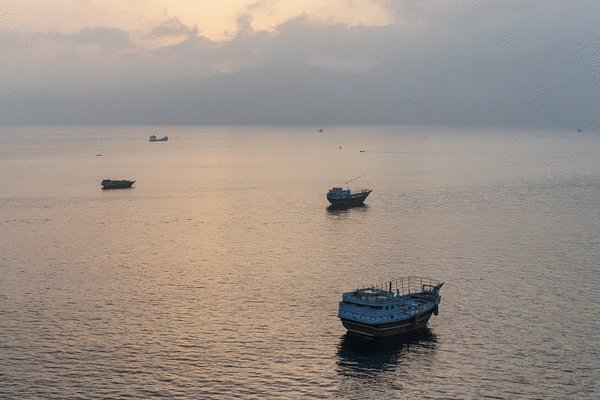
With the bombing paused and negotiations beginning, Donald Trump’s war has finally accomplished something considered unthinkable.
It has united red and blue America.
Everyone can find something in the Iran treaty proposal to detest.
America did not declare war on Iran. Trump did. Americans never had a chance to debate putting American blood and treasure at risk. Trump made sure of it.
Congress was kept in the dark. Trump wanted it that way. Now, Trump owns the war that claimed the lives of 13 American service members and scores of Iranian schoolgirls.
He owns the still-unfolding economic havoc it created. He owns its unpopularity. A June AP-NORC poll showed 65% of Americans were displeased with his handling of the war, with only a majority of Republicans supportive.
A one-sided capitulation
He also owns the justifiably reviled terms of a treaty that might — or might not — end it.
Anyone who reads the outline of those terms knows that despite Washington’s lipstick-on-a-pig posturing, if America can exit this war at all, it will do so as the biggest loser.
It won’t be Iran. Not with this deal.
Iran will be gifted a $300 billion reconstruction fund paid for by the U.S. and unspecified partners.
It can start selling its oil again at market rates, a massive win after being squeezed for years by U.S. sanctions. Other tankers can now freely transit the Strait of Hormuz, just as they could before the war, with no tolls.
But that’s only for 60 days. Once unthinkable, Iran now knows how to make money by blocking access to the crucial waterway, and despite the treaty talks, is already making plans to do so.
No limits on missiles
There are no restrictions on Iran building new missiles, either.
It would not be fair to say no to Iran on that, Trump explained. Besides, he said, the Iranian leadership he once derided as “deranged scumbags” and “animals” were now “nice to deal with.”
Perhaps that is why he believes Iran will commit to not building a nuclear weapon, although it had already pledged not to do so in President Obama’s 2015 Iran nuclear deal.
Ever the showman, Trump famously ripped it in two, paving the way for increased enriched uranium stockpiling, which, he once said, was the reason for this war.
As for helping the Iranian protesters that Trump once declared America would rescue? That’s not even on the table.
Living under the constant threat of Iranian-supported terrorism, Israelis have more reason to attack Iran than America, and more experience in recognizing a treacherous deal. And 92% of Israelis believe Iran has won.
True to form, the Trump administration responded to Tel Aviv criticism with a threat.
Israelis, said Vice President JD Vance, should not attack “the only powerful ally (they have) anywhere left in the entire world.”
But Trump’s war showed the world that America is not the all-powerful friend of any Mideast country.
We could not protect Iran’s neighbors and our allies from bombardment by Iran. Cheap drones rendered our battleships ineffective at keeping the Strait of Hormuz open, despite daily chest-thumping about how many bombs we were dropping.
We have fought a bad war badly, not because of our skilled and brave troops, but because of the men who led them.
That’s why Vance is not actually in Switzerland negotiating a treaty to end Trump’s war.
He’s negotiating how much money America will have to pay to make it all go away before the midterms.
____
The Sun Sentinel Editorial Board consists of Opinion Editor Steve Bousquet, Deputy Opinion Editor Dan Sweeney, editorial writers Pat Beall and Martin Dyckman, and Executive Editor Gretchen Day-Bryant. To contact us, email at letters@sun-sentinel.com.
___
©2026 South Florida Sun Sentinel. Visit at sun-sentinel.com. Distributed by Tribune Content Agency, LLC.


















































Comments