John Rash: As America turns 250, rediscover the spirit of '76
Published in Op Eds
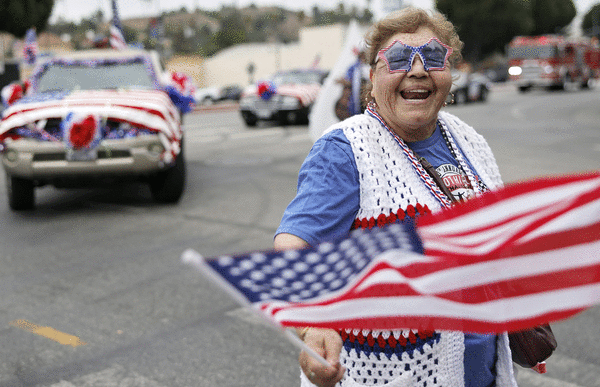
According to the Pew Research Center, sentiment from polls this year can be characterized with this headline: “On the Country’s 250th Anniversary, the American People Are in a Sour Mood.”
The statistics are stark: 69% are dissatisfied “with the way things are going in the country today,” and 59% “think the country’s best years are behind us.”
It’s not just Americans who are sour.
Across three dozen countries Pew surveyed, “[President Donald] Trump Gets Negative Reviews Internationally as Fewer Say U.S. is a Reliable Partner.” Overall, stated the recent report, 57% have an unfavorable impression of this country, and the percentage expressing no confidence in its commander in chief is even higher: 76.
To many, that number — 76 — evokes the “Spirit of ’76,” the famous phrase reflecting the American idea and ideal embodied in the Declaration of Independence, which turns 250 on July 4th.
Considering the country’s dour, even dire, mood, maybe it’s time to rediscover that proverbial spirit. Of 1776, if possible. But for those who find the Revolution remote, another Spirit of ’76 is worth reviving.
1976.
That year, America’s Bicentennial, much of the country coalesced despite difficulties that eerily echo today: Watergate then, Washington’s corrosive corruption now; an ill-conceived conflict in Vietnam then, Iran now; spiraling prices then and now.
A half-century ago, there were real reasons for Bicentennial cynicism. But instead, as historians (and those of a certain age) recall, the country rallied around the event — and itself.
Sure, the run-up was marked (and marred) by crass commercialism. (There’s even a Yale museum exhibit dedicated to the detritus: the “Bicentennial Schlock Collection” of Pez dispensers, cereal boxes and other packaging rife with fife-and-drum corps and other representative revolutionary images that led some critics to call 1976 the “buy-centennial.”)
But bits of legitimate history entered the common conversation, too. Maybe not from products, but in primetime, especially with CBS’ “Bicentennial Minutes,” where Minutemen, Paul Revere and others were revered in relatively accurate accounts of what happened that day 200 years ago. Reaching a mass mostly impossible in today’s fragmented media landscape (save for the Super Bowl and other big-tent events), the two-year program featured one-episode hosts spanning a spectrum of actors, activists, athletes, artists and beyond who reminded Americans of their origin story at a disorienting time.
Because of network equal-time rules back then, there was one particularly famous face who didn’t appear: President Gerald Ford. At least until the last episode, after he had lost the 1976 presidential election to another savvy Navy veteran, Jimmy Carter.
Today, of course, it’s unimaginable that the current occupant of 1600 Pennsylvania Avenue wouldn’t appear — often. Indeed, in stark contrast to previous presidential protocol, Trump has made Independence Day individual, promising on social media “the most spectacular TRUMP RALLY of them all” on July 4th after many musicians, sensing partisanship, pulled out of a concert. This comes after the mixed-martial-arts fights (Washington as not just a figurative, but literal cage match) held on his birthday in a capital where his glowering image hangs from ostensibly nonpartisan entities like the Department of Justice.
Compare that to a half-century ago, when it was 200 tall ships from more than 50 nations in New York’s Hudson River, not a dead duck in Washington’s Lincoln Memorial Reflecting Pool, that reflected the national zeitgeist. That July 4th, “blasé New Yorkers massed around the Battery broke into ‘The Star-Spangled Banner,’” wrote historian Richard Norton Smith in “An Ordinary Man: The Surprising Life and Historic Presidency of Gerald R. Ford,” a biography reflecting Ford as anything but ordinary.
In fact, Ford’s story is extraordinary. And yet compared to today’s incumbent, he “minimized his own qualities, and he certainly minimized his historical significance,” Smith told me when his book was published in 2023.
But he didn’t minimize America’s historical significance. Ford, for instance, officially opened the Smithsonian’s new National Air and Space Museum on July 1, 1976 (the Trump administration, in contrast, has sought to constrict unflattering national history at the Smithsonian and National Parks). The next day at the National Archives, Ford urged citizens to read “the dull part, the negatives” of the Declaration of Independence “because the injuries and invasions of individual rights listed there are the very excesses of government power which the Constitution, the Bill of Rights, and subsequent amendments were designed to prevent.”
Earlier in his two-year tenure, Ford fought fellow Republicans who declined his request to fund refugee resettlement of some 70,000 South Vietnamese. Taking his case directly to the American people, he said Congress contradicted “the values we cherish as a nation of immigrants. … It reflects fear and misunderstanding rather than charity and compassion.” Confronting the nation’s nativism, he changed and saved lives.
In contrast, on June 25, the Trump-supporting Supreme Court ruled in favor of the administration’s quest to end Temporary Protected Status for beleaguered people fleeing Haiti, Syria and potentially many more countries, as well as limited asylum-seekers at the southern border. Now, the White House eagerly awaits word on ending birthright citizenship.
Independence Day is singular, but the idea is enduring. So it’s fitting that Ford’s finest Bicentennial, and even presidential, rhetoric came on July 5, when he continued his advocacy of America’s mosaic near Monticello for a swearing-in of 106 naturalized citizens.
In words that seem revolutionary today, Ford described the U.S. as “a new kind of nation” in which origin or blood ties were less important than “the most revolutionary idea in the world.” As Smith wrote, Ford believed that “unity in diversity” was the country’s greatest achievement over two centuries.
Telling his new fellow Americans that “you came as strangers among us, and you leave here citizens, equal in fundamental rights, equal before the law, with an equal share in the promise of the future,” Ford finished with these resonant words:
“Remember that none of us are more than caretakers of this country. Remember that the more freedom you give to others, the more you will have for yourself. Remember that without law, there can be no liberty. And remember, as well, the rich treasures you brought with you from whence you came, and let us share your pride in them. This is the way we keep our independence as exciting as the day it was declared, and the United States of America even more beautiful than Joseph’s coat.”
That’s the spirit.
___
©2026 The Minnesota Star Tribune. Visit startribune.com. Distributed by Tribune Content Agency, LLC ©2026 The Minnesota Star Tribune. Visit at startribune.com. Distributed by Tribune Content Agency, LLC.
















































Comments