Commentary: How to win the fight against Ebola
Published in Op Eds
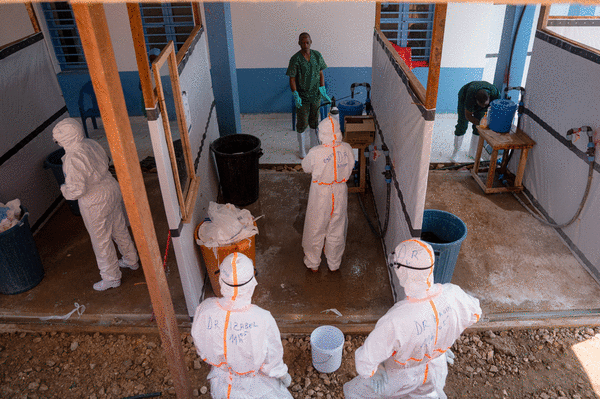
When the World Health Organization declared the West African Ebola epidemic a global emergency in 2014, I sat with my wife, Julie, and said aloud what both of us were thinking: People needed to step forward to fight the virus. As an ER nurse, I had the training; I had the experience. Our children were mostly grown. If not me, then who?
That question took me to Port Loko, Sierra Leone, where I worked with Partners In Health in an Ebola treatment unit for three months. When I arrived in November, regional hospital services had collapsed following the deaths of many staff members. Bodies lay on porches and in the streets. Families were terrified. Health workers were exhausted. The Ministry of Health was desperate.
What I remember most is not simply the horror of the virus’s devastation, but also the extraordinary cooperation of the international response efforts. I worked alongside Sierra Leonean nurses, cleaners, chlorine sprayers and doctors, as well as a Cuban medical team and Nigerian clinicians working through the African Union. Partners In Health and the World Health Organization were both active on-site, as well. The effort was imperfect, under-resourced and often improvised. But it was also a living rebuke to the practice of nations walling themselves off from one another.
At the 108-bed unit in Port Loko, called Maforki, where I worked, we were treating Ebola in a building never designed for that work, often without adequate equipment. At first, about 90% of our patients died. We hung IV bags from nails pounded into wooden posts, and tracked patients on a whiteboard. We learned from our Sierra Leonean colleagues, from our patients and from our own mistakes. Over time, we developed new protocols, and our survival rate improved to 40%.
That experience taught me that Ebola response cannot be only about containment. It must also be about care. If communities see outsiders arrive only to take those who are sick into quarantine and bury those who are dead without traditional rituals, trust collapses. People hide their symptoms, families resist treatment, and rumors spread faster than facts. In Sierra Leone, outreach to families and tribal chiefs and education were not optional elements of crisis response. They were essential components of the work.
Twelve years later, Ebola is again spreading, this time in the Democratic Republic of Congo and Uganda — a region scarred by armed conflict, poverty, displacement and fragile health systems. This outbreak involves the Bundibugyo species of Ebola, for which there is no approved vaccine or specific treatment. Once again, dealing with the outbreak comes down to the basics: rapid identification of cases, isolation, contact tracing, protective equipment and laboratory capacity.
And once again, those basics depend on institutions.
Instead, the Trump administration has launched an all-out assault on public health: withdrawing from the World Health Organization, dismantling USAID programs and cutting medical research and disease prevention. In a world of deadly pandemics, these are acts of disarmament.
Strip away global health infrastructure and the result is predictable: fewer trained outbreak investigators and contact tracers, shortages of masks and other protective equipment, layoffs of frontline aid workers and shuttered preparedness programs. This in turn leads to slower detection, worse data, poorer coordination and more preventable deaths.
Ebola is not the only warning. Combating climate change, artificial intelligence, pandemics, antimicrobial resistance and ecological collapse requires strong democratic institutions, international cooperation and public goods that no billionaire, militia, border wall or private corporation can replace.
The right wants us isolated, frightened and suspicious of one another. It offers walls where we need clinics, nationalism where we need solidarity, and cruelty where we need care.
Governments and NGOs need to stop showing up only at times of global crisis, and instead work to build relationships with local health systems that address daily health issues such as malaria, measles, malnutrition and the need for accessible potable water.
In Sierra Leone, I learned that outbreaks will happen, but they do not have to become epidemics. Epidemics are fueled by weak health systems, poverty, distrust and delayed response. Those are political choices.
Walls do not stop viruses. Institutional, structural, people-to-people solidarity does.
____
Marc Rosenthal is a retired emergency room nurse who has been involved in international solidarity and disaster relief for decades. This column was produced for Progressive Perspectives, a project of The Progressive magazine, and distributed by Tribune News Service.
_____
©2026 Tribune Content Agency, LLC.




















































Comments