Commentary: Defending reparations program means defending the promise of fair housing
Published in Op Eds
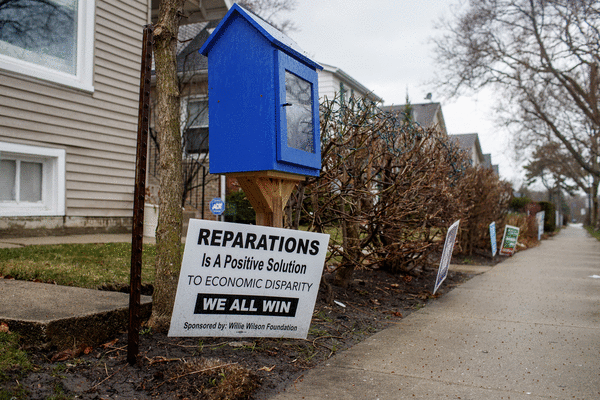
The U.S. Department of Justice’s decision to intervene against Evanston, Illinois’ local reparations program is being framed as a defense of constitutional equality and the Fair Housing Act. In reality, it reflects a painfully shortsighted understanding of what equality requires when government itself amplified and even created enduring patterns of racial exclusion.
As a fair housing professional working in Evanston, I constantly bear witness to the downstream effects of racist housing policy from the 20th century and beyond. For decades, Black Americans — including Black Evanstonians — were subjected to restrictive covenants, exclusionary zoning practices, discriminatory lending, real estate steering and municipal decisions that concentrated investment in some neighborhoods while withholding it from others.
In light of this, Evanston’s reparations initiative is not a story of granting arbitrary preferences, but a story of a city bravely confronting its own documented history of injustice — a history that produced lasting disparities in wealth, opportunity and health that remain undeniably visible today.
Let us be clear. These practices did not simply determine where people lived. They influenced who accumulated equity, the quality of childhood education, access to employment and ultimately how long residents lived.
According to data from the Centers for Disease Control and Prevention, residents of census tract No. 8092 — covering much of Evanston’s historically Black 5th Ward — have an average life expectancy of approximately 75.5 years. Just a short distance away, in the more affluent and substantially whiter census tract No. 8088, average life expectancy reaches roughly 88.8 years. A gap of more than 13 years cannot be explained by individual choices alone. It reflects the accumulated damage of structural inequality, including the legacy of residential segregation.
In the fair housing community, we understand that housing is not merely shelter. Home and community together form the platform upon which educational attainment, employment, environmental quality, wellness and intergenerational wealth are built. When discriminatory housing policies persist over decades, their consequences reverberate across nearly every one of those measures for generations.
That reality helps explain why Evanston’s reparations effort deserves support rather than condemnation.
Critics argue that the program improperly considers race as a factor for a public benefit, casting it as a clueless modern-day mirror of the discriminatory policies its proponents decry. But that characterization obscures both its purpose and its meaningful precedent.
In 1988, Congress passed, and President Ronald Reagan signed, the Civil Liberties Act, providing a formal apology and monetary compensation to surviving Japanese Americans who were cruelly incarcerated during World War II. That legislation rested on a straightforward moral proposition: When government itself inflicts deep, discriminatory harms, acknowledging those harms and offering redress can be an appropriate exercise of equal protection rather than a violation of it.
Just as Japanese Americans deserved the modest redress provided by the Civil Liberties Act, Black Evanstonians deserve it for the deluge of discriminatory housing practices that were enforced and perpetuated by local government. Refusing to acknowledge and repair harmful history does not produce a magic, neutral playing field — it allows injustice to echo.
The Fair Housing Act was passed in the wake of the assassination of the Rev. Martin Luther King Jr. with the ambitious objective of dismantling patterns of segregation and expanding access to housing opportunity. Courts and regulators have long recognized that remedying discriminatory practices sometimes requires more than simply declaring discrimination unlawful going forward. It requires affirmative efforts to overcome its powerful residential effects.
Evanston chose to take active, rather than passive, steps toward justice. Residents debated the proposal publicly. Local officials considered evidence of historical discrimination. Ultimately, residents acknowledged that our place-based inequities were largely built through policy choices, and they chose a new, radical, compassionate policy to help repair them.
Evanston’s reparations program, however imperfect in its impact, is the embodiment of responsible governance. It ignited a public grasping toward truth, reconciliation and repair — all of which should be at the heart of civic life but are in woefully short supply today.
The program is not a departure from the principles of fair housing. It is an affirmation of them.
____
Dominic Voz is the director of fair housing at Open Communities, a civil rights organization serving northern Cook County.
___
©2026 Chicago Tribune. Visit at chicagotribune.com. Distributed by Tribune Content Agency, LLC.





















































Comments