Commentary: Peace for whom? Iran after the agreement
Published in Op Eds
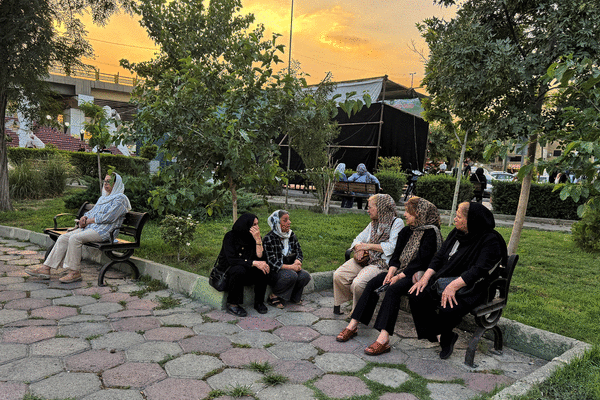
On June 17, President Donald Trump and Iranian President Masoud Pezeshkian signed a 14-point memorandum of understanding laying out a framework for ending the war and reopening the Strait of Hormuz. International media deemed this agreement as a significant diplomatic achievement. But inside Iran, a fundamental question remains: Whose peace is this?
First and foremost, this memorandum revealed an important structural reality: Iran’s government is not united behind it. Supreme Leader Mojtaba Khamenei stated in a message that he had, as a matter of principle, opposed signing the memorandum, but authorized it after Pezeshkian and the Supreme National Security Council accepted responsibility for the outcome.
This distance between the president and the supreme leader is not merely ceremonial. A hard-line member of Iran’s Parliament, Mahmoud Nabavian, claimed during a live state television broadcast that Khamenei had repeatedly objected to the course of the negotiations in letters to senior security council officials. He was cut off, and the director general of the state news network resigned. Hard-line factions have since deployed their broad access to state media as a weapon against any negotiation with the United States.
This portrait of Iran’s political system — a president who negotiates, a supreme leader who formally objects but permits and factions actively working to undermine the process — suggests that even at the diplomatic level, this peace rests on deeply unstable foundations.
What is nearly absent from diplomatic analyses, however, is the condition of ordinary Iranians. Since the U.S. and Israeli military strikes began on Feb. 28, Iranian authorities have arrested more than 6,000 people — including journalists, lawyers, human rights defenders and protesters. According to research by the Center for Human Rights in Iran, between March 17 and April 27 alone, at least 22 political prisoners were executed — an average of one execution about every two days — following proceedings that relied on confessions extracted under torture.
Even after the April ceasefire, the head of the judiciary ordered that the cases of detainees be processed with extraordinary speed, describing them as “foot soldiers of the enemy.” This directive was issued after the guns had already fallen silent.
This wave of repression unfolded while Iran maintained a nationwide internet blackout from Feb. 28 through May 25. When citizens cannot document what they witness or communicate with the outside world, repression becomes easier to conceal.
At the time the historic memorandum was being signed at Versailles, a court in Qom Province issued a ruling that made international headlines. Parastoo Ahmadi, a 29-year-old Iranian singer, was sentenced to 74 lashes, a two-year travel ban and a two-year prohibition on all artistic activity for performing an online concert without a hijab. Eight members of her production team received identical sentences. Her offense was singing a historic patriotic anthem in her own voice.
The contradiction is stark: The same judicial apparatus whose representatives flew to Switzerland to negotiate was, at the same time, issuing flogging sentences against a singer. These simultaneous actions are not coincidental — they provide an accurate portrait of a government that makes peace with the outside world while waging a different kind of war against its own people.
The memorandum speaks at length about many matters: sanctions relief, the unfreezing of Iranian assets, the reopening of the Strait of Hormuz and a reconstruction fund of at least $300 billion. But a legitimate and pressing question follows: Where will these resources actually go?
Analysts estimate that Iran’s actual military expenditures — including off-budget Revolutionary Guards activities, the ballistic missile program and financial support for proxy forces in Iraq, Yemen and Lebanon — are two to three times larger than the officially declared defense budget. Iran-backed militia networks in Iraq, including factions within the Popular Mobilization Forces, have continued to regroup and rearm even after absorbing significant losses during the war. This historical pattern raises a serious and unavoidable question about the current agreement: Will the lifting of sanctions and the release of billions in frozen assets translate into improved living conditions for ordinary Iranians, or will these funds flow once again into regional proxy networks?
This question is especially urgent given that, according to independent reports and the accounts of many Iranians inside and outside the country, prices for basic food staples, essential medications and everyday necessities have risen sharply, in some cases several times over, since the ceasefire announcement.
Even Pezeshkian acknowledged that years of 40% to 60% inflation have left millions of Iranians unable to afford basic necessities — a reality no diplomatic agreement has yet addressed.
The memorandum itself says nothing about political prisoners, accelerated executions or human rights standards inside Iran. United Nations experts welcomed the signing but warned that any final agreement that fails to address human rights in Iran would be “fundamentally incomplete,” adding that the Iranian people are “barely visible” in the current framework.
After the April ceasefire, some Iranians expressed a sense of abandonment and despair, describing the agreement as a missed opportunity for political change — one that would instead allow authorities to intensify domestic repression. It is a feeling that, given the available evidence, is far from unfounded.
In international law, a ceasefire and a peace memorandum signify the end of armed hostilities between states. But these concepts create no obligation whatsoever regarding how a government treats its own citizens. The consequence is that a regime can simultaneously be party to a diplomatic agreement and accelerate its domestic machinery of repression.
The essential question is not whether the Trump-Pezeshkian memorandum represents a diplomatic achievement. The question is whether the international community is prepared to define the measure of success beyond the silencing of guns and the reopening of the Strait of Hormuz — and to tie that measure to the condition of those whose voices went unheard throughout all of this.
With regards to a government that has not made peace with its own people, can it truly be trusted to honor its peace with the rest of the world?
____
Pegah Banihashemi, a native of Iran, is a legal scholar and journalist in Chicago whose work focuses on human rights, constitutional and international law, and Middle East politics.
___
©2026 Chicago Tribune. Visit at chicagotribune.com. Distributed by Tribune Content Agency, LLC.

















































Comments