Andreas Kluth: No diplomacy please, we're American
Published in Op Eds
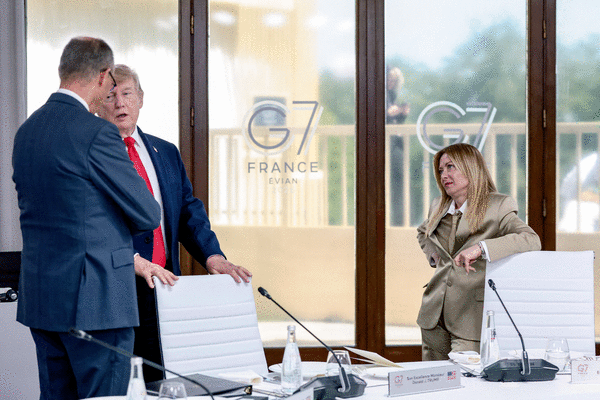
It has long been clear to anybody outside the die-hard MAGA scene that America First would sooner or later amount to America Alone. And still, the accelerating pace at which President Donald Trump is alienating other nations and isolating his own is breathtaking.
As one example of this pathology, consider his recent interactions with Italy’s prime minister, Giorgia Meloni.
Meloni, you may recall, was until recently considered one of the foreign leaders who was chummiest with the president — a European “Trump whisperer.” Besides having a good chemistry with him, she often strikes far-right chords — anti-immigration and pro-Christianity, say — that are consonant with those coming out of the White House.
But Trump is unpopular in Italy and not only because he keeps inveighing against the pope. Meloni has had to distance herself from the U.S. president’s most egregious mistakes, including the war he launched with Israel against Iran. Italy was among several European countries that denied the U.S. the use of their air bases for its bombing campaign.
Trump apparently couldn’t let that sit. After having his picture taken with Meloni and other leaders at a summit of the Group of Seven in France, the president told an Italian TV station that she “begged” him for that photo and that he only posed for it because he “felt sorry” for her.
That was petty, gratuitous and unnecessary — but also diplomatically fateful. “Neither I nor Italy ever beg,” Meloni replied on social media, calling his story about the photo “completely fabricated.” Offended by Trump’s “serious and offensive” tantrum, Italy’s foreign minister and deputy prime minister canceled a trip to the U.S. All of Italy, not usually a picture of concord, is suddenly united behind its leader and against Trump.
And so the list of America’s erstwhile friends that have been snubbed, insulted and bullied continues to grow. Denmark, which has sovereignty over Greenland, which Trump wants to seize, and Canada, which the president also wants to annex, were among the first. Italy and others are just catching up.
The ledger of neutrals that Trump has affronted is equally long, stretching from South Africa (whose leader he practically ambushed in the Oval Office) to Oman, which the other day heard Trump say that he might “have to blow ’em up.” Only America’s main adversaries, in Russia and China, seem to be spared: Trump is oddly deferential toward their leaders.
America’s diplomats, such as they are, have taken their cues from the boss and are adopting the same confrontational and condescending tone toward the governments they are dealing with. This pattern began in Trump’s first term, when he appointed acolytes to ambassadorial postings in places such as Germany. But it has become the foreign-policy leitmotif of Trump’s second term, as the administration fills many more postings — 108 of the 195 are still vacant — with donors, friends and toadies.
France, America’s oldest ally, has already summoned the American ambassador in Paris twice — the diplomatic equivalent of a reprimand — and was snubbed both times when he didn’t show up. That ambassador, Charles Kushner, is the father of Trump’s son-in-law. (The elder Kushner did time in prison for tax evasion and witness tampering, but Trump later pardoned him.) As ambassador, Kushner has kept busy with stunts such as publishing an open letter to Emmanuel Macron in which he publicly lectured the president about exactly what is wrong with France and apparently only France (such as antisemitism). French officials avoid meeting Kushner.
In South Africa, U.S. Ambassador Leo Brent Bozell III has adopted Trump’s narrative that the country systematically oppresses White people, also getting himself summoned by the foreign minister. South Africa’s president, Cyril Ramaphosa, has said that “We will not be bullied.”
The American ambassador to Poland, Tom Rose, cut off contact with the speaker of the country’s parliament for allegedly “outrageous” insults made against Trump. Rose didn’t specify what those might have been, but it appears that the speaker didn’t want to sign a letter nominating Trump for the Nobel Peace Prize. The Polish president had to remind Rose that “Allies should respect, not lecture, each other.”
The U.S. ambassadors to Israel, Belgium, Chile, Australia, Turkey and other places have all raised eyebrows in their own ways. When the ambassador to Canada, Pete Hoekstra, was supposed to give a toast at a gala in Ottawa, he instead fulminated against a Canadian official.
America under Trump is not the first Great Power to practice undiplomatic diplomacy as deliberate policy. Earlier this decade, China tried the same, encouraging its ambassadors to be “wolf warriors” in foreign capitals. (The term comes from a Chinese war movie in which Chinese studs kick Western butts.) But Beijing soon noticed that its jingoistic style was self-defeating and quietly reverted to traditional — meaning tactful — diplomacy.
For Trump, that penny hasn’t dropped yet. He fails to see the trend among foreign leaders who are giving up on flattery and instead standing up to him — from Canada’s Mark Carney to India’s Narendra Modi and now Meloni. This voluntary self-isolation is baffling. “I don’t know why the president of the United States behaves this way toward his own allies,” Meloni said in her video response to his gibes.
The lesson to other world leaders is simple: Listen to Ramaphosa, Meloni and Carney, and don’t let Trump bully you.
The lesson to America is so obvious it shouldn’t need spelling out: If you continue to be rude and nasty to the world, the world will eventually return the favor. If you want to isolate yourself, carry on. Otherwise, try a different approach. It’s called diplomacy.
More From Bloomberg Opinion:
•America’s Subpar Diplomats Are Not the Only Option: Max Hastings
•Japan Is the Superpower of the Middle Powers: Hal Brands
•The Iran War Is All About Psychology: Trump’s and Khamenei’s: Andreas Kluth
This column reflects the personal views of the author and does not necessarily reflect the opinion of the editorial board or Bloomberg LP and its owners.
Andreas Kluth is a Bloomberg Opinion columnist covering U.S. diplomacy, national security and geopolitics. Previously, he was editor-in-chief of Handelsblatt Global and a writer for the Economist.
©2026 Bloomberg L.P. Visit bloomberg.com/opinion. Distributed by Tribune Content Agency, LLC.


















































Comments