Allison Schrager: Loan forgiveness made students worse off, then and now
Published in Op Eds
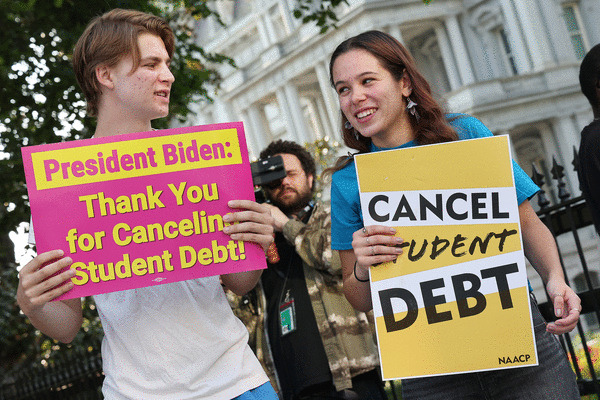
Student loans are a special kind of debt. They are an investment to increase someone’s future earnings, though they must be paid back before most of those earnings are realized. Most of the loans are directly from the government, which not so long ago was telling borrowers they wouldn’t have to pay them back, and didn’t require them to. They are among the few kinds of debt that can’t be discharged in bankruptcy. They also have one of the highest rates of default.
A new research paper argues that all these facts may be related. During and just after the pandemic, there was a moratorium on student loan payments, and the government even promised to forgive much of the debt. The Supreme Court put an end to that idea in a 2023 decision — and since payments have resumed, more borrowers than ever are delinquent.
The high delinquency rates are often attributed to financial hardship, which is related to the affordability crisis. No doubt some borrowers are finding it hard to make their payments. But the paper says that the uncertainty around debt repayment is a big reason that many people aren’t paying back their loans. In 2022, according to the paper, nearly 50% of borrowers surveyed expected their debt would be forgiven. That figure fell to 25% after the Supreme Court decision — and even after President Donald Trump’s re-election in 2024, about 10% still expected forgiveness. The three-and-a-half year pause on payments fostered this belief.
There are now 9.2 million borrowers who are delinquent, the highest rate since the government began keeping records 10 years ago. The paper estimates that borrowers who expect relief are paying less, if anything at all. Counting on forgiveness also altered spending behavior: Some purchased other goods or took on other forms of consumer debt.
All this confusion, the paper says, resulted in making borrowers worse off. Some will end up paying more in interest, carrying even more debt, and damaging their credit.
It was strange, and not just to me, that student-debt forgiveness ever caught on as a policy in the first place. Most borrowers are able to pay back their debt because they tend to be higher earners. There are some who can’t: for example, students from lower-income families who took on debt to go to for-profit schools and got degrees that offered little value.
But there already is a program to wipe out those loans. Other borrowers struggle because their degree has not delivered higher income, but there is an income-based repayment program to help them, too. There are also forgiveness programs for teachers and people who work in public service, though they are being changed.
Most of the biggest student borrowers incurred their debt getting graduate degrees in fields such as medicine or law, which is why they also tend to be the highest earners. If the goal was to help the most needy, widespread forgiveness never made much economic sense. In the end, a promise that was never fulfilled still managed to make many people worse off.
Still, a lot of people took the idea of student loan forgiveness seriously, both practically and politically. In that sense, it is hard to blame someone for making bad financial decisions when politicians and other officials enable their delusions. And it’s not just student debt, but debt overall. For that, it’s more appropriate to blame Republicans, for adding to the debt with unfunded tax cuts, and Democrats, who say they can expand the state and make billionaires pay for it.
Too many Americans have come to believe that they don’t need to pay for government services because someone else, either the rich or future taxpayers, will pick up the bill. Student borrowers are now facing a rude awakening. That realization is coming for everyone else, too. On its current path, America faces essentially three choices: higher taxes, higher interest rates, or learning to live with less.
_____
This column reflects the personal views of the author and does not necessarily reflect the opinion of the editorial board or Bloomberg LP and its owners.
Allison Schrager is a Bloomberg Opinion columnist covering economics. A senior fellow at the Manhattan Institute, she is author of “An Economist Walks Into a Brothel: And Other Unexpected Places to Understand Risk.”
_____
©2026 Bloomberg L.P. Visit bloomberg.com/opinion. Distributed by Tribune Content Agency, LLC.





















































Comments