Clive Crook: The political breakdown that dare not speak its name
Published in Op Eds
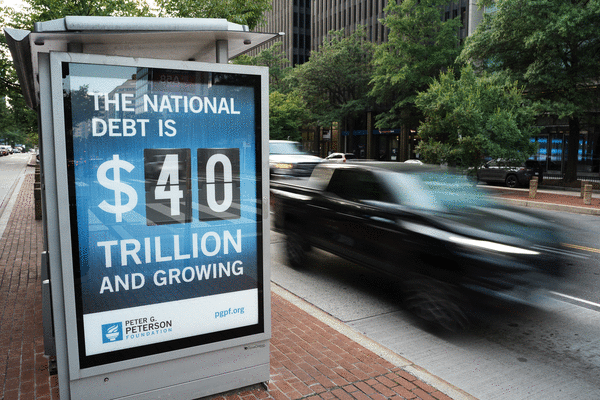
The most pressing policy question facing the U.S. — how to restore fiscal control — has been conspicuously absent in campaigning for the midterm elections. Neither party is willing to frame a plausible way to solve the problem, so they’ve seemingly agreed not to discuss it. Their silence is an abject failure of governance. One wonders how much longer Washington will be able to get away with it.
Yes, narrower arguments about tax and public spending have featured prominently — but not as part of a debate about reducing the budget deficit. Democrats aren’t short of ways for the government to spend more, and Republicans are as devoted as always to cutting taxes. Just don’t mention the deficit.
Some Democrats do favor higher taxes on the wealthy as well as “Medicare for all” and so forth. But they don’t pretend that any such plan would pay for itself, or that “fairer taxes” more broadly would be enough to cover the cost of their many ambitions for extra spending — much less yield a surplus that would cut public borrowing. That might be wise for campaign purposes, since such a claim couldn’t withstand scrutiny. Instead, they advocate higher spending and higher taxes as worthy goals in their own right. No need to do the math. No need to mention public borrowing.
For Republicans, the corresponding article of faith is that more tax cuts are the answer to everything and would raise growth by enough to cure the fiscal sickness. By now, this is both provably false and implausible on its face — and therefore not to be emphasized for electoral purposes. Concentrate instead on the other side’s plans to take away your health insurance and an even bigger chunk of your wages. Deficit? What deficit?
Maybe bigger things are at stake in these elections. First things first, you might think: Fiscal control can wait. Well, it may not. Consider the signal the bond market has been sending lately. With public borrowing at 6% of gross domestic product (despite decent growth and full employment) and net public debt at 100% of GDP (on track to hit 120% by 2036), 10-year yields have climbed to more than 5% — the highest in decades and on a par with what France’s government has to pay amid rising fears of an outright debt crisis.
Note that U.S. public debt is projected to keep on rising even if all goes well. A brave assumption. U.S. investors are torn between incipient anxiety over public borrowing and peak exuberance over future AI-driven profits. If the first gets worse, upward pressure on bond yields will rise, adding to the fiscal imbalance and, in the worst case, starting an abruptly accelerating vicious circle. If the second subsides all at once, the hit to aggregate demand could slow the economy — adding to the budget deficit in its own right and demanding discretionary fiscal stimulus to cushion the blow.
Digging out of this hole will be difficult even if Washington starts immediately. Continuing to ignore it doesn’t keep things in a holding pattern of gradual, hence manageable, deterioration. As the debt creeps up, it eventually reaches a point where the problem is literally insoluble. Fiscal restraint severe enough to stabilize the debt would hit the economy so hard as to be self-defeating. Well before that doomsday tipping-point is reached, years of avoiding the subject will have achieved “fiscal dominance” — meaning that the Federal Reserve is forced to finance public borrowing by buying debt, driving up inflation, and in effect enabling default.
Meantime, the harm isn’t confined to hypothetical worst-case scenarios. The collapse of fiscal control is already making Americans a lot worse off.
Fiscal fragility makes it harder to unwind the tariffs that have raised prices and suppressed non-AI investment, because the revenue can’t be spared. Fiscal excess obliges the Fed to keep short-term interest rates higher than otherwise. Rising long-term rates drive mortgage rates and the cost of credit, adding to complaints about affordability. The worsening outlook complicates remedies for the impending insolvency of the Social Security and Medicare trust funds, adding to the prevailing economic anxiety.
Forgive me for thinking all this is at least worth discussing. The answers, once the country’s politicians decide to come up with some, will be bitterly contested — as indeed they should be. Do you restore fiscal control by raising taxes, cutting spending, or some of both? Which taxes? Which spending programs? What are the trade-offs? Who pays? Democrats and Republicans approach these questions with radically different priors. Elections are supposed to be about having such arguments and making some choices.
Bipartisanship isn’t dead after all. Where it counts, Democrats and Republicans are united: Fiscal breakdown won’t be addressed until it kicks the country in the teeth.
____
This column reflects the personal views of the author and does not necessarily reflect the opinion of the editorial board or Bloomberg LP and its owners.
Clive Crook is a Bloomberg Opinion columnist and member of the editorial board covering economics. Previously, he was deputy editor of the Economist and chief Washington commentator for the Financial Times.
©2026 Bloomberg L.P. Visit bloomberg.com/opinion. Distributed by Tribune Content Agency, LLC.














































Comments