Commentary: The best macabre betting tip for the Breeders' Cup on Halloween
Published in Op Eds
If an airline assures you that its flights are 99.9% safe, you would feel secure getting on one of its planes, right? However, if that same airline tells you that it’s had a crash in one out of every thousand flights—which is actually the same as “99.9% safe”—you would cancel your ticket right away.
The horse racing industry uses the same tactic when reporting the hundreds of deaths every year in this “sport.”
The federal Horse Racing Integrity and Safety Authority (HISA), which has worked hard to reduce deaths, and with some success, touts that “(r)acetracks operating under HISA’s rules continue to report roughly 1.0 fatalities per 1,000 starts across all benchmarks—marking a significant achievement in equine safety,” adding that this means that “99.90% of starts occurred without a fatality.”
This is better than it used to be before HISA came on the scene. But it makes it seem like there is minimal risk and that the deaths are anomalies. In fact, according to HISA’s statistics, there were 365 confirmed racing and training deaths in 2025—that’s an average of exactly one death every day. Imagine a baseball season in which a player is killed daily.
Controversial trainer Bob Baffert tried a similar spin when he was disqualified from the Kentucky Derby after a positive drug test on his horse Medina Spirit revealed 21 picograms of betamethasone. Baffert argued that a picogram is just a “trillionth of a gram,” as if it were an inconsequential, trivial amount. What Baffert didn’t say is that the betamethasone positive was 21 picograms per milliliter of blood or plasma. And I’m sure Baffert wouldn’t be saying that a picogram is just an innocuous amount if he himself had been exposed to 21 picograms of the Botulinum toxin, which would be lethal. Context is everything.
The devil is in the fatality detail too. Some tracks have much higher death rates than others and are keeping the overall statistic high in 2026. Parx Racing in Pennsylvania, Churchill Downs in Kentucky, and the Churchill Downs Inc.-owned Ellis Park, also in Kentucky, are some of the worst. Why does the state synonymous with horse racing have so many fatalities? And there can be no excuse for the home of the Kentucky Derby, with all its resources, to have even one death of a horse.
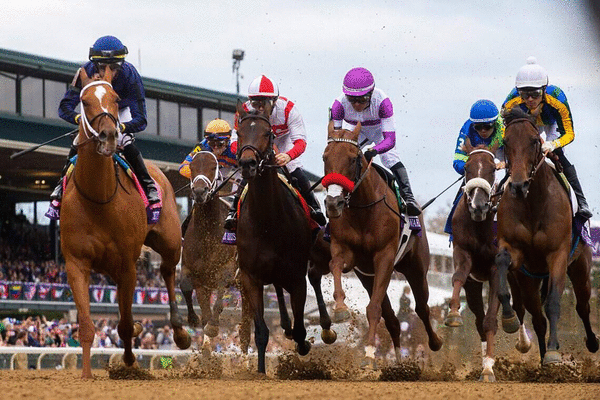
Keep this in mind when the Breeders’ Cup World Thoroughbred Championships—horse racing’s biggest weekend—is run at the Keeneland Race Course in Lexington, Kentucky, later this month, with the feature race on Halloween. The statistics show that there is a significant risk of a death during the Breeders’ Cup, like the fatal injury Mongolian Groom sustained in the 2019 Breeders’ Cup Classic. PETA captured exclusive footage of his catastrophic injury.
This risk can be calculated in actual odds. Over the two-day event, around 230 horses will start races. At one fatality for every thousand starts, that means there is an approximately 4½ to 1 (or 9 to 2) chance of a horse being killed.
So if you are offered a macabre prop bet on whether a horse will die at the Breeders’ Cup at 5:1 or higher odds, you might be tempted to take it.
Of course, that’s a bet you would hope to lose. So don’t be complicit in this cruelty. Don’t bet on any Breeders’ Cup races, because for now the only sure thing in horse racing is that the horses always lose.
____
Kathy Guillermo is a senior vice president with People for the Ethical Treatment of Animals, 501 Front St., Norfolk, VA 23510; PETA.org.
_____
©2026 Tribune Content Agency, LLC.
















































Comments