Noah Feldman: The White House will fail to overturn any elections
Published in Op Eds
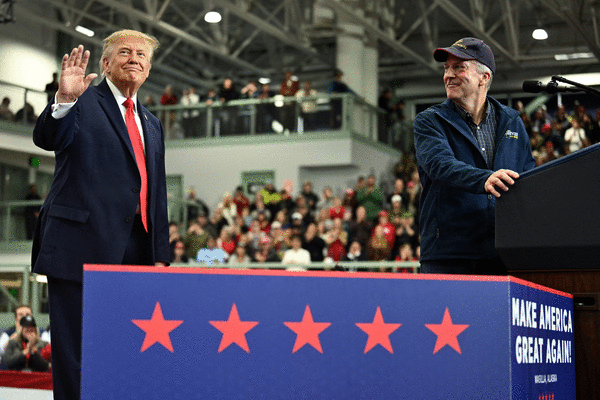
If you’re a lawyer and your client tells you to file a meritless case, you’re supposed to say no. The U.S. Justice Department is apparently not constrained by this ethical obligation.
That helps explain why the department filed a lawsuit against Alaska last week seeking an injunction against the results of the state’s election only if the Republican candidate loses: It stemmed not from DOJ lawyers, but from President Donald Trump himself. From a political standpoint, the department’s efforts to undermine the results of next week’s elections are concerning, if unsurprising. As a legal matter, however, there is little to worry about.
Trump posted last week that it is “totally confusing” that there are two candidates for U.S. Senate in Alaska named Dan Sullivan, and that the courts should remove the one who is not the Republican incumbent. But it is not a legal violation of any kind for a candidate to run for office who has the same name as one of the other candidates. There is no allegation of error in the formation of the ballots. Even if there were, there would be no way a court could know which votes cast on behalf of which candidate should be excluded.
In California, meanwhile, the DOJ has filed a pre-election request for a federal district court to block the state from counting some 20,000 mail-in votes that have not yet been cast. It had so little effect that the department took the unusual step of asking the court of appeals to weigh in before the district court had had a chance to hold a hearing. The panel of appellate judges who heard that case seemed pretty skeptical. The government had trouble arguing even that it could demonstrate that the named recipients were non-citizens, or even that they had actually gotten ballots.
None of this qualifies as unexpected. Since Trump first ran for office 10 years ago, he has tried to use the courts to meddle in elections. And the Supreme Court has consistently declined to intervene to help him.
The best way to understand Republicans’ pre-election feints and Democrats’ jitters is to see them all as part of a new normal. It’s easy to forget, but the current reality distortion field around electoral results dates not to Trump’s loss in 2020 but to 2016. Before Trump won that election, he was already alleging that the election was “absolutely rigged” and that this was happening “at many polling places.” On October 17, 2016, he tweeted, “Of course there is large scale voter fraud happening on and before election day.”
Then and now, the purpose of Trump’s unceasing efforts to undermine the legitimacy of electoral outcomes is not just that he wants to win. Talking up voter fraud was a way for Trump to empathize with his supporters’ sense of being disempowered and disenfranchised. Beyond that political objective, Trump also understood from the start that he could hedge against the embarrassment of defeat by seeding the idea that the other side was cheating him. If he won, no one would remember his pre-election claims. If he lost, he could continue with his aggrieved narrative.
But even though these cases consistently lose, there is a cost to this now-regularized practice of alleging election fraud before an election: They weaken trust in the democratic process. One way to restore that trust is to emphasize that there is a third branch of the government, the judiciary, that is also charged with safeguarding our democracy. If more Americans started correctly discounting the dangers associated with such legal attempts, it could weaken the incentives for such claims to be made in the future.
The only time the Supreme Court has decisively intervened in an election was in Bush v. Gore, the case that emerged from the 2000 election. There was no allegation of fraud. The litigation challenging the initial count came from Al Gore’s side. George W. Bush had been declared the winner after the initial Florida count. Only after the Gore team got the recount going in state court did the Supreme Court ultimately intervene to end the recount.
That was an unfortunate episode, to be sure. (Full disclosure: I was a baby lawyer on the Gore side.) But to give the Supreme Court some credit, it did not flip the electoral results. And it has not done so since.
Trump’s multiple efforts to subvert democracy after the 2020 election still haunt our politics, as they should. And the memory of January 6, 2021, is still crisp. But protecting democracy is a cause that rises above politics, and it is not served by too much fretting about the Trump administration’s now-standard and unsuccessful attempts to use the courts as one vector in the delegitimization process. They won’t work.
____
This column reflects the personal views of the author and does not necessarily reflect the opinion of the editorial board or Bloomberg LP and its owners.
Noah Feldman is a Bloomberg Opinion columnist. A professor of law at Harvard University, he is author, most recently, of “To Be a Jew Today: A New Guide to God, Israel, and the Jewish People."
©2026 Bloomberg L.P. Visit bloomberg.com/opinion. Distributed by Tribune Content Agency, LLC.













































Comments