Andreas Kluth: Trump should do a Helmut Schmidt when he meets Xi and Putin
Published in Op Eds
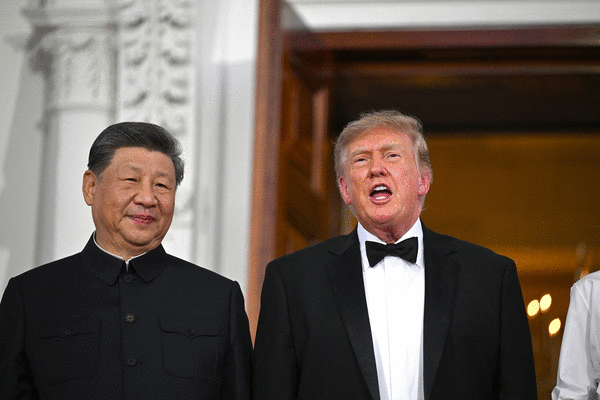
For reasons that could range from good to atrocious, President Donald Trump wants a three-way summit with his Russian and Chinese counterparts when the three men are in Shenzhen next month for an economic forum.
In the worst scenario, Trump and Xi Jinping would conspire to doom Ukraine to Vladimir Putin’s subjugation. In the best, however, they would open a long and necessary process toward an eventual nuclear detente among the U.S., Russia and China. Trump claims he wants this trilateral meeting “not so much for Ukraine” but “to talk about nuclear weapons and denuclearization.” Let’s take him at his word.
What would such talks look like? And what lesson could Trump take from a West German chancellor in the 1970s?
At least three developments — even aside from new dangers such as artificial intelligence entering the nuclear command chains — make trilateral nuclear talks urgent.
First, since the expiration this year of the last arms-control treaty between the U.S. and Russia, no formal limits constrain the nine nuclear powers at all.
Second, whereas arms control used to be a (relatively) simple matter between the two atomic superpowers — Russia and the U.S. still account for 86% of all nukes — it is now a much more complicated “three-body problem” because China is fast catching up. And the U.S. must assume that Moscow and Beijing could one day gang up against Washington.
And third, today’s arms race isn’t only about the number of nukes but also about the types of warheads, delivery vehicles and war plans that are emerging.
China and Russia are increasingly investing in “tactical” weapons. Those are designed not to destroy the homeland of the main adversary (the U.S., in their case) but to win, with allegedly “limited” strikes, a conventional war in a local theater, such as the Taiwan Strait or Eastern Europe.
Tactical nukes are considered especially dangerous precisely because they appear more usable but could still cause uncontrolled escalation to Armageddon. That’s why the U.S. after the Cold War mothballed almost all its tactical warheads (except for about 100 that are stationed at allied bases in Europe).
Moscow retired fewer of its tactical nukes, and it now outnumbers the U.S. about 10-to-1 in that category. Worse, Putin has repeatedly threatened to use such weapons in Ukraine.
And China has been adding tactical nukes to signal to the U.S. that it cannot be blackmailed or defeated in a regional conflict over Taiwan. In response, the Trump administration is considering redeploying its own tactical nukes to Asia.
So a new arms race is on, and even though Trump keeps inviting Xi and Putin to talk about it, Xi refuses. It’s “neither fair, reasonable nor realistic to ask China to join the so-called trilateral nuclear disarmament negotiations at this stage,” China’s foreign ministry said this month.
That impasse is prompting some policy veterans in Washington to think outside the box. One of them is Joel Wit, a veteran of the State Department who has, since the 1990s, been negotiating with, and often in, North Korea to stop its nuclear program. (Unsuccessfully, obviously.)
“It seems to me, it’s inevitable that we are going to redeploy tactical nuclear weapons aimed at China,” Wit told me. In isolation, such a move could invite disaster, he agrees, because “these things are dangerous.” The plan could work, however, if “we link it to an arms-control proposal.”
The model, Wit said, would be the hugely controversial, but ultimately successful, dual-track decision taken by NATO in 1979. Its main brain father was the West German chancellor at the time, Helmut Schmidt. Even though the political backlash cost him dearly in his own party, country and continent, Schmidt considered it one of his biggest contributions to peace, as he told me not long before his death in 2015, when he was in his 90s.
Just as China is deploying more tactical nukes in Asia today, the Soviet Union in the 1970s was stationing more medium-range missiles in Europe to threaten America’s European allies but not the U.S. itself. This caused a crisis of credibility and deterrence: Nobody believed that Washington would retaliate for a tactical strike by Moscow against Europe with U.S. strikes against the Soviet Union itself.
So Schmidt urged the U.S., and by extension NATO, to do two things at once: First, Washington was to send more of its own tactical nukes, mounted on medium-range and cruise missiles, to Western Europe. Simultaneously, it offered the Kremlin arms-control negotiations to get rid of this class of weapons altogether.
The decision provoked not only Moscow but also millions of Germans and other Europeans who chose to hear the first part but not the second and took to the streets in protest. By the early 1980s, moreover, the plan seemed to be failing when the U.S. began stationing the threatened missiles but Moscow wasn’t budging.
But then a new Soviet leader, Mikhail Gorbachev, agreed to talks with his U.S. counterpart, Ronald Reagan. And in 1987 (five years after Schmidt left the chancellery), the two signed a treaty to eliminate all ground-based missiles with intermediate ranges. Schmidt told me that the dual-track decision eight years earlier had made it possible.
Today’s situation is more complicated, not least because any dual signal by Washington would have to bring both Beijing and Moscow to the table, and ideally Pyongyang and others as well. But the logic remains the same: Trump would offer a stick in one hand and a carrot in the other while highlighting the insanity of the current arms race if it continues.
Nothing so far suggests that Trump, who seems increasingly and bizarrely deferential to Putin and conciliatory toward Xi, has the nerve to take this risky but promising step. And yet nothing should in theory be Trumpier: For a president who has branded his foreign policy as “peace through strength,” a dual track would add the strength to get the peace.
____
This column reflects the personal views of the author and does not necessarily reflect the opinion of the editorial board or Bloomberg LP and its owners.
Andreas Kluth is a Bloomberg Opinion columnist covering U.S. diplomacy, national security and geopolitics. Previously, he was editor-in-chief of Handelsblatt Global and a writer for the Economist.
©2026 Bloomberg L.P. Visit bloomberg.com/opinion. Distributed by Tribune Content Agency, LLC.















































Comments