Editorial: University of Chicago Lab Schools strikes a blow for making classrooms indoctrination-free zones
Published in Op Eds
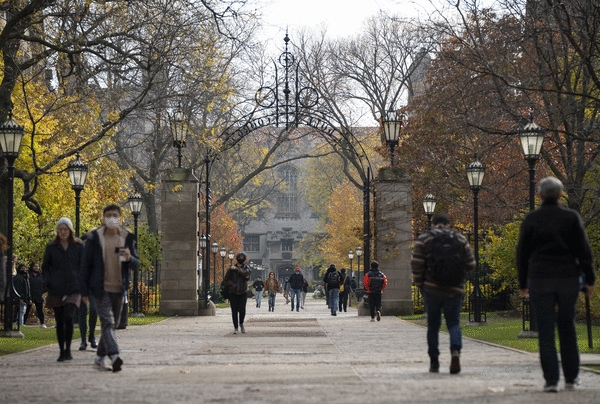
At a moment when many schools increasingly blur the line between education and activism, the University of Chicago Laboratory Schools is attempting something unfashionable: protecting classrooms as places of open inquiry rather than ideological instruction.
The private pre-K-through-12th-grade school in Hyde Park, which serves about 2,000 students and is affiliated with the great university, this year adopted a “viewpoint-neutral” policy designed to prevent teachers and staff from steering students toward preferred conclusions on contested political and social issues.
We read the school policy, which is very much in keeping with the traditions of liberal education, and encourage others to do the same before they take to the streets or even render any opinion.
The school’s position can be boiled down to affirming that “instruction and school environments should not privilege, presume, or promote a correct viewpoint on contested issues.” They define contested issues as “topics about which reasonable, informed people disagree in contemporary public debate.”
We appreciate the school’s emphasis on cultivating “independent judgment.” Beats telling kids what to think any day.
When educators use their platforms to broadcast political views, the message to students is unmistakable — conform or be left out.
And in addition, teaching kids the “right” conclusions to draw on matters of history, current issues and literature frustrates one of the most important tasks of any education — learning to be a critical thinker. Doing so necessitates seriously grappling with differing points of view and debating them honestly.
Not everyone feels the same way, however, and some progressive parents and staff are in a huff. The issue has gotten so hot that the union representing Lab School teachers has (to our surprise and disappointment) filed a grievance over the policy, arguing it violates the collective-bargaining agreement. We can’t imagine all the Lab teachers, known for their excellence, agree with that position.
Protesters at the Hyde Park campus last Friday showed up wearing shirts that read, “free teachers raise thinkers,” a sentiment almost everyone can get behind. Indeed, that motto would seem to jibe with the notion of free expression Lab is attempting to protect and foster. Where many of the protesters went wrong was by pairing that message with posters and signs emblazoned with partisan messaging. Perhaps their frustration with the new policy is that it prevents teachers from championing their progressive views in school.
We were struck by some of the commentary reported at the Friday protest.
“Usually rules that restrict what people can say are called censorship,” Patrick Morrissey, a professor of poetry at U. of C., told the Chicago Sun-Times.
This is yet another accurate sentiment. But misapplied.
Teachers may argue they’re exercising their right to free speech. True, but they should also worry about whether they are depriving students of theirs. And their right to learn how to form their own views.
Students are unlikely to speak freely when they know the authority figure in the room has already signaled the “correct” political answer. That’s the problem Lab’s thoughtful policy is seeking to avoid.
We saw concerns expressed by opponents of the new policy in the Maroon, the student newspaper at the university, that classroom discussion would be — or has been — constricted. The policy, as the Maroon reported, is aimed at avoiding issues that aren’t appropriate for younger students, encouraging free student expression, and discouraging teachers from framing “contested moral issues with fixed conclusions.”
What in the world is wrong with that? Teachers should be guiding respectful and open discussions and encouraging different viewpoints, not leading the class to an inevitable end point.
At critical moments in our country’s history, the University of Chicago has served as a guiding light on remaining committed to free expression as a prerequisite for educational institutions.
One of U. of C.’s most foundational texts on this matter is the Kalven Report, written in 1967, which articulated the university’s principle of institutional neutrality on social and political issues.
“A university must sustain an extraordinary environment of freedom of inquiry and maintain an independence from political fashions, passions and pressures,” the authors wrote.
A school, in this long-standing University of Chicago view, should not diminish itself by assuming “the role of a second-rate political force or influence,” which it risks doing if authority figures in the classroom inhibit students’ freedom to express themselves openly by casting judgment and making their political views widely known and felt.
Under the late President Robert Zimmer, the university reaffirmed its commitment to free expression in 2014 when it drafted its Chicago Principles, a gold standard adopted by many universities across the country, including Princeton, Purdue and Johns Hopkins. It has continued to do so in subsequent years, as political polarization has intensified.
After all, as former U. of C. President Hanna Holborn Gray put it, “education should not be intended to make people comfortable, it is meant to make them think.”
All of which applies to Lab and its students.
Intellectual freedom is baked into the U. of C. DNA, and the Lab School is right to defend it.
Free thought can’t exist in classrooms where educators’ strongly held political views hang over every lesson.
Fostering an environment that supports intellectual openness and discovery for students trumps any grown-up’s need to blather about their political grievances, and we suspect the silent majority of parents support the school’s decision. It’ll be fairly simple to tell whether it’s popular or not over time — enrollment numbers don’t lie.
Folks who prefer a side of anti-capitalist politics with their son’s algebra lesson are free to take advantage of all too many of Chicago’s neighborhood public schools. If only they’d adopt the Chicago Principles, too.
___
©2026 Chicago Tribune. Visit at chicagotribune.com. Distributed by Tribune Content Agency, LLC.

















































Comments