Commentary: Forty years after Chernobyl, war threatens a new nuclear disaster in Ukraine
Published in Op Eds
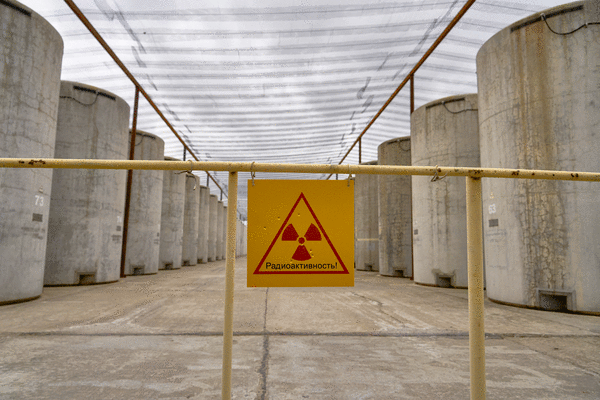
On April 26, 1986, the world experienced the worst nuclear power plant disaster in history: the explosion and fire of reactor No. 4 at the Chernobyl nuclear power plant in Ukraine. The accident was caused by a combination of design flaws of the Soviet RBMK reactor and human error. The explosion and subsequent graphite fire released a plume of radiation over 10 days that contaminated large areas of Ukraine, Belarus, Russia and much of Europe. Two workers died in the explosion, and 28 died from acute radiation syndrome. Thousands of children developed thyroid cancer, liquidators developed leukemia and tens of thousands are estimated to have developed other cancers. More than 300,000 people were resettled from their homes.
The accident resulted in high rates of psychological trauma, stigmatization and social disruption. The long-term economic costs are estimated in the hundreds of billions of dollars. All of the Chernobyl reactors were shut down in 2000. Reactor No. 4 was sealed under a sarcophagus and is surrounded by a nearly 20-mile exclusion zone. The damaged reactor will stay radioactive for tens of thousands of years.
Today, Russia’s war on Ukraine has increased the risk of another nuclear power plant disaster. On March 4, 2022, Russia seized the Zaporizhzhia Nuclear Power Plant (ZNPP) in southeastern Ukraine, which is the largest nuclear power plant in Europe. The 1977 Protocol 1 Amendment to the Geneva Convention outlaws attacks on nuclear generating stations, “even where these objects are military objectives, if such an attack may cause the release of dangerous forces and consequent severe losses among the civilian population.”
The reactors at the Chernobyl and ZNPP stations differ in design and levels of containment. ZNPP has more robust containment and uses water rather than flammable graphite as a moderator. The ZNPP reactors have been placed into shutdown mode that decreases the risk of a meltdown. The International Atomic Agency has staff on-site to monitor the situation.
Yet as we learned from the nuclear power plant accident in 2011 at Fukushima, Japan, that was precipitated by an earthquake and tsunami, even these types of reactors are susceptible to loss-of-coolant accidents. A continuous flow of cooling water is needed to remove heat from the reactor core and spent fuel cells. If external power is lost, the fuel overheats, and the zirconium cladding reacts with steam-generating hydrogen. If cooling is not restored, the fuel can melt and the hydrogen explode, breaching containment and releasing radioactive materials.
Since Russia’s occupation of the ZNPP, there have been several near-miss nuclear safety situations. ZNPP has lost all external grid power multiple times due to damage to transmission lines, forcing it to rely on diesel generators to keep cooling systems running. Military equipment has been stationed within the perimeter of the plant. Shelling has damaged areas around the plant. The plant relies on a cooling reservoir connected to the Dnipro River that was affected by the destruction of the Kakhovka dam.
Ukrainian plant operators are working under stressful occupation conditions. In a worst-case scenario, a prolonged loss of power would lead to a Fukushima-like accident releasing a plume of radiation that could spread over a large area. Chernobyl has shown the consequences of such accidents: deaths from acute radiation syndrome, mass evacuations, contamination of land and water, cancer, and psychological impacts and economic collapse.
In July 2024, the United Nations passed a formal resolution demanding that Russia immediately return the ZNPP to Ukraine and withdraw its military and other unauthorized personnel. Nuclear power stations must not be battlegrounds. The Chernobyl accident showed us how design flaws and human error can lead to catastrophe. The Fukushima accident showed us how vulnerable we are to natural disasters.
The safety systems at nuclear power plants are not designed for war. Russia’s military seizure of an operating civilian nuclear power plant has set a dangerous precedent.
As we learned from Chernobyl, nuclear power plant catastrophes are not just local events. The safety and security of nuclear power plants should concern us all.
______
Dr. Daniel Hryhorczuk is an emeritus professor for the University of Illinois School of Public Health with expertise on the health and environmental impacts of radiation. Hryhorczuk is also a member of the Ukrainian Medical Association of North America and the Ukrainian Congress Committee of America.
___
©2026 Chicago Tribune. Visit at chicagotribune.com. Distributed by Tribune Content Agency, LLC.





















































Comments