George Skelton: Jack up taxes on California's rich? Popular liberal mantra, but bad idea
Published in Op Eds
SACRAMENTO, Calif. — The Democrats’ mantra this election year — especially among wannabe governors — is that the richest Californians should “pay their fair share.” But by any objective measurement, they already do.
I’m referring to state taxes, not federal. It’s a valid argument that the most prosperous Americans should kick in more to the federal government, particularly after President Trump and the Republican Congress lowered taxes for the wealthy, who already had a pretty good deal.
But it’s a different story in California, where state government lives off the well-heeled. Yet, never-satisfied liberal Democrats and public employee unions constantly cry for more.
In fact, an unexpected surge of $16.8 billion in state tax revenue, mostly due to the stock market boom and capital gains earnings, is bailing out Gov. Gavin Newsom and allowing him to claim a balanced budget as he prepares to depart Sacramento and run for president in 2028.
The state Franchise Tax Board recently reported which income groups pony up the most taxes. The more money you earn, the steeper your income tax burden. Of course, that’s the way it should be. But California pushes its progressive tax system to the extreme.
We’ve got by far the highest state income tax rate in the nation at 13.3%.
In 2024, the latest year for which there’s complete data, the top 1% of California taxpayers accounted for 40% of the total state income tax revenue, the FTB reported. But they earned just 24% of the taxable income. To be in the top 1%, your annual earnings had to be at least $973,000.
The top 0.1% kicked in 21% of the tax, while earning 12% of the income. To be in that megarich class, you needed annual earnings of at least $4.7 million.
By contrast, middle-class families with incomes between $73,000 and $139,000 paid 9% of the state’s income tax take.
This doesn’t mean we should weep for the rich and demand more from the struggling lower middle class.
But the problem with Sacramento living off the wealthiest taxpayers is that they’re unreliable. Their fortunes flourish in boom times and fall when the economy busts. When the stock market sneezes, California state government catches pneumonia.
If the state treasury is overflowing, Democratic lawmakers tend to spend freely, expanding programs and creating new ones. Then when the cache inevitably shrinks in bad times, the policymakers’ usual response is to essentially turn their eyes.
Rather than sharply whack spending and raise taxes, they gimmick up the budget with borrowing, deferred spending and crossed fingers. And they dig the hole deeper.
For decades, under Democratic and Republican governors, we’ve sorely needed to update our archaic tax system to make it less volatile and more dependable.
A reform that makes lots of sense is to extend the sales tax to services primarily used by businesses. They could deduct the cost on their federal tax returns. And California state and local governments would steadily collect several billion dollars annually. Some income and sales tax rates could even be lowered.
California also has the nation’s highest state sales tax rate at 7.25%. Combining state and local sales tax rates, we have the seventh-highest at 8.99%.
Taxing deductible business services makes sense to many politicians — but only privately. They’re too weak-kneed to seriously consider it in public. There’d be winners and losers and high political risks.
When Xavier Becerra, the current Democratic front-runner in the June 2 gubernatorial primary, entered the race a year ago, I asked him about extending the sales tax to services, as all other states do. He wanted nothing to do with it.
“We need to stabilize our tax system in California with a more steady source of revenue,” he told me. “But I’m not a fan of the sales tax to begin with. It lands on working families.”
He was not interested in exploring a possible tax on services that didn’t hit working families.
Becerra, a former California attorney general and U.S. health secretary, added: “Before we start exploring new taxes, we should explore existing budget spending. We have to scrub the budget.”
In revising his new budget proposal last week, Newsom proposed $5.1 billion in modest tax hikes on businesses — even as unanticipated revenue was surging. He asked the Legislature for a limit on corporate tax credits and a tax on digital software.
He also proposed to trim $3.7 billion from Medi-Cal healthcare for the poor.
Newsom proposed spending $349.9 billion in the next fiscal year and asserted that budgets would be balanced for 18 months. But after that, he and practically everyone else in Sacramento foresee deficit spending without extensive fiscal restructuring.
But you don’t hear a peep about that from leading Democratic candidates running to replace Newsom. Most are talking about imposing significantly higher business taxes to pay for new or expanded programs.
Billionaire hedge fund founder Tom Steyer wants to close “the corporate tax loophole.” What he’s talking about is gutting Proposition 13’s property tax breaks for commercial holdings. He’d make it easier to reassess when partners sell their portions of a property — a commonly called “split roll” that would treat commercial property differently than residential.
That was tried in 2020 and rejected by voters.
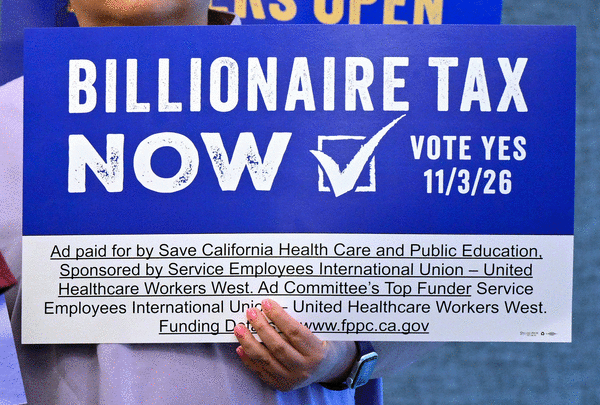
Steyer also supports the billionaire tax that’s expected to be on the November ballot. It would impose a one-time 5% tax on the net worth of California’s 200-plus billionaires.
To their credit, no other gubernatorial candidate supports this misguided proposal. Practically all the $100-billion windfall would flow solely into healthcare while causing fed-up super wealthy to flee the state.
Former Orange County Rep. Katie Porter would raise taxes on the most profitable corporations to pay for free child care and college tuition. They’re both good causes but of questionable fiscal feasibility right now.
Rather than pushing rich investors and job creators out of state, we should be encouraging them to stick it out in California and continue to pay their fair share.
©2026 Los Angeles Times. Visit at latimes.com. Distributed by Tribune Content Agency, LLC.



















































Comments