Allison Schrager: Not everyone will need a Trump IRA
Published in Op Eds
Years ago, I volunteered teaching financial literacy at a women’s homeless shelter. I may have a doctorate in economics, but I was pretty useless. Being poor in America requires making many complex financial decisions involving details of government benefits that I don’t know much about.
Still, I like to think I was of some use when it came to retirement saving, which is my specialty. I was surprised how many of the women had money in a retirement account from a former job. I gently suggested they make what is called a hardship withdrawal, get out of the shelter, and stop worrying so much about retirement. They were resistant. Saving for retirement is important, they told me.
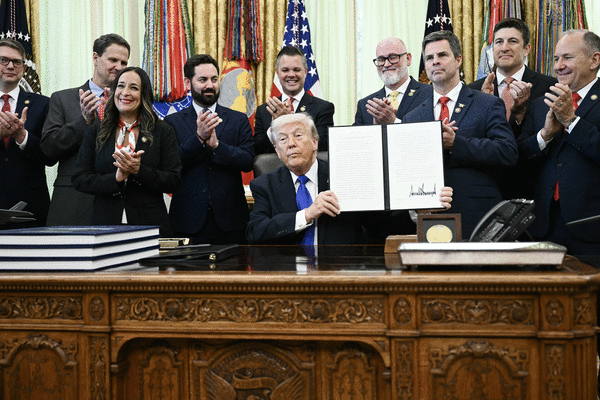
One of my controversial opinions about retirement is that not everyone needs to save for it. It is a heresy to say so — the conventional wisdom is that everyone should have access to a retirement account. Just last month President Donald Trump signed an executive order creating access to IRA accounts for lower earners (any individual earning less than $35,500, or couples less than $71,000). Less than half of Americans in the bottom 25th percentile of income have access to a retirement account, if they work in private industry — and just 23% participate in their workplace plan. The Trump IRA plan is very generous, with up to a $1,000 in matching funds each year for some participants.
In this era of wealth inequality, when market gains outpace income growth, almost any attempt to grow wealth and participation in the market among lower earners is worthwhile. The growth of retirement accounts is a big reason that both stock ownership and financial wealth are near all-time highs, even for middle-class Americans. Expanding access to higher-yielding assets among lower earners could transform their lives and help them share in a growing economy.
But retirement accounts may not be the best way to achieve these goals. Low earners who qualify for full Social Security can expect to get more than 80% of their final salary as an annual benefit, adjusted for inflation. They may also qualify for other income and health benefits. Older Americans have the lowest rates of poverty because the U.S. has a fairly robust safety net for the elderly. Low earners are hardly rich in retirement, but they are often no worse off than they were while working — sometimes better, even without much money in the bank.
But their working years can be financially precarious. In 2022, the median financial wealth of a single person earning less than $35,000 was $1,000 (about $2,000 for a married household earning $70,000). About 25% of those in these income groups have hardly any savings at all. Clearly that $1,000 would be transformative.
At the same time, lower-income people are also more financially vulnerable to disruptive events, such as divorce, unemployment or even car repair. They need liquid savings instead of retirement assets. Many of the state-sponsored retirement accounts are Roth IRAs, which means savers can take money out if they need it. A Roth may be a better structure than a traditional IRA for the Trump retirement plan — though offering a match on a liquid account complicates a program that is intended to build wealth.
Building retirement savings for low-income Americans is a hard problem, because they often need their wealth before they retire. Between the president’s actions to expand access to retirement accounts and his plan to create accounts for children, this administration is working hard to reduce wealth inequality — and more directly than any government benefit that discourages work.
____
This column reflects the personal views of the author and does not necessarily reflect the opinion of the editorial board or Bloomberg LP and its owners.
Allison Schrager is a Bloomberg Opinion columnist covering economics. A senior fellow at the Manhattan Institute, she is author of “An Economist Walks Into a Brothel: And Other Unexpected Places to Understand Risk.”
©2026 Bloomberg L.P. Visit bloomberg.com/opinion. Distributed by Tribune Content Agency, LLC.





















































Comments