LZ Granderson: Jason Collins came out so we all could keep moving forward
Published in Op Eds
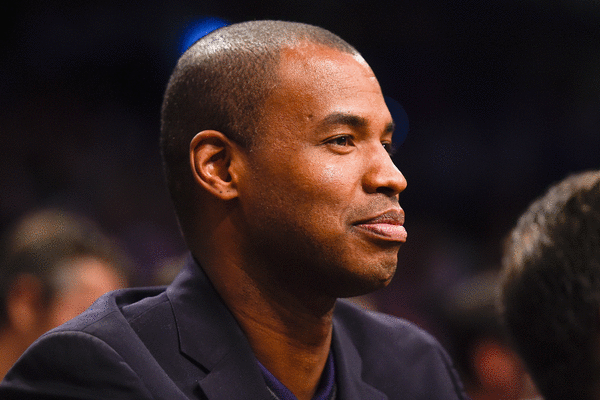
"I didn't set out to be the first openly gay athlete playing in a major American team sport. But since I am, I'm happy to start the conversation." —Jason Collins, April 2013
During a wide-ranging interview with "60 Minutes," Ben Sasse — the former Nebraska senator Ben Sasse who announced he had Stage 4 pancreatic cancer back in December — was asked if social media was to blame for the current state of American politics. His response stuck with me. After calling social media a "central piece" of our division, Sasse ultimately placed the blame at the feet of an older nemesis: segregation.
"I think one of the fundamental things that's wrong in America is young people don't know old people," he told anchor Scott Pelley. "One of the things 15- and 17-year-olds need is 60-year-olds and 80-year-olds in their life. And so pure segregation is I think a fundamental sociological problem in America. And social media is like dumping gas on that."
In addition to the separation of generations, Sasse pointed out how fissures stemming from class can also lead people to "bubble yourself into something that implies only your narrow demographic cohort or identity politics or market niche is where life is lived."
Which is why trailblazers like my friend Jason Collins, who in 2013 became the NBA's first openly gay player, are so vitally important to society. They burst people's bubbles — not by force or coercion but by having the audacity to exist as a whole person rather than as convenient curated fragments with smooth edges.
Collins, who died of brain cancer Tuesday at the age of 47, did not set out to make history. He was seeking community and understood he could not find it by hiding.
And when his playing days were over in 2014 — a career that included battling Shaquille O'Neal in the NBA Finals — Collins spent the next decade doing whatever he could to foster better understanding with the hopes that the next generation would not have to hide. He was willing to absorb the stares whenever he walked into a room, endure the whispers when he left, and navigate the uncomfortable conversations that inevitably unfolded in the seconds, minutes, hours in between.
When Collins came out in April 2013, Gallup found 45% of Americans believed same-sex marriage should not be legal. Today less than a third of the country feels that way. Research has found visibility, knowing someone who is gay, as the top reason for the change in culture. One can't help but credit Collins, who married his husband Brunson Green in Texas less than a year ago, with playing a role in that shift.
The word "segregation" is usually associated with race. It was May 1896 when the Supreme Court ruling in Plessy vs. Ferguson gave racism cover under the guise of "separate but equal." It was a May 2026 Supreme Court ruling that allowed Alabama to use a congressional map that is racially discriminatory. With decisions like that, segregation and race will forever be intertwined in America.
However, Sasse pointed out how other forms of segregation have also derailed our ability to fulfill our promise. The lack of diversity he cited may create bubbles that can feel safe, but they often rob us of the connections we need.
Regardless of wealth, race, age or any other characteristic that separates us, death has a way of reminding us we have far more in common. Each month this year, more than 175,000 Americans — a little under 6,000 new cases a day — are expected to hear some version of the news Collins and Sasse got: You have cancer. Tremendous progress has been made over the past century, and yet every day the disease claims 2,000 people. This according to the American Cancer Society, an organization that is nearly half as old as the country itself.
And cancer doesn't care who you voted for. You can't hide from it or the mortality that it represents. One can move to the suburbs, handpick the news that reaches you and ban every book except the dictionary … but there is no outrunning this one, simple truth: Life is fragile and we need each other. Just as 15-year-olds need 60-year-olds in their lives to help them better understand the world, members of majority groups need members of minority groups in their lives and vice versa.
That's something Collins understood about our collective humanity.
That's what Sasse was getting at when he talked about the root cause of the maddening division plaguing our country.
Technology has connected us, yet we hardly know each other. Collins said "send me," and that willingness became part of a larger moral shift in how Americans treat one another.
Often when confronted with questions of mortality, the question of legacy soon follows. Legacy, properly understood, isn't the name of a street or a statue of gold: It's the feeling people carry when you're gone. It's the ripples you created that will touch someone who will never know your name. Collins coming out forever made it easier for those who come after him many years from now — many of whom folklore will never connect back to him. He also provided those who didn't know anyone from the community with a clearer picture of the world we live in.
It was Collins' willingness to break down the walls, to bring people together, that defines his legacy.
____
©2026 Los Angeles Times. Visit at latimes.com. Distributed by Tribune Content Agency, LLC.



















































Comments