Commentary: Is AI coming for your job? A bigger government can help
Published in Op Eds
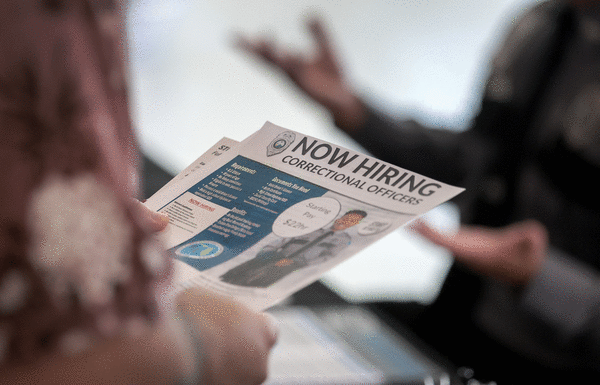
What happens if you lose your job and never find another one? That question is at the heart of the fear AI inspires: permanent job loss accompanied by a painful reduction in quality of life.
On one level, that fear is misplaced. Most unemployed workers get jobs quickly; half find a new position within three months. The flames of that fear are fanned by AI CEOs who talk of a “new idle class.” In fact, not all AI job loss will result in a permanently unemployable worker.
It is true, however, that the U.S. does not have a long-term unemployment program. The current unemployment system offers weekly benefits for six months (in some states it’s shorter, in recessions it’s longer). That’s it. To take the fear out of AI, America needs a long-term unemployment system that’s both effective and reassuring — that is, good and with a good reputation.
There’s no clear and obvious historical case the U.S. can learn from, which in some ways makes this exercise more straightforward. It can start by asking the question at the most basic level: When someone who wants to work can’t find a job, what should a government do?
Step one should be to make sure that the worker has looked. The long-term unemployment program must be preceded by a short-term one that requires workers to search for a job and offers counseling to help them. After that, it’s about aligning them with the best option given their circumstance.
So step two should be to have the worker meet with an employment counselor and pick the most viable path. That doesn’t always mean retraining workers for a new career, although sometimes it might. There are more creative options, such as:
•Moving assistance. Moving is expensive and risky, but different labor markets can offer very different opportunities. A long-term unemployment program could help relocate workers to markets with more jobs, or even markets where the worker has a stronger network.
•Business assistance. Entrepreneurial activity is on the rise in the U.S., in part in response to a weak labor market. But having enough cash to start a business can be tough, especially if a worker is at the end of long spell of unemployment that hurt their finances. A long-term unemployment program could offer small seed investment, mentoring and education.
•Training and education assistance. Workers can be amenable to big career switches — with the caveats that they cannot afford to be without a paycheck for very long and that training doesn’t create jobs. Training and education aligned to the needs of the labor market, and in coordination with other public support, can make this kind of assistance effective.
The degree of creativity will also depend on the public’s comfort level with capital-G Government. What if moving assistance included a federal home-buying program? That could be a way to ease any housing stickiness and stabilize prices in distressed areas. What if workers could opt into public employment, instead of accepting unemployment benefits? Reviving and expanding Americorps would be a start, and there’s lots of on-the-ground need for government labor, such as Census workers.
For what it’s worth, however, the biggest challenge of establishing a long-term unemployment program and executing on any of these policies has nothing to do with the labor market or government capability. The main obstacle is health insurance.
The U.S. has structured its health insurance in a way that is cruelly punitive for the unemployed. If workers insure themselves and their families through their employer, unemployment can become catastrophically expensive as they either get health insurance through COBRA (paying their former employer’s share of the cost in addition to their own) or by purchasing a private plan. If they want Medicaid, they need to be poor enough to qualify, which would require spending down all their savings (including retirement) — and of course, Medicaid now comes with a work requirement.
What health insurance should unemployed workers be on, and how do they get it?
The simplest solution would be to enroll workers in Medicaid as they apply for unemployment benefits. Nondisabled adults and children are by far the cheapest enrollees, as they don’t consume that much healthcare, and providing healthcare would go a long way toward providing the peace of mind workers afraid of permanent job loss are desperate for. Sure, there’s a risk that they’ll enjoy public coverage so much that they’ll have no incentive to get on a private plan. But that says more about how warped and expensive private health coverage is than it does about the motives of an unemployed worker.
The main argument against any of these forms of assistance — for moving, for starting a business, for training and education — is that they wouldn’t help out-of-work Americans get a job. But that’s hardly a reason not to try. If middle-class Americans are on the brink of financial ruin because they lost their job to a computer program, the least the government can do is err on the side of being creative and generous.
____
This column reflects the personal views of the author and does not necessarily reflect the opinion of the editorial board or Bloomberg LP and its owners.
Kathryn Anne Edwards is a labor economist, independent policy consultant and co-host of the Optimist Economy podcast.
©2026 Bloomberg L.P. Visit bloomberg.com/opinion. Distributed by Tribune Content Agency, LLC.



















































Comments