Marc Champion: Did Trump just say he's at war for PR reasons?
Published in Op Eds
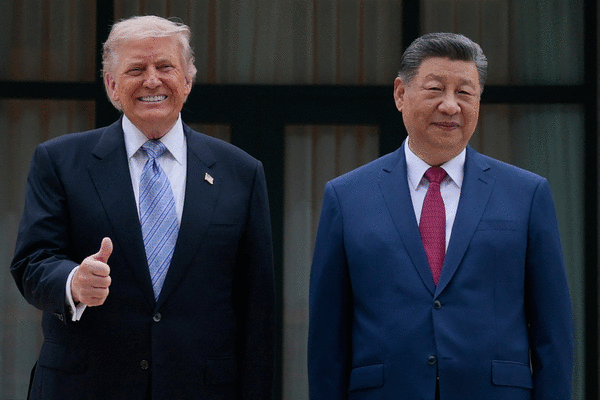
While in China, Donald Trump said the pile of 440 kilograms of 60% enriched uranium that was at the heart of his justification for going to war with Iran is, in fact, safely under 24/7 surveillance by nine cameras and no one is getting close to it. In fact, although he’d prefer to get the material out of the country altogether, he said that would be “more for public relations than it is for anything else.”
Wait, what?
I thought this near-weapons grade uranium was the basis for believing Iran was about to build a nuclear arsenal. I thought it posed an existential threat not just to Israel, but also the Middle East, Europe and — just as soon as Tehran acquires an intercontinental ballistic missile — the U.S. itself. I thought the reason the U.S. had to send its bombers back to Iran, after turning the underground storage site into a tomb last summer, was that its presence still made for too high a risk of nuclear breakout.
Trump last month told Americans and the wider world that he didn’t go to war to achieve regime change in Tehran. He has said that making sure Iran doesn’t acquire a nuclear weapon was “99%” of the problem.
The U.S. military, according to Trump, has by now obliterated all other Iranian threats, including its navy and ballistic missile capabilities. He’s called the closure of the Strait of Hormuz a minor issue because the U.S. doesn’t use it much (which is true, although though American consumers pay the same cost in rising gasoline prices as everyone else), and the waterway will open just as soon as a settlement is reached.
At the same time, Trump also has said on multiple occasions that if he doesn’t get the nuclear deal he wants, he’s ready to restart the war, putting thousands of lives and the global economy at risk. He has threatened to destroy Iran as a civilization if forced to end the ceasefire. Given that removal of the uranium is a key sticking point in negotiations, can it really be true that he would do all that for PR reasons?
Trump’s statements on Iran across the board offer about as clear a reflection of reality as a carnival hall of mirrors, so it’s wrong to take him too literally. All you need do is look at Israel’s approach to the war, or its impact on the Gulf States and economies in the Far East, to understand that Tehran’s nuclear program is not 99% of the problem.
To begin with, U.S. intelligence agencies reportedly believe that Iran still retains 70% of its pre-war missile stocks and can access 30 of 33 missile launch sites along the coast near the Strait of Hormuz. And none of these calculations account for the arsenal of drones that have done much of the damage to the Gulf States and the U.S. military bases they host. So Iran’s ability to do mischief in the region has not been eliminated and, failing regime change or a ground invasion, it probably can’t be.
Likewise, even if Hormuz reopens, Iran has now claimed the right to control which ships may pass when and at what price. That plan represents a major problem to resolve that did not exist before the U.S. and Israel attacked in February. And yet I think Trump spoke an important truth about his own motivations for going to war again, and the reasons for which he is finding it so hard to find an exit. PR is how a businessman and reality TV star turned president would naturally describe this; but in the literature of international relations and war, this not uncommon motivation is called “prestige.”
That’s typically about the prestige of nations, but Trump is not a typical leader and the prestige largely concerns himself. As I’ve written before, he’s wanted the U.S. to deal with Iran by force since the 1980s. He thought the Islamic Republic made U.S. leaders look weak. “They’ve been talkin’ for 47 years with other presidents, and we’re not doing much talkin’,” Trump told reporters at last month’s Andrews Air Force base press gaggle. It was just supposed to be a lot easier to win.
What does seem clear is that, unlike Israel and the United Arab Emirates, Trump now wants out of the war. The truth he spoke on Thursday was that while for those countries success means either true regime change or the irrecoverable destruction of the Islamic Republic’s ability to hurt them, for Trump the primary motivation has always been to become the president who finally showed Iran who’s boss.
Regime change would be welcome. The Islamic Republic has nothing but nihilism to contribute. It is hated by its people, whom it has failed and brutalized. It spreads only fanaticism and religious hate across the region, undermining states from Lebanon to Yemen. To let it have a nuclear arsenal would spark proliferation across a volatile region and provide the regime with impunity. All of this is a matter of cross-party consensus in the U.S., the West and among much of the international community. The question is not over the diagnosis, but the cure.
Israel’s Prime Minister Benjamin Netanyahu says sending a force into Iran to extract the 60% uranium stock would be easily done. The fact that it hasn’t yet been attempted strongly suggests that’s just not true. He also thought assassinating former Supreme Leader Ayatollah Ali Khamenei would quickly bring about regime collapse — and was wrong about that, too.
But at least Netanyahu has a consistent strategic purpose for attacking Iran, which has for years been using its proxies to harm Israel and routinely calls for its elimination as a state. For Trump, whether to resume this war does seem finally to rest on to a large extent on whether he can sell it as a win ahead of November’s mid-term elections. That kind of PR should never decide issues of war and peace.
____
This column reflects the personal views of the author and does not necessarily reflect the opinion of the editorial board or Bloomberg LP and its owners.
Marc Champion is a Bloomberg Opinion columnist covering Europe, Russia and the Middle East. He was previously Istanbul bureau chief for the Wall Street Journal.
©2026 Bloomberg L.P. Visit bloomberg.com/opinion. Distributed by Tribune Content Agency, LLC.





















































Comments