Commentary: Cutting summer flights at Chicago's O'Hare airport is a terrible idea
Published in Op Eds
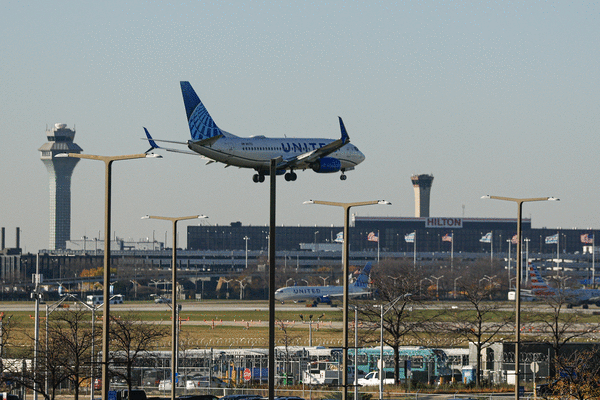
The Federal Aviation Administration announced recently that Chicago’s O’Hare International Airport would need to reduce its flight volume during the summer of 2026, with a cap of 2,708 daily operations between May 17 and Oct. 24. That’s down from 3,080 flights planned during peak days.
This requirement is intended to reduce possible flight delays during the busy summer travel period. A flight is classified as late if it arrives at least 15 minutes after its scheduled arrival time. Who will be most affected by this mandate, and will this solve the anticipated flight delay problem? Or is this just partisan politics levied against Chicago?
O’Hare is the busiest airport in the nation, as measured by the number of flight operations (that is, take offs and landings). In 2025, more than 857,000 such flight operations were handled by air traffic control, or around 2,350 per day. The airport has eight runways, with the ability to operate four of them simultaneously under ideal weather conditions. O’Hare is also a hub airport for two of the three largest airlines in the nation: American Airlines and United Airlines.
Given that these two airlines operate around 88% of the flights into and out of O’Hare, they will bear the brunt of the flight reductions. Conventional wisdom suggests that it is a better solution to cut flights that use smaller regional jets into and out of O’Hare, rather than cutting larger airplanes that hold 200 or more passengers. Yet conventional wisdom does not always produce the best results.
The issue is that more than half of the people flying out of O’Hare are connecting passengers. Simply cutting the flights carrying passengers on smaller airplanes will affect the number of people on larger airplane flights, too.
Nonetheless, cutbacks of smaller airplane flights are inevitable. These would affect smaller communities where United announced plans to begin service this summer, including Champaign and Bloomington in Illinois; Kalamazoo and Lansing, Michigan; and La Crosse, Wisconsin. It would also put headwinds on United’s plans to become the largest Midwest hub in its competition with American. The ongoing feud between the CEOs of American and United for O’Hare supremacy adds additional drama to the situation.
The bigger issue is whether a one-size-fits-all approach to reducing flight delays, by making across-the-board daily flight operation reductions, will work. The answer is, probably not.
The leading cause of flight delays is weather. During the summer months, thunderstorms that roll through the Chicago area affect all air travel, typically requiring a reduction in flight operations. This is often due to reduced visibility that limits the number of parallel runways that can safely operate. If lightning is present, a ground stop may halt all flight operations.
In June through August in Chicago, around two-thirds of the days on average are sunny or partly sunny. The remaining days are cloudy, some with precipitation. Chicago averages a total of 19 days with thunderstorms in June, July and August. Flight operations may need to be limited on some or all these days.
Yet O’Hare is by no means the most affected airport in the U.S. by thunderstorms. Houston and Denver average around 28 and 29 thunderstorms during this period, respectively — 50% more than Chicago. They are also hub airports for United. Atlanta, a Delta hub with the largest airport passenger volume, averages around 26 thunderstorms during this period. One hopes that politics does not play a role in reducing flights at O’Hare, while leaving Houston, Denver and Atlanta untouched, given the political leans of the states where they reside.
The good news is that the number of thunderstorm days each month for all these airports is relatively small. That is why making flight reductions that apply every day is unnecessary. On the few days each month when thunderstorms are present, delays are inevitable, even with the reduced number of scheduled flights. Why punish the airlines and their flyers every day when delays may only occur on just a few days each month?
If the likelihood of flight delays and cancellations affecting passengers is the measure used by the FAA to mandate flight reductions, then reductions at Atlanta Hartsfield would be more appropriate, given the volume of passengers that it serves.
To ensure that O’Hare and all large hub airports operate safely and efficiently, a well-staffed group of air traffic controllers and a modern air traffic controller system is needed. That is the responsibility of the FAA. Allowing the airlines to adjust their schedules as needed, not in anticipation of something that may never occur, is a far more effective and sensible strategy.
____
Sheldon H. Jacobson, Ph.D., is a professor of computer science at the University of Illinois Urbana-Champaign. He applies his expertise in data-driven risk-based decision-making to evaluate and inform public policy. This piece was originally published by The Hill.
____
©2026 Tribune Content Agency, LLC.





















































Comments