Commentary: Utah housing model is the wrong way to go
Published in Op Eds
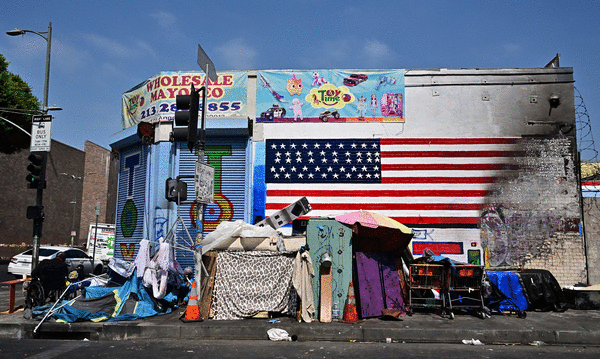
A controversial plan in Utah to build a remote “homeless campus” is being hailed in some quarters as a bold new approach to the nation’s soaring homeless population.
The plan, developed in the wake of President Donald Trump’s executive order on homelessness (tellingly titled “Ending Crime and Disorder on America’s Streets”), reflects a broader national shift toward centralized services, stricter enforcement of laws against living on the street, and expanded use of involuntary psychiatric and substance use treatment against unhoused individuals.
Supporters see Utah’s initiative as a “bold” alternative to the ballooning rate of street homelessness. Critics see a costly, coercive model that departs from the evidence on what actually reduces homelessness.
A new report sponsored by the Corporation for Supportive Housing raises serious doubts about whether the project can deliver on its promises.
The proposed facility, located seven miles outside of Salt Lake City, would combine multiple services on a single campus: a large emergency shelter, an “accountability center” providing involuntary substance use treatment, and a psychiatric unit with hundreds of beds. State officials have described the project as a way to reduce homelessness while improving public safety.
But the report finds that the project’s goal is unclear. Planning documents alternately describe the target population as people experiencing homelessness broadly and, more narrowly, as “high utilizers” of emergency and law enforcement services. There is little publicly available data to show how many people would meet that definition.
More fundamentally, the report challenges the assumption that centralized facilities are an effective solution. Drawing on evidence from comparable projects in other cities, the authors find no consistent relationship between large, centralized facilities and reductions in homelessness. Where declines have occurred, they appear to be driven by investments in permanent housing.
That finding aligns with a large body of research on homelessness interventions. In a review of 42 studies, the report concludes that involuntary or coercive treatment models do not outperform permanent housing programs, and may in some cases prolong episodes of homelessness. Long-term success, even in treatment-based models, depends heavily on access to stable housing after discharge.
This raises an obvious question: If existing approaches centered on housing and voluntary services are more effective, what problem is the Utah model solving?
One oft-cited answer is cost. Proponents point to analyses of similar facilities, such as San Antonio’s Haven for Hope, which claim substantial public savings through reduced use of emergency services. However, the report promoted by the Corporation for Supportive Housing casts doubt on those claims, identifying methodological flaws in a widely cited cost-benefit analysis.
The study also suggests Utah’s own projections may significantly underestimate the true cost of the project. State officials have estimated construction costs at roughly $75 million, with annual operating expenses around $34 million. Based on comparable facilities, the report estimates those figures could be closer to $165 million in construction and $53 million in annual operations, excluding about $90 million more in associated public services and on-site psychiatric care.
At that cost, the authors estimate equivalent resources could support 691 households in permanent supportive housing at just 30% of the ongoing cost.
Beyond effectiveness and cost, the report also raises concerns about feasibility.
Legal questions remain about the use of involuntary commitment at the proposed scale. Long-term funding for operations has not been secured. And local service providers may lack the capacity to deliver the level of intensive care the model requires.
The Utah proposal is not just a local experiment. It reflects a broader shift in federal and state thinking about homelessness: one that emphasizes visibility, control and short-term management over long-term housing stability.
Policies that prioritize containment over housing may reduce the visibility of homelessness without addressing its underlying causes. Decades of research show that permanent supportive housing, paired with voluntary services, is the most effective and cost-efficient way to reduce homelessness.
While policymakers are right to demand better outcomes, building larger, more restrictive systems is not the same as creating better ones.
____
Dr. Garrett Grainger is a housing policy researcher at Wrexham University in Wales whose writing on homelessness and social policy has appeared in The Hill, Shelterforce, Truthout, and NPR. This column was produced for Progressive Perspectives, a project of The Progressive magazine, and distributed by Tribune News Service.
___
©2026 Tribune Content Agency, LLC.





















































Comments