Commentary: The measles outbreak is evidence of a broken system
Published in Op Eds
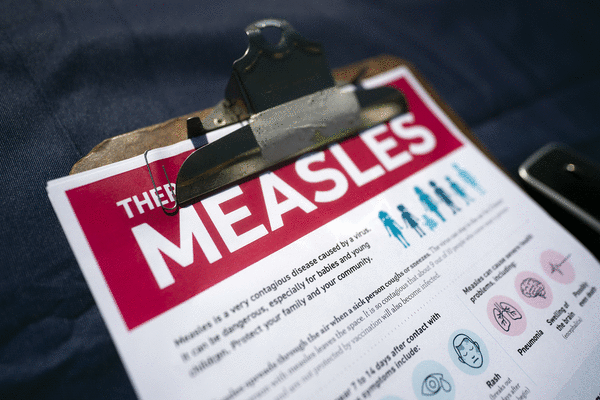
U.S. measles cases now number nearly 3,300, with no sign that the outbreak has abated. This is the highest number since 1991, when 9,643 cases were reported, a total that reflected a decline from previous years following the addition of a second dose of the measles vaccine to the childhood immunization schedule. The federal government’s announcement in 2000 on measles eradication was a major public health achievement, largely driven by vaccination campaigns and school vaccine requirements. Unfortunately, the current outbreak signals a possible end to this status.
Some may argue that measles is just another pediatric infection. Clinical outcomes suggest a much darker picture.
Measles is one of the most transmissible infectious diseases. On average, a single infected person can spread the virus to between 12 and 18 nonimmune people. Around 30% of people who contract measles develop complications, with nine percent of those infected in 2025 and 2026 requiring hospitalization. When a person becomes infected, they are also exposed to a host of health vulnerabilities and complications that may last far after their initial recovery.
There is also mortality risk: Around 1 to 3 out of every 1,000 infections lead to death. The recent public debate surrounding a death in Pennsylvania as to whether measles was indeed the cause of the death illustrates how politicized measles has become. This rings back to the COVID-19 death debate on whether a person died from COVID-19 or while infected with COVID-19. Given the many differences between measles and COVID-19, the “from” or “with” framework is not appropriate for an entirely avoidable measles death.
What is most disturbing about the current measles outbreak is that it was preventable. There exists highly effective and safe immunization available that prevents around 97% of infections. A measles vaccine has been available for over 60 years, with tens of millions of people receiving it. Without this vaccine, the number of measles infections would have been measured in the millions.
So why is the current measles outbreak a significant event? Given that measles is so transmissible, the presence of measles is symptomatic of an ailing public health immunization structure. Even though outbreaks are not currently reported for mumps, rubella, pertussis or tetanus, the environment is ripe. It is just a matter of time before more reports surface.
Trust in public health was shattered during the pandemic. Given that COVID-19 was a novel coronavirus, public health was faced with the daunting task of making real-time decisions with incomplete information, yet was expected to get it right the first time.
As we now know, with 20-20 hindsight, things could have been done differently.
Measles is not COVID-19, and placing mistrust in the measles vaccine is misguided. Yet vaccine skeptics have been around for many years. One of the most vociferous naysayers has been Robert F. Kennedy Jr., our current health and human services secretary. He chaired the Children’s Health Defense, considered an anti-vaccination organization that expressed concerns about childhood vaccine safety. That skepticism has become a fixture driving federal health policy, not just public debate.
Even Kennedy’s recent statement urging measles immunization for children has done little to fix federal policy, as evidenced by the president’s executive order on Aug. 10 recommending the measles, mumps and rubella vaccine be broken into separate injections. Unfortunately, this executive order would subject children to extra shots to gain the same immunization protection. If followed, such actions are more likely to lead to missed immunizations and more disease.
The current measles outbreak should be a call for action to renew immunization as a public good with personal benefits. And such actions must begin at the highest levels of government.
Public health means health for the public. The measles outbreak indicates public disease that is almost entirely avoidable. Where the Department of Health and Human Services has failed, states and professional societies have picked up the ball and run with it, all for the greater good. Yet federal guidance is critical for states to make informed decisions. One place that states can begin with is a closer examination of nonmedical vaccine exemptions for schoolchildren. Adopting more stringent standards to grant them would provide a concrete approach to reverse current trends.
What remains to be seen is whether efforts will be sufficient to turn the tide and keep our children and population safe. If we remain passive and accept this new status quo, preventable diseases will continue to spread, with everyone, particularly our children, paying the price.
Indeed, the outbreak is not the failure. It is evidence that the current system cannot prevent it.
____
Sheldon H. Jacobson, Ph.D., is a professor in computer science at the University of Illinois at Urbana-Champaign. Dr. Janet A. Jokela, MPH, is an infectious disease and public health physician and a clinical professor at the Carle Illinois College of Medicine at the University of Illinois Urbana-Champaign. She serves as the chair of the Illinois Immunization Advisory Committee.
___
©2026 Chicago Tribune. Visit at chicagotribune.com. Distributed by Tribune Content Agency, LLC.














































Comments