Commentary: How to stop data centers from grabbing too much power
Published in Op Eds
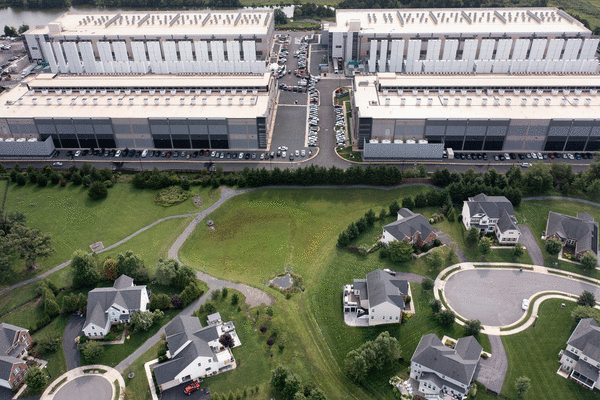
The rapid expansion of data centers has become one of the most tangible expressions of the artificial intelligence revolution. But debate about their environmental, economic and social impact threatens their future development. And rightly so. Although the digital economy is often seen as weightless, every cloud service and AI application depends on massive physical infrastructure that takes up land, consumes energy, uses water and requires ever-increasing investment.
International experience suggests that as the data center industry scales up, tensions emerge. In Ireland, data centers accounted for 21% of the country’s electricity consumption in 2023 and could reach 32% this year. In the US, their share of demand is expected to triple from 4% in 2023 to a projected 12% by 2028. No surprise, then, that this is a source of growing political and public concern. A Gallup poll found that 71% of Americans oppose data center construction in their local community.
Beyond concerns over energy and water consumption, evidence increasingly points to other unwelcome local effects. Researchers at Cambridge University have identified what they call a “data heat island effect,” whereby large facilities can raise temperatures in surrounding areas. And a recent study by researchers from Yale and the University of Chicago found that the development of a new data center is associated with an increase in nearby housing prices.
Given these realities, the question isn’t whether data centers are needed — they are — but how they are developed. What type of data centers do we need? And who will govern their expansion?
Economic experience teaches a simple lesson: that proactive regulation is more effective than reactive intervention. And it’s certainly much better than no intervention at all. Having clear rules from the start makes it possible to separate responsible projects from unsustainable ones, align private incentives with public interests and ensure that investment and growth go hand in hand with protecting critical resources and communities.
International experience is, again, instructive. Ireland tightened its rules only after data centers became a major source of pressure on the electricity grid. In the US, the state of New York has adopted a temporary moratorium, and a growing number of projects have faced delays or cancellation as local resistance intensified. The lesson could not be plainer: Failing to plan and regulate up front ends up being costlier and less effective.
Spain is still a long way from facing that kind of pressure. And yet, our healthy economy and renewable capacity has sparked huge investor interest in building data centers, meaning their energy needs are certain to outstrip expectations. Current estimates of electricity demand for computing power run as high as 4 gigawatts by 2030, but requests and permits granted for this type of facility exceed that target several times over.
While many of these projects are unlikely to materialize, the rapid upward trend is obvious. We are approaching a tipping point, and we must act to stay ahead. In August, my government launched a public consultation on a new regulatory framework designed to do exactly that. The proposal starts from a straightforward principle: Access to the electricity grid is a scarce strategic asset and should not be held up by projects that lack credibility, viability or a meaningful contribution to the economy and society.
Our proposal introduces energy- and water-efficiency standards. Data centers will have to disclose key performance indicators, letting us assess and compare their resource use and discourage waste.
Any increase in electricity demand must also be accompanied by additional renewable capacity. The framework includes requirements to make sure that a significant portion of data center consumption is supported by newly built clean-energy projects. The logic is economic and environmental.
Large new power consumers should not compete with existing demand or drive greater reliance on fossil fuels; they should help catalyze investment in the energy transition.
The regulation recognizes, too, that data centers are a strategic asset. In a world where Europe still relies heavily on non-European digital capabilities, the framework combines safeguards on how data is controlled — and how the infrastructure is managed — with incentives designed to expand Europe’s technology sector and strengthen the continent’s sovereignty.
Our objective must be to trade in bytes, not in watts. Spain wants to fully capture the opportunities created by data centers and AI. Yet the challenge is making sure the infrastructure expands in line with the capacity of the power system, that valuable energy resources are directed toward useful projects and that this all makes Europe less dependent technologically.
The goal is not to slow down growth or constrain innovation. Quite the opposite: It is to ensure that they remain economically sustainable, and environmentally and socially fair. Countries that understand this will be the ones best positioned to lead the next phase of the digital economy.
_____
This column reflects the personal views of the author and does not necessarily reflect the opinion of the editorial board or Bloomberg LP and its owners.
Pedro Sanchez is the prime minister of Spain.
©2026 Bloomberg L.P. Visit bloomberg.com/opinion. Distributed by Tribune Content Agency, LLC.


















































Comments