Commentary: Why Trump's renaming fixation is frightening
Published in Op Eds
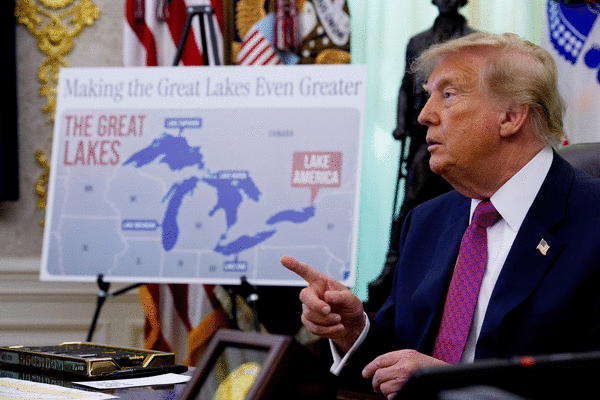
Heard the latest? President Donald Trump, after deciding that Lake Ontario will henceforth be known as Lake America, has floated the idea that New Mexico should be renamed New America. This continues a trend that began on Trump’s first day in office, when he issued an executive order renaming the Gulf of Mexico the Gulf of America. Can Trumptown be far behind?
It’s easy to dismiss the president’s obsession with renaming things as signs of his pettiness and insecurity and ultimately not as significant as, say, his starting a war that he cannot seem to get out of. But from my perspective as a scholar who specializes in war, memory and law, this behavior is deeply disturbing.
Trump, who is obsessed with his appearance, seeks to cultivate the image of a powerful man and a powerful country: Trump is America and America is Trump. His goal in these renamings is to glorify himself and project his vision of national identity,
Sadly, history is rife with examples of dictators and fascists renaming things to glorify themselves, with dangerous consequences.
In Soviet Russia, Volgograd was renamed Stalingrad. In Italy, a massive sports complex was inaugurated in 1932 and given the name Foro Mussolini. In Spain, after the civil war of 1939, several cities and public squares were named “the Leader,” after General Francisco Franco.
In Iraq, Baghdad International Airport was originally called Saddam International Airport after President Saddam Hussein. In Syria, several public squares were renamed after members of the Al-Assad family. In Iran, several public squares bear the name of Ruhollah Khomeini, the Shiite cleric who overthrew the Shah and led the Iranian revolution in 1979.
All of these renamings were designed to create a heroic image of the leader, an ideal version intended to foster unquestionable devotion to him. They also assisted these leaders in their quest to assert dictatorial power.
In Trump’s case, it does not matter who started the legal process of the renaming, whether it was the leader himself or his followers. The outcome remains the same: the legal cultivation of a god-like image of the leader, an image meant to be etched in public consciousness.
Trump and his allies are embracing renaming to promote the president — a wealthy, heterosexual, white, nondisabled man — as the protector of the United States’ national identity.
Thus, we saw that the United States Institute of Peace became the Donald J. Trump United States Institute of Peace last year. And similarly, as a result of state legislation signed by Gov. Ron DeSantis, Florida renamed the Palm Beach International Airport in Florida the President Donald J. Trump International Airport earlier this year.
In Washington, D.C., the board of the John F. Kennedy Memorial Center for the Performing Arts attempted to add Trump’s name to the facility. A judge ruled that it lacked the legal authority to approve such a change. The board then voted again to add an inscription: “The John F. Kennedy Memorial Center for the Performing Arts, Restored and Renovated by President Donald J. Trump.” The judge nixed this as well, prompting the board to shut the facility down for “renovations.”
Perhaps most egregiously, the U.S. Navy leadership is now discussing whether to rename a Navy aircraft carrier after Trump. Initially, the ship, which is still under construction, was set to be called the USS Doris Miller, after a World War II hero who staffed an anti-aircraft gun during the attack on Pearl Harbor.
This move is particularly alarming after the U.S Army removed web sections honoring Black and female veterans at the Arlington National Cemetery, and the Department of Defense website took down pages celebrating minority service members including Medal of Honor recipients. Both agencies acted under President Trump’s anti-DEI directives.
These legal changes do not simply amend the names of public places. They alter the historical record, glorify Trump and erase the people and facts that do not fit within his narrative.
This is an abuse of power that is not only offensive but dangerous. We the people should demand that our shared history not be reconfigured to serve the president’s politics.
____
Mireille Rebeiz is director of the Dickinson Program in New Zealand and associate professor of politics at the University of Otago. This column was produced for Progressive Perspectives, a project of The Progressive magazine, and distributed by Tribune News Service.
_____
©2026 Tribune Content Agency, LLC.

















































Comments