Commentary: Bring your cat indoors -- Before it's too late
Published in Op Eds
When police in Salem, Ohio, received a call for assistance for an injured cat, they couldn’t have been prepared for what they found. He had been shot with a crossbow, lost the use of his legs and, with the bolt still lodged in his body, lain in agony for days before a kind person discovered him. Despite the shocking nature of this crime, it was only one of many reported instances of cruelty to cats outdoors just this summer.
In Florida, a cat named Liam was shot by a man who claimed that the animal had been damaging his vehicles. Weeks later, Liam was found with a badly injured leg reeking with infection and full of bullet fragments. The leg had to be amputated. In Ohio, at least eight cats who were fed in a neighborhood were found dead or dying from suspected poisoning. And in Texas, a man admitted to shooting cats to keep them away from his property. These are just some of the cases that made headlines—most go unreported.
Every year, PETA receives thousands of reports about cats outdoors who have endured almost unimaginable suffering, often at the hands of people who consider them a “nuisance.” Many have been shot, poisoned, hit by cars or attacked by dogs or other animals—or they have contracted diseases such as feline leukemia, feline immunodeficiency virus, rabies or bird flu. Researchers at the University of California–Davis found that cats kept safely indoors can live an average of 15 to 17 years, while the life expectancy for “outdoor cats” is only two to five.
Cats have no more need to roam outside than dogs do, and they are no better equipped to survive on the streets. Yet the myth that they can somehow overcome the danger persists, fueled by trap-neuter-release propaganda and those who push deceitfully named “no-kill” shelter policies (which result in more animals suffering terribly and dying without being included in reported shelter statistics).
Under pressure to inflate “live release rates” and encouraged by marketing groups like Best Friends Animal Society, shelters are increasingly refusing to accept cats and even instructing people to leave these fragile animals—and their babies—on the streets. These domesticated animals commonly survive only a short time outdoors.
The good news is that bringing cats inside is easier than many guardians might think. In a recent New Zealand study, researchers spoke to families who had brought their cats indoors out of concern for local wildlife and their animals’ own safety. Nearly all reported that the transition was easier than expected. Most cats adapted within the first few weeks and some within days, especially when guardians took simple steps to ensure that life indoors would be interesting and fulfilling.
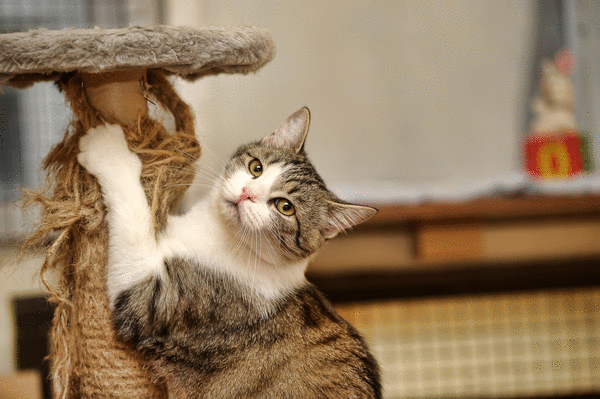
Cat trees, window perches, cardboard boxes, puzzle feeders, scratching posts with different textures and a rotating selection of toys allow cats to engage in natural behaviors such as climbing, perching, hiding, problem-solving, scratching, chasing and pouncing. Daily interactive play with wand toys or balls provides exercise and quality time with guardians. Study participants reported enjoying lower veterinary costs, greater peace of mind, improved ability to monitor their cats’ health and a closer bond with their feline companions.
Keeping cats indoors also protects the other animals who share our communities. Domestic cats are skillful, nonnative (invasive) predators. Research published in Nature Communications found that in the U.S. alone, free-roaming cats kill between 1.3 and 4 billion birds and from 6.3 to 22.3 billion mammals every year. A single roaming cat kills about 186 animals annually. The victims guardians find on the doorstep represent only a fraction of the toll. They have contributed to the extinction of at least 63 wildlife species globally and are a key factor in the dangerous declines of many others.
The kindest choice is also the clearest one: Bring cats indoors, keep them there and give them the safe, enriched lives they deserve—while sparing wildlife from preventable suffering, too.
_____
Teresa Chagrin is the animal care and control issues manager for PETA, 501 Front St., Norfolk, VA 23510; www.PETA.org.
_____
©2026 Tribune Content Agency, LLC.


















































Comments