Commentary: The Trump family's corruption costs America
Published in Op Eds
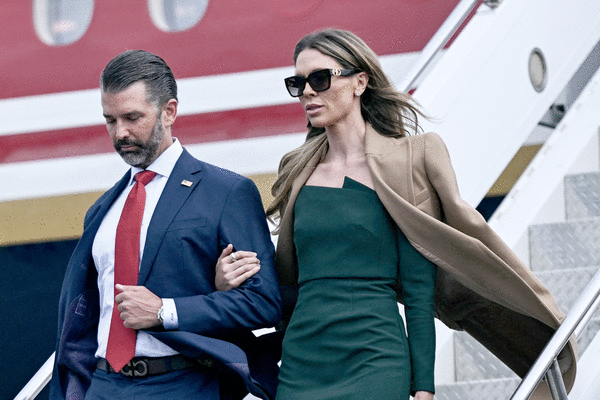
Donald Trump Jr.’s lavish Bahamas wedding was already a bad look, coming amid America’s brutal affordability crisis and when gaping inequality is on the rise. But the news that it was largely funded by Russian oligarch Umar Kremlev shifted this story from distasteful to dangerous. It is more concerning still that this is no isolated incident but part of a well-established pattern of a corrupt regime.
Kremlev reportedly rented the ultra-private islands for the weekend of festivities and paid for the fireworks show, costs that reached hundreds of thousands of dollars. Guests only numbered about 50, and this close associate of Russian President Vladimir Putin who speaks limited English made the cut.
Try taking yourself out of our current political moment, when nothing seems surprising anymore, and consider what you would think if you heard that this had happened with the son of any other U.S. president. The scandal would be the center of congressional inquiries and investigations. It would dominate the news cycle for weeks. Look no further than the Hunter Biden scandal, which launched numerous investigations over his attempt to profit off the name of his father, Joe Biden, who was president at the time. Objectionable as the son’s actions may have been, the investigations found no wrongdoing by government officials or influence on U.S. policy, and yet it remains a go-to grievance on the right.
The same people who were indignant over Hunter Biden have turned a blind eye to the conflicts of interest rife in this administration. The Trump family and its hangers-on have been so blatant and prolific in their corruption that each individual incident barely registers anymore. They have earned billions exploiting government power, knowledge, resources and connections.
We must not normalize it or become numb to its impact, because this is not a victimless crime. Every time a political choice is made in the self-interest of political leaders and their associates, it comes at the cost of the national interest, and that costs us. This is true in foreign policy and domestic issues alike, but let’s consider this example with foreign interests at play.
When a Russian oligarch close to Putin offers a significant gift to a close family member of the U.S. president, it is not out of generosity. Kremlev was either seeking something in return for his own business or, more likely in this case, some payoff for his benefactor Putin. Russian oligarchs hold their positions of power at the pleasure of Putin, after all, and they keep them by being both loyal and useful to him. So, the question then becomes: How does this gift serve Putin’s interests? What might be offered in exchange?
We have no evidence of a specific quid pro quo at this time, so it may be just one piece of the larger influence puzzle to help shape an overall U.S. foreign policy that works in Russia’s favor. Trump Jr. has demonstrated plenty of influence on his father’s decisions. Even Vice President JD Vance credits his close friend for landing him on the ticket. The Russian government has used him as a conduit before too, so he is a natural target. Putin probably considers a few hundred thousand dollars a bargain to keep Trump Jr. on side.
Putin’s effort to influence other key Trump associates includes the promise of generous business deals in return for a favorable peace agreement with Ukraine. While these would enrich the businesses involved, it would be a poor trade-off for American national security to reward the Russian state for its illegal and violent aggression. Pushing a pro-Russia position not only undermines sovereignty and democracy in Ukraine but also harms America’s relationships with other critical European allies, for whom Russia’s aggression is a paramount threat. It is even more shocking considering that Russia continues to help Iran with targeting information and intelligence specifically to help it attack U.S. forces in the Middle East. This is no friend of the United States.
But those leading and influencing U.S. foreign policy appear to be looking out for their own interests rather than American ones. The administration has largely entrusted diplomacy with Russia to Trump’s son-in-law, Jared Kushner, who is mixing diplomatic discussions with private business negotiations and doesn’t even hold an official position in the U.S. government.
Whatever investments Putin has made certainly seem to be paying off, though. Since the start of Trump’s second term, U.S. policy has been suspiciously aligned with Russian interests. Most recently, Kushner’s remarks after talks with Putin and Ukrainian President Volodymyr Zelenskyy made clear he was championing Russia’s position explicitly, blaming the stalled negotiations on Ukraine’s unwillingness to surrender.
“President Putin laid out his line of what he wants to achieve,” Kushner said, and a deal would happen “if Ukraine wanted to withdraw to that line.”
This isn’t even the first time that Kushner has presented Russia’s demands as his proposal for peace. The 28-point peace plan that Kushner and special envoy (and Trump family friend) Steve Witkoff presented last fall was very similar to a Russian document reflecting Putin’s wish list for how the war would end.
What could be driving this approach that is so awkwardly and obviously pro-Russian while offering so little for U.S. interests? It could be the case that U.S. foreign policy is for sale on several fronts, and at a bargain price.
____
Elizabeth Shackelford is a foreign affairs columnist for the Chicago Tribune and a distinguished lecturer with the Dickey Center at Dartmouth College. She was previously a U.S. diplomat and is the author of “The Dissent Channel: American Diplomacy in a Dishonest Age.”
___
©2026 Chicago Tribune. Visit at chicagotribune.com. Distributed by Tribune Content Agency, LLC.













































Comments