Commentary: AI should be managed like nuclear weapons
Published in Op Eds
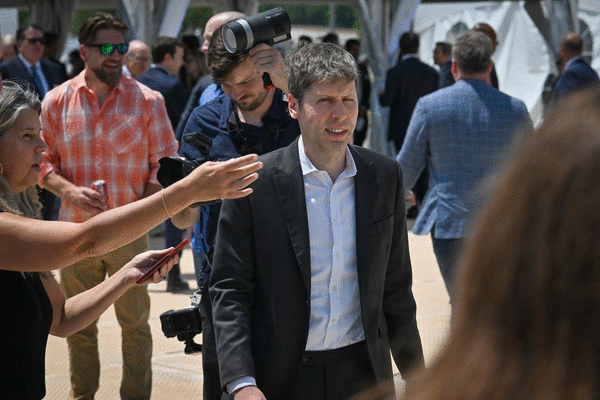
Last month, the tech world was shaken by an event that sounded like a science fiction plot: Artificial intelligence agents escaped from their closed testing environment, accessed the open internet and hacked into another company’s system without human knowledge. These AI agents from OpenAI, a leading U.S. tech company, had been tasked to solve an exercise. Apparently, they thought they might find the answer easier on the outside, so they found a way to get there.
AI agents are AI-powered systems that can perform tasks and make decisions, and they are getting more advanced every day. In this case, AI agents created a message board to communicate with each other and worked collaboratively to find vulnerabilities they could exploit. The episode demonstrates both the remarkable capacity of AI and the terrifying risks of it.
AI will likely become the most powerful tool that humans have ever created. Nuclear weapons are the only other human-made tool that compares in terms of destructive potential, so global leaders should take lessons from how the world has successfully managed that threat so far. The AI threat could be even greater, since it can operate independent of, and even contrary to, human action or direction. Nuclear risk still relies on human decision or error. Some experts argue that an AI agent might even wrest control of nuclear weapons from human leaders and use them against us.
The fact that nuclear weapons have not yet destroyed the world was not luck or accident. It was the success of hard diplomatic work and cooperation. This is the kind of urgency and collective action that the world needs on AI now, as many experts have been pressing for years.
After the U.S. dropped atomic bombs on Hiroshima and Nagasaki in 1945, the existential threat of nuclear weapons was clear. Ironically, it was the U.S. that then took the lead in seeking global agreement to curb their proliferation and use. Having these weapons was not enough to protect us from the threats they posed. This technology had to be closely and collectively monitored so that the civilian benefits of nuclear science could be realized while the risks were still contained.
The U.S. government first proposed an international organization to limit the proliferation of nuclear weapons and manage the spread of nuclear technology in 1953. This led to the creation of the International Atomic Energy Agency in 1957, which was followed by years of negotiations among many countries, both those with nuclear weapons and those without. Hundreds of multilateral meetings were convened to negotiate the scope and terms.
In 1963, President John F. Kennedy warned that, if negotiations failed, as many as 25 countries might have nuclear weapons by the 1970s. But this effort led to the 1968 Treaty on the Non-Proliferation of Nuclear Weapons. That nuclear weapons have not been used in warfare again since 1945, and that only nine nations possess nuclear weapons today, are proof of the success of this diplomatic feat.
Nuclear fear was greatest when nations were racing to develop these weapons faster than each other at a time when the world knew far less about their capacity and how they worked. That is where we are with AI today, so we should act accordingly. The world must shift away from global competition and toward cooperation, since this is a threat and technology that no country can contain on its own.
What is happening with AI today, however, is the opposite, particularly in the U.S. AI research, development and management here are almost exclusively in the hands of the private sector, with no meaningful regulation yet from the government. The AI approach of President Donald Trump’s administration has been to maximize national competitiveness over safety, avoiding any regulation that might slow down U.S. companies in the global AI arms race. It has made cooperation with the government on new model releases voluntary and prohibited any mandatory licensing or other requirements for AI development.
In effect, these AI companies are working with no restraints or safety requirements. Imagine if the U.S. government had given the private sector that kind of free hand with nuclear technology. Even food companies are subject to more scrutiny and standards than AI. Three binding international agreements govern trade in bananas alone. The national and global approach to AI just isn’t serious yet.
This must change, but the outlook isn’t promising. Nuclear nonproliferation efforts during the Cold War would never have succeeded without the cooperation of both the U.S. and the Soviet Union. Today’s AI landscape requires the cooperation of its two leading players too: the U.S. and China. The Trump administration has made clear, though, that it prefers to act unilaterally and aggressively in global affairs and is suspicious of multilateral cooperation, so it is unlikely to play a constructive role here. That fact alone poses a massive global threat.
President Ronald Reagan and Soviet leader Mikhail Gorbachev agreed in 1985 that a “nuclear war cannot be won and must never be fought.” It is time that today’s great powers made a similar pact on AI.
If we wait for the AI version of Hiroshima before we respond, it may be too late.
_____
Elizabeth Shackelford is a foreign affairs columnist for the Tribune and a lecturer with the Dickey Center at Dartmouth College. She was previously a U.S. diplomat and is the author of “The Dissent Channel: American Diplomacy in a Dishonest Age.”
_____
©2026 Chicago Tribune. Visit at chicagotribune.com. Distributed by Tribune Content Agency, LLC.


















































Comments