Commentary: Keeping mentally ill Angelenos in jail doesn't help anyone
Published in Op Eds
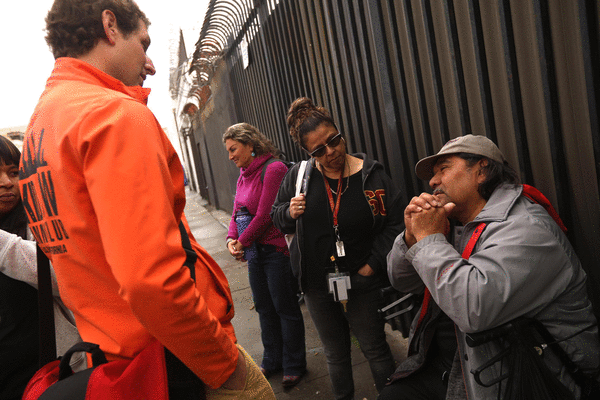
A man slammed me onto the concrete on East 7th in Skid Row — fast, hard and without warning.
One moment, I was walking. The next, I was on the ground, my head hitting the pavement inches from a tree trunk. He stood over me, screaming words I could not understand, with his arms swinging wildly. I covered my head and braced for blows that never came.
Within seconds, he was gone, disappearing into the chaos of downtown Los Angeles. As I gathered myself, a man offered to bring over a police officer who was down the street. Did I want to file a police report?
The man who tackled me didn’t need jail. He needed psychiatric treatment. I wished I knew how to find him and get him into care before someone else got hurt.
I understand that may not be everyone’s response to an assault that could have sent me to the hospital, or worse, but I am a physician, and I lead the Office of Diversion and Reentry at the Los Angeles County Department of Health Services. I work at the intersection of healthcare, homelessness and the criminal justice system. I see what happens when people like the man who tackled me are arrested, temporarily jailed and released, and then arrested again — a tragic cycle that is often the reality for those suffering from serious mental illness.
I have also seen what happens when, instead of jail, they are offered supervised mental health treatment through mental health diversion.
When we fail to treat people, we pay for jails, emergency room visits and hospital stays, shelters, law enforcement and court days at costs exceeding $115,000 per person each year. Diversion changes that trajectory by safely treating people suffering from serious mental illness in the community instead of in jail.
Many people stabilize with housing and treatment. They stop cycling through jails, streets, emergency rooms, courtrooms and hospitals, and are much less likely to commit new crimes. Stopping the jail cycle through diversion and treatment makes our communities safer.
Instead, bills like the recently signed AB 46, which limits mental health diversion, and the proposed SB 1373, which would further curb the practice and keep more people in jails, ignore evidence and introduce costly administrative delays that keep more people with treatable mental illness in already overcrowded jails at high cost to taxpayers.
By restricting judges’ ability to divert people with serious mental illness into treatment, SB 1373 would push more people through the revolving door to jails that have failed our communities for decades — because they are not intended to address mental illness. Jails do not treat schizophrenia or stabilize bipolar disorder. They do not rebuild trust, restart medication in a sustainable way or bring someone back from the edge of psychosis.
Untreated mental illness becomes more dangerous when we lock it in a cell. It is tempting to think incarceration improves safety, but few people are locked away forever. Experience with mental illness teaches us to ask harder, more practical questions: What will prevent the next crisis? What will reduce future harm? What will help this person and protect the community at the same time?
One in four people enter our jails with serious and urgent mental health needs, such as untreated schizophrenia or bipolar disorder, delusions, hallucinations, suicidal thoughts or even a complete disconnection from reality.
Los Angeles County has years of data showing what actually works. Through diversion efforts in the Office of Diversion and Reentry, the county has linked more than 15,500 people with serious mental illness to treatment over the last decade. People who committed serious crimes stabilize with treatment and housing.
The outcomes are clear. More than half (56%) were never rebooked within two years of entering diversion, despite averaging nearly 10 prior jail stays before diversion. Participants spent 380,000 fewer days in jail within two years after entering diversion compared with the two years before. Diversion also reduced emergency department visits and inpatient psychiatric stays, lowering county costs and easing pressure on overwhelmed systems.
These findings show that community-based treatment, through diversion, makes communities safer and healthier.
While jail sentences are often short-lived, diversion offers long-term care, court‑ordered accountability and mandated treatment. Participants must appear before judges, follow clinical recommendations, take medication, participate in substance use treatment and comply with supervision. If they fail to comply, they risk returning to jail
Treatment requires clinicians and case managers to build trust and a sense of belonging through persistence and love with people who have been continually marginalized and failed by systems. It is the only thing shown to interrupt the cycle that drives repeated incarceration and homelessness for people suffering from serious mental illness.
California has spent decades swinging the pendulum between treating mental illness as a public health crisis and treating it as a crime. Each swing toward criminalization leaves more people sick and cycling between homelessness and jail, more families desperate, more tax dollars spent and more communities unsafe.
If SB 1373 passes, more people with serious mental illness will remain in jail longer, unable to access effective treatment. They will be released in worse condition and return to the streets, emergency rooms and jails at great cost to taxpayers and at greater risk to public safety.
If lawmakers are not satisfied with the outcomes of diversion, they should demand more data transparency, expanded clinical capacity and housing, and stronger program standards. They should not reduce a judge’s ability to choose treatment.
Sometimes the “safest” sentence is not jail. It is the one that finally gets someone well.
I still think about the man who tackled me. I do not know his name or where he went, but I do know that if he cycles through jail without treatment, nothing will change for him, and I fear for anyone he may encounter next.
Jail is not treatment. California should preserve diversion, one of our most effective tools for reducing homelessness and crime. It’s one thing that can actually change what happens next.
____
Clemens Hong, a physician, is the director of the Office of Diversion and Reentry at the Los Angeles County Department of Health Services.
©2026 Los Angeles Times. Visit at latimes.com. Distributed by Tribune Content Agency, LLC.





















































Comments