Editorial: As wildfires get worse, California needs to face reality
Published in Op Eds
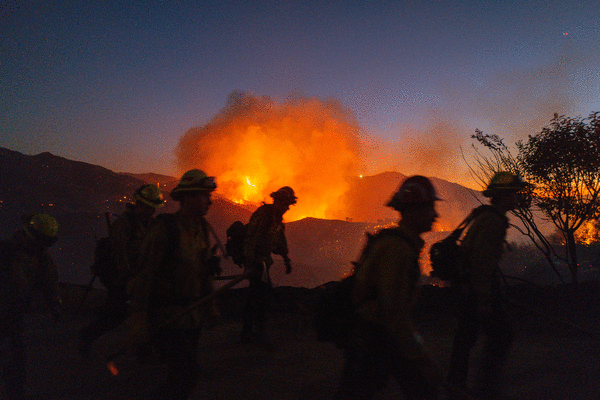
After enduring 14 of the most destructive wildfires in its history over the past decade, California has started waking up to a related crisis: its dysfunctional and inadequate insurance system. Before the next catastrophe, reform is urgently needed.
For nearly four decades, state-imposed constraints on premiums gave property owners a false sense of security, contributing to rampant development in wildfire zones. That illusion was shattered when cataclysmic fires wiped out insurers’ income in 2017 and 2018. Seven of the state’s 12 largest underwriters stopped or reduced new business.
The result was a rush for coverage from the state’s insurer of last resort, the FAIR Plan, which was created in 1968 as a temporary safety net but has more than tripled its exposure and doubled its policies since 2022, only to sustain enormous losses in last year’s fires. Increasingly, that huge pool of concentrated risk includes coverage of the state’s wealthiest homeowners and communities.
This mess could’ve been avoided if state officials had focused more on wildfire mitigation and prevention than on suppressing the cost of insurance. Now they have a much harder problem to contend with, and further subsidies are unlikely to help. Three steps should be under consideration.
First, reform the FAIR Plan. Policymakers should ensure that the plan charges higher premiums than the so-called voluntary market and pays insurance agents lower commissions — or none at all.
They should consider reducing the $3 million residential coverage limit and restricting eligibility to the neediest homeowners — for instance, by excluding second homes (whose owners could resort to the often pricier “non-admitted” market). A state clearinghouse that allows private insurers to compete for FAIR Plan customers should also offer better incentives for brokers and mandatory transfers when standard premium offers are within 20% of the state plan (an approach that has succeeded in Florida).
Meanwhile, state officials should continue to loosen constraints on the private market. True, average monthly home insurance premiums have already jumped by 45% in real terms since 2020, but they were still insufficient to cover last year’s losses. By one estimate, the state still has a coverage shortfall of as much as $2 trillion, with a disproportionate amount of the gap in low-income communities at high risk of wildfires.
Finally, the state’s historically slow process for approving insurers’ requests to raise premiums should be accelerated or even eliminated. In the short term, that will surely be painful. But California’s home insurance costs have been low compared with other states, and higher premiums will have many benefits: Competition should return to the market, homeowners and communities will be encouraged to invest in preventing and limiting fires, and the state’s famous innovators should have an incentive to pioneer technological solutions, including better construction materials and techniques.
Such reforms aside, California also needs to refocus on the basics to limit wildfire risks. That should include reducing underbrush, hardening infrastructure and managing controlled burns, especially in the communities least able to pay for it themselves. Some areas may become uninsurable — an important signal that should drive developers closer to urban centers, where zoning and other rules should accommodate them.
California isn’t alone in facing growing wildfire danger and rising insurance costs. But by correcting failures of its own making, the nation’s largest insurance market could well become an exemplar for others to follow.
____
The Editorial Board publishes the views of the editors across a range of national and global affairs.
©2026 Bloomberg L.P. Visit bloomberg.com/opinion. Distributed by Tribune Content Agency, LLC.




















































Comments