Commentary: Children are uniquely vulnerable to extreme heat
Published in Op Eds
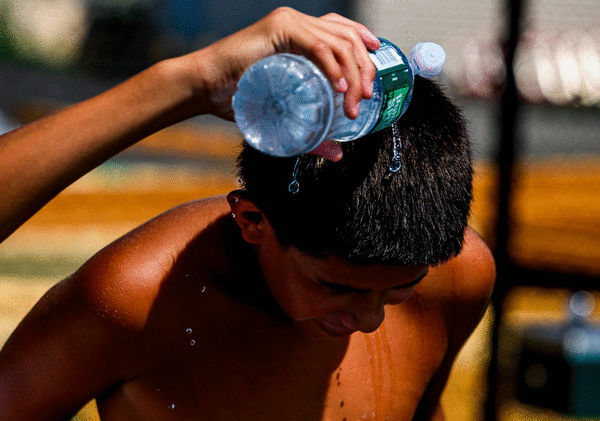
As summer vacation ends and children return to school, record-breaking heat continues across much of the country. Fortunately, many states and athletic governing bodies have adopted measures to protect their student athletes from extreme heat.
But when those athletes step off the field and into the classroom, the protections disappear. Few states have comprehensive heat safety standards to protect children from heat exposure during the school day.
Extreme heat does not distinguish between a football player, a third-grade student at recess or a sophomore sitting in a hot classroom. Why should we?
As a pediatrician, I know that children are uniquely vulnerable to heat. I’ve seen firsthand the physical and mental health consequences when heat illness is not recognized early. As the earth’s average temperature continues to rise, children’s risk of heat-related harm continues to increase with it.
Children’s bodies heat faster than those of adults, and are less efficient at sweating and cooling. Young kids are also less able to recognize high temperatures and have less awareness of thirst than adults. As a result, they must rely on adults for heat protection.
If left unrecognized or unaddressed, extreme heat exposure can lead to dehydration, heat cramps, heat exhaustion and eventually heat stroke, which is a life-threatening medical emergency. It can also affect the heart, cause liver and kidney injury, and contribute to changes in mood, including irritability, aggression and even suicidality. Children with chronic health conditions such as diabetes, obesity, sickle cell disease and asthma, are even more susceptible to heat-related illnesses.
Recognizing these risks is the first step. The next step is determining how schools can realistically put protections in place.
Children spend a significant portion of their day at school, including the hottest parts of the day. Between recess, physical education, field trips and walking to and from school or waiting for a school bus, their outdoor heat exposure can be extensive. Nor does the danger from that exposure necessarily end when students enter their classrooms. In older schools with aging infrastructure or inadequate air conditioning systems, classroom temperatures can become extremely uncomfortable.
Schools need to protect students from indoor and outdoor heat while providing an environment conducive to learning and good health.
The educational impacts of extreme heat on children are significant. When the brain overheats, it becomes less efficient, making it harder for children to concentrate, learn, retain and recall information.
A 2019 study found that the optimal temperature for learning is approximately 72 degrees Fahrenheit, and that lowering classroom temperatures from 86 to 68 degrees improved students’ performance on school tasks and psychological testing by an average of 20%.
Meanwhile, school-day temperatures above 100 degrees Fahrenheit are associated with learning losses of up to 50%. And hot temperatures on high-stakes testing days have been tied to lower test scores and a decreased likelihood of graduating on time.
There are legitimate challenges to expanding heat protections to all students. School budgets are already stretched. Older buildings with aging infrastructure may face greater financial challenges than newer ones. Still, the solution should not be to eliminate outdoor play or physical education. These are essential for children’s physical, mental and social development. The question is not whether children should be active, but how to ensure they can do so safely.
While reducing greenhouse gas emissions is essential to addressing climate change, schools cannot wait for these long-term solutions. Many practical steps can be taken now, beginning with developing comprehensive heat action plans that protect all students.
Plans might include monitoring classroom temperatures, establishing contingency plans for air-conditioning failures, increasing access to shade, cooling and hydration and training school personnel to recognize and respond to heat illness.
Extreme heat doesn’t care if a child is scoring a touchdown, climbing the jungle gym or tackling honors algebra. If we acknowledge that extreme heat can endanger athletes, then we must recognize that it places other children at risk as well.
It is time to extend the same thoughtful heat protections afforded to athletes to all students. Every child deserves to learn, play and live safely — on and off the field.
____
Dr. Michelle Kirwan Bythwood is a board-certified pediatrician, member of the Florida Clinicians for Climate Action, and a 2026 Climate and Health Equity Fellow with the Medical Society Consortium on Climate and Health. This column was produced for Progressive Perspectives, a project of The Progressive magazine, and distributed by Tribune News Service.
____
©2026 Tribune Content Agency, LLC.





















































Comments