Editorial: As Trump rose, Harley-Davidson fell. Now this Midwest icon needs to get back in gear
Published in Op Eds
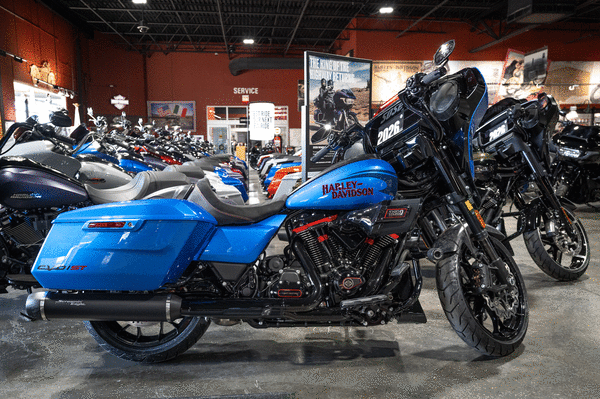
The rise of Donald Trump could have been a plus for Harley-Davidson, given that many of its longtime customers are proud fans of the Republican president. When the GOP held its National Convention in Harley’s hometown of Milwaukee two summers ago, Republican delegates streamed in by the busload to the local Harley-Davidson Museum.
Yet Trump’s rise to power has produced no windfall for the company. Trump’s trade wars continue to drag down Harley’s financial results. Conservative activists alleging so-called “woke” policies recently renewed attacks on its executives. Even the company’s decision earlier this year to bring overseas jobs back to its U.S. factories received a surprisingly perfunctory acknowledgment from the White House.
Since Trump’s first term began in 2017, the company’s market value has cratered from about $10 billion to less than $3 billion today, extending a two-decade-long slide. Its public financial filings show that Harley sold about half as many motorcycles worldwide last year as it did in 2016, the year before Trump launched his crusade against free trade from the White House.
Trade wars aren’t the only problem: Harley’s core customers are aging, and its premium-priced machines aren’t attracting enough younger customers. Once among the Midwest’s most valuable home-grown brands, Harley is at risk of fading away forever. That would be a big loss for a U.S. manufacturing sector feeling the heat not only from tariffs but also from tough competitors overseas.
Just as U.S. automakers are losing ground in foreign markets to Chinese-made electric vehicles, Harley faces fierce competition from Japanese brands such as Honda, Yamaha and Kawasaki, whose lower-priced, feature-packed motorcycles have proved attractive to younger riders.
Harley’s main domestic customer base of older, predominantly male riders is a blessing, as they’re devoted to the brand, but also a curse as they’ve resisted change. And, as is the case at most American companies in these divisive times, Harley’s customers are not all on one side of the aisle, forcing it to tiptoe through today’s political minefield.
There’s reason for optimism. The stock price has staged a notable rebound this year, and the company has a dynamic new chief executive officer who is making smart moves.
As CEO Artie Starrs told investors last month, 2026 will be a “transition year” as he carries out a strategic plan aimed at restoring Harley to its former glory. The launch of new Deadwood and Super Glide motorcycle models “has our whole community super-excited and galvanized,” he gushed.
Starrs doesn’t fit the outlaw stereotype that made Harley’s big, loud motorcycles — nicknamed “Hogs” — a badge of authenticity for generations. He joined the company last fall from Topgolf International and, before that, Pizza Hut, and sounds more like a bean counter than a Son of Anarchy.
His bottom-line focus is helping him relate to Harley dealerships that have struggled with low profits and bloated inventories.
Harley is still best known for high-priced, gas-powered touring and cruising motorcycles. Companies like Honda, Yamaha and Kawasaki dominate the entry-level market, and Harley’s costly stab at electric vehicles under the LiveWire brand has failed miserably. Hard-core Harley riders show little interest in motorcycles that don’t make noise, and other companies make better, cheaper electric alternatives.
Starrs is on the case: The company is planning a slew of new models in coming years, including at lower price points. He also expanded a customization program that die-hard fans of the brand appreciate.
He even scored points with Trump, who attacked the company in 2018 when it moved production overseas after Europe imposed ruinous retaliatory tariffs. Harley was “surrendering” and waving a “white flag,” Trump griped, while promoting a consumer boycott against it.
In June, Harley announced the return of some production to plants in Wisconsin and Pennsylvania, conspicuously crediting Trump, who has chalked up few such victories from his trade wars. The White House applauded the move as an “American manufacturing win” — but celebrated with less vigor than it put into denouncing the company’s 2018 “surrender.”
In fact, Trump’s trade chaos continues to hurt Harley, which reported an operating loss from its core motorcycle division for 2025. Tariffs were mentioned repeatedly on last month’s conference call with investors. Harley expects to book up to $90 million in new or increased tariff costs this year – a punishing tax on a struggling company — and it is chasing tens of millions in refunds from previous Trump tariffs overturned by the U.S. Supreme Court.
So, don’t expect Harley to launch a MAGAcycle anytime soon. Let’s hope this Midwest stalwart can power through the trade barriers without hitting any more Trumpian speed bumps on its path to the open road.
_____
©2026 Chicago Tribune. Visit at chicagotribune.com. Distributed by Tribune Content Agency, LLC.


















































Comments