Commentary: Staged send-offs leave a trail of harm
Published in Op Eds
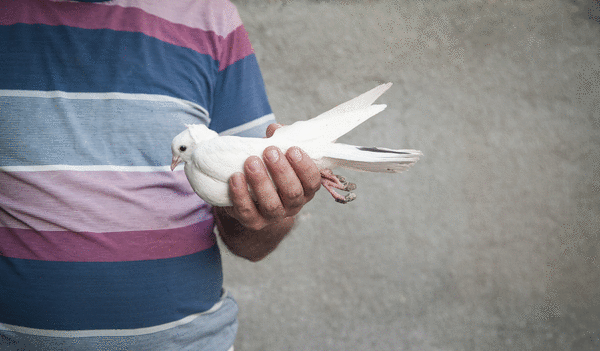
It’s prime season for weddings, graduations, showers and family reunions. But some of these memory-making moments include staged “send-offs” that come at a hidden cost. Behind every butterfly and dove release is an animal who was bred, shipped, confined and treated like a disposable party favor. For many, the celebration ends in injury, starvation or death.
Animals aren’t decorations, centerpieces or ornaments. They’re living beings, not extras in someone else’s special day.
Companies that sell butterflies treat them as replaceable merchandise. These fragile insects are stuffed into envelopes, where they remain during shipping and right up until they’re released. Many guests are horrified to find only corpses.
Some companies offer refunds if butterflies arrive dead. Others include “extra” butterflies to compensate for losses during shipping. Many warn customers that the insects must be released quickly or they will starve. Living beings are treated like damaged merchandise.
Beyond the cruelty, entomologists, biologists and environmental experts have reported concerns about butterfly releases. Releasing captive-bred butterflies into unfamiliar environments can spread disease, disrupt local populations and undermine conservation efforts by muddying scientists’ understanding of natural migration patterns. The environment in which butterflies are released may not be appropriate for them, and many may die shortly afterward.
Research has found that captive-bred monarchs are significantly weaker than their wild counterparts, with poorer flight performance and reduced ability to migrate. As a result, released butterflies are less likely to survive and reproduce in the wild.
Butterflies aren’t the only animals sacrificed for spectacle. Pigeons, too, are exploited for party profits. Birds used as props in weddings, funerals, graduations and other services are often not actually doves but homing pigeons bred to be white. It’s not possible to release these birds at ceremonies without possibly sentencing them to a painful death. These domesticated birds often fall prey to raptors and other predators, or they become disoriented and lost and succumb to starvation or extreme weather conditions. Banded homing pigeons have been found horribly injured, suffering from malnutrition or worse.
Businesses that breed and rent out white pigeons for profit are exploiting them without any concern for their well-being.
Pigeons are smart and personable. Brown University researchers found that they can quite easily learn to recognize each of the 26 letters of the Western alphabet. They are also models of fidelity who mate for life, and both parents are devoted to and take turns caring for their young. Pigeons are gentle beings and never hurt us, but humans often unthinkingly put them in harm’s way.
Nor should we replace one harmful tradition with another. Balloon releases wreak havoc on wildlife by leaving behind debris that animals can mistake for food, often with fatal consequences.
A celebration should leave behind memories, not casualties. In an age of limitless creativity, there’s no excuse for treating butterflies, pigeons or any other animals as decorations. Whether it’s flower petals, seed bombs, bubbles or countless other alternatives, we can mark life’s milestones without putting living beings in harm’s way.
_____
Jennifer O’Connor is a senior writer with the PETA Foundation, 501 Front St., Norfolk, VA 23510; www.PETA.org.
_____
©2026 Tribune Content Agency, LLC.



















































Comments