Commentary: America's digital supremacy depends on our ability to upgrade the power grid -- quickly
Published in Op Eds
The nation’s service industry has been fueled in lock step with the digital economy. In such an environment, data has become a monetizable asset, a driver for innovation and economic growth. And with the spread and growth of artificial intelligence across numerous sectors of society, the collection, storage and analysis of data has become a multibillion-dollar growth industry.
This has become most apparent with the proliferation of data centers. There are now more than 4,400 data centers scattered around the U.S., more than the total number in Germany, the U.K., France, Canada, Australia, Netherlands, China and Japan combined. Six states (Virginia, California, Texas, Illinois, Ohio and Georgia) collectively house around one-half of these centers, providing a concentration of data storage and analytics capacity that positions the U.S. for worldwide data supremacy well into the foreseeable future.
This all sounds quite promising. However, what is well known is that data centers consume massive amounts of electricity and water. This is placing strains on local infrastructures, creating headwinds on data centers being located in some communities. In 2023, just over 4 percent of all electricity consumed across the nation was due to servicing data centers. This is expected to grow to as much as 12% of all electricity consumed by 2028.
In terms of kilowatts used, data centers consumed 58 billion kilowatts in 2014, 176 billion kilowatts in 2023, and are estimated to use as much as 580 billion kilowatts in 2028. To put these numbers into perspective, data centers in 2023 used as much electricity as about 16 million homes, corresponding to more than 10% of all homes in the U.S.
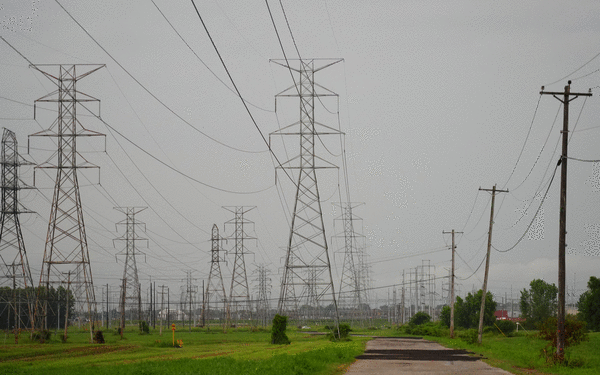
Sustaining data center growth and meeting the needs of the digital economy demands an efficient and reliable power grid. The good news is that the nation’s grid has proven itself to be remarkably dependable during the growth of the digital economy. The bad news is that it badly needs to be modernized, given that the majority of the power grid is more than 25 years old.
Like any complex cyber-physical system, increased maintenance and growing risks of unplanned breakdowns are inevitable. The cost of replacing and upgrading this infrastructure is estimated to be on the order of$10 billion annually over the next several decades.
Government investments will buffer some of these costs, but much of the cost will be borne by consumers. This has already resulted in persistent electricity cost increases, outpacing the cost of other sources of energy (heating oil, gasoline and natural gas) and even the consumer price index.
Remaining cool during the summer of 2024, a year measured to be one of the warmest in recent history, placed additional stress on the power grid. The good news is that the power grid weathered the heat remarkably well. It utilized a variety of power sources, including solar energy, to meet demand surges during some of the hottest days. In fact, without solar energy generated, it was unclear whether the demand surges on peak days could have been met.
Given that 60% of the electricity generated in 2023 was from burning fossil fuels like natural gas and coal, growth in demand for electricity requires a commensurate diversification in sources of electricity. Hence, efforts by the administration to slow the growth of renewable electricity like wind and solar are misguided if residential, industrial and data center electricity demands continue to grow.
Reliability of fossil fuel production of electricity means that this vector will not end any time soon, though its position of dominance is lessening. However, suppressing the growth of all other means to efficiently generate electricity is a formula to undermine the resilience of the power grid. Its impact on consumers will add to a level of risk and uncertainty that is unnecessary and, most importantly, avoidable.
Moreover, as data centers continue to expand across the nation, localized electricity demand burdens will surface. The basic economic principles of supply and demand will ultimately dictate how much electricity will cost consumers. What is certain is that recent electricity price increases are not a short-term phenomenon — and will likely continue for the foreseeable future.
Concentrating electricity production on fewer sources creates unnecessary risks, with cyberattacks high on this list. Any time a cyberattack successfully disrupts the production of electricity, the power grid must find alternative pathways to meet demand. Such redundancy adds reliability across the entire power grid.
Like any critical infrastructure, the nation’s power grid is now under a microscope. Investments to upgrade and enhance its performance are critical for the nation to maintain its data dominance. What makes the power grid unique is that it supports several critical infrastructures, including the financial sectors, healthcare and national defense, to name just a few. This is why supporting the grid is more than just keeping the lights on; it is about preserving our nation’s data supremacy, keeping the nation functioning, and protecting society for everyone’s benefit.
____
Sheldon H. Jacobson, Ph.D., is a professor of Computer Science at the University of Illinois Urbana-Champaign. He applies his expertise in data-driven risk-based decision-making to evaluate and inform public policy. This piece was originally published by The Hill.
____
©2026 Tribune Content Agency, LLC.




















































Comments