Gautam Mukunda: Big business bought political influence. The bill is now due
Published in Op Eds
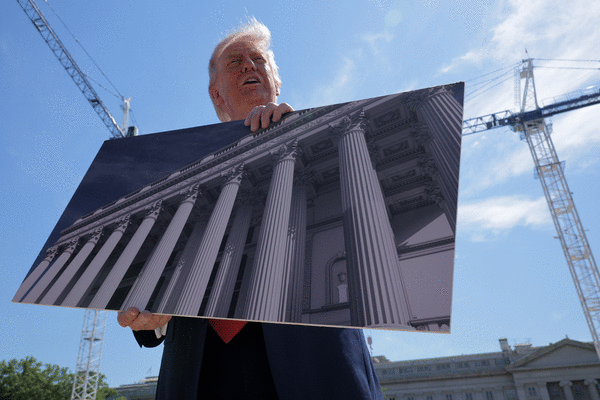
Brunswick and Echelon Insights asked registered voters in late June what they would tell America's chief executive officers if they had the chance. Only three percent said anything about politics. Before any CEOs breathe a sigh of relief, the same poll asked about contributing to the president's new White House ballroom. That was the most damaging thing a company could do, worse than endorsing his policies outright, at a net negative of 37 points.
The bill for using money to buy political influence is about to arrive, and CEOs who think the safe course is staying out of politics will find that they have already signed for it.
This is a problem facing every large company in America, and it’s really three problems. There’s this administration, which has shown that it’s willing to inflict real damage to any company that fails to bend to its wishes. There’s the public, which is watching how companies respond. And there’s whoever holds the White House next, who will inherit the same power along with a record of who paid what and how much. What protects a company from the first makes its position worse with the other two.
Start with why this is happening, noting that no law caps what a president can raise for a nonprofit like the ballroom trust or his presidential library, and most of it requires no public disclosure of who gave. The Wall Street Journal reported on July 30 that President Donald Trump calls his fundraiser most nights to ask which companies have written checks and which haven’t, that he often tells her to raise the size of the ask to as high as $50 million, and that he supplies the names, frequently of people who just met with him. Executives described understanding that their money buys access. A CEO with a merger under review wasn’t being asked because he supported the president’s politics. There was one right answer and the CEO knew it.
The checks write fast, but the damage is permanent. The White House published the ballroom donor list in October. Amazon.com Inc., Apple Inc., Microsoft Corp., Google-parent Alphabet Inc., Meta Platforms Inc., Lockheed Martin Corp. and Palantir Technologies Inc. sit alongside Harold Hamm, who founded Continental Resources. Google's money took a different route. Its parent company settled Trump's lawsuit over YouTube's suspension of his account for $24.5 million, $22 million of which went to the ballroom.
Sen. Elizabeth Warren, a Democrat from Massachusetts, and Rep. Dave Min, a Democrat from California, wrote in December to seven companies with antitrust business pending before the administration and released the answers a month later. Amazon, for one, said it had been talking to the fundraising group since August 2025 about giving amounts and about the dinner planned for donors.
Then the ground moved. The party that business chose to work with is now deeply unpopular, and Democrats are favored to take control of the House in the November midterm elections. But voters don’t see business as an innocent bystander. Brunswick asked them to place industries on the political spectrum, and oil and gas came back 52 points Republican, banking 27, technology 19. Sixty-five percent of those same voters said businesses should be politically neutral and have concluded they aren’t.
Nor will business find many defenders, because the target of American anti-elite politics has moved. When online, progressive publication The Argument surveyed 3,000 registered voters in late July and asked who counts as elite, professors didn’t qualify (I’m a little hurt). Neither did journalists. Billionaires did, overwhelmingly, along with celebrities, and to a lesser extent elected officials and business executives. When Gallup asked Americans which institutions they have confidence in, big business beat only Congress and TV news. The public has spent a decade watching wealth transmute into political power and drawn the obvious conclusion.
The third problem is the one companies have thought about least. The power that made this administration worth paying does not stay with it. In Trump v. Slaughter, the Supreme Court held that the president may remove the commissioners of independent agencies at will, overruling a precedent that had stood since 1935. The Federal Trade Commission administers roughly 80 statutes reaching nearly every part of the economy, and it now answers to the White House, as do the SEC, the FCC and the National Labor Relations Board. Justice Neil Gorsuch was more specific. A company might fend off a single FCC investigation, he said, but then asked whether “a business out of favor with the party in control of the White House” could also survive an FTC rule outlawing one of its longstanding practices, an in-house OSHA proceeding, and a prosecution under a crime the SEC had just announced. And he was writing in support of the ruling! What this President can do for you, the next can do to you.
Which is why the quiet option is worse than it looks. Saying nothing buys you nothing. The record is public and Congress already has the letters. Saying privately that you didn’t have a choice is worth what it costs. “It was a shakedown, but I got what I paid for” is not a defense anyone is going to accept.
What might work is making it clear that the experience was so bad that business is willing to give up its ability to buy favors in the future. Any company can say it hated the process. Only one willing to lose the ability to repeat it is saying anything worth listening to. Credible signals are costly signals. Business’s most important political weapon has been money. Pushing to limit its influence is the one move that reads the same way to shareholders, customers, and a future Congress.
The Trump administration changed the rules of American politics, and the business community reaped tax cuts and deregulation. The bill will come soon, and it will be much larger than a ballroom donation. Democrats might not win in November, but the record doesn’t expire, the weapons don’t go away, and whoever holds the White House and Congress next will find both waiting and have the chance to write the new rules. Their shape will depend on whether business is in the room, and the price of admission is saying something now, while saying it still costs something.
_____
This column reflects the personal views of the author and does not necessarily reflect the opinion of the editorial board or Bloomberg LP and its owners.
Gautam Mukunda writes about corporate management and innovation. He teaches leadership at the Yale School of Management and is the author of "Indispensable: When Leaders Really Matter."
_____
©2026 Bloomberg L.P. Visit bloomberg.com/opinion. Distributed by Tribune Content Agency, LLC.


















































Comments