Parmy Olson: Math's AI crisis has a lesson for the rest of us
Published in Op Eds
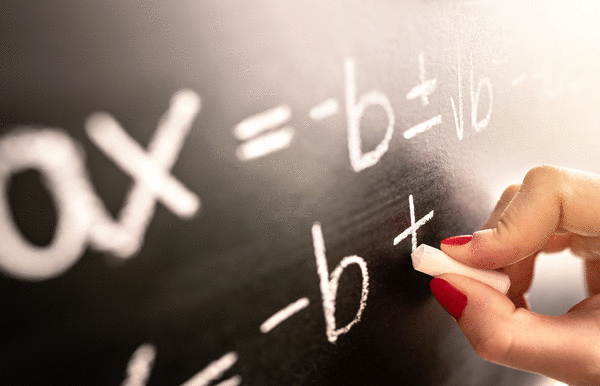
Math can mean different things to different people. It’s simple sums for children or sophisticated models for hedge fund managers. For mathematicians, it is an act of discovery. Many spend years trying to find new mathematical truths or “proofs,” work that can underpin everything from cryptography and computing to finance and engineering.
Now artificial intelligence is taking over some of that exploration, helping solve longstanding problems like the so-called Jacobian conjecture, and the field’s top minds find themselves deeply uncertain about whether that is ultimately good or bad. The answer could go either way, depending on whether mathematicians can quickly establish new standards for dealing with AI. With promising developments (1) on that front already underway, the field could create a valuable blueprint for other forms of knowledge work.
An online post went viral recently when its writer, a PhD student in pure mathematics named Kirwin Hampshire, confessed to having a “spiritual crisis” over the threat of AI taking away the most meaningful part of his work. While bots discovered new proofs, he warned that mathematicians were becoming mere spectators.
Keith Carne, a retired Cambridge mathematician, says his field is particularly susceptible to AI because the technology can cross-reference so many potential connections. “A computer can look at the way 20 different mathematicians have looked at a problem (and) have an advantage over those 20,” he says.
Fields Medal winner Terence Tao, one of the world’s best-known mathematicians, says that AI could shift math from “proof scarcity” to a state of “proof abundance,” essentially putting mathematicians in much the same precarious spot as writers, artists and analysts: The world is being flooded with AI-generated versions of what they normally produce, threatening to devalue the final product.
Professional mathematicians publish a vast number of papers each year, often containing new proofs or step-by-step arguments that show how a math rule is true. But the most important breakthroughs do something more, unlocking entirely new ways of thinking and laying paths for other mathematicians and use cases to follow.
Thousands of years after Euclid proved that there are infinitely many prime numbers, number theory has become crucial to the cryptography systems that underpin much of today’s digital economy. Work pioneered by Belgian mathematician Ingrid Daubechies on tiny oscillations called wavelets in the late 1980s helped lay the blueprints for modern image compression and how smartphones store photos.
Most mathematics doesn’t seek a final use case but is instead a quest driven by human curiosity to map out the hidden patterns of the universe, as with Fermat’s Last Theorem, a centuries-old puzzle pursued largely for the intellectual challenge itself. Pure math might find real-world applications decades after a mathematician dies, but it doesn’t have to.
Still, the discipline has long had a “publish or perish” culture, with papers acting as a kind of currency that buys you credibility among other academics, even though the deeper goal is an increase in collective understanding — an abstract concept that is seemingly impossible to value.
That communal knowledge was always the real product, while the published theorems and proofs were “residue,” says Benjamin Collas, a mathematics researcher at Kyoto University. Artificial intelligence has simply “called the bluff” of the system, he adds; the risk now is that as software generates more mathematical knowledge, humans understand less of it.
It might take a few hours to produce a proof with AI, but it can take years to absorb new results into human knowledge. In that sense, the bigger risk isn’t so much that AI replaces mathematicians, but that universities stop supporting the slow, human work that helps them grasp those truths.
Much the same dilemma hangs over fields like writing, where AI generates endless prose while the skill of deciding what is worth saying in the first place becomes scarcer. A law firm can churn out reams of briefs and contracts with AI, but the judgment involved in choosing which arguments to pursue becomes more important for humans and harder to value.
Not helping matters: Institutions have historically paid people based on the things that AI is making cheap, from publication counts in academia to billable hours and documents in law. The silver lining to math’s spiritual crisis may be that it forces humans to realize they’ve been measuring value the wrong way all along.
How do you reward judgment and taste, or smart questions that open new avenues of inquiry? In math, that could mean giving more credit and funding to teaching, explaining other people’s results or building tools like shared databases and mathematical libraries that help other mathematicians advance — not just publishing endless papers.
That would also reward the very thing that keeps mathematicians in the field. “What I like most is that (process) itself, endlessly renewed,” Collas tells me. “Going from not understanding something to understanding it. Everything points towards one still-dark part of the landscape, and then it appears with the simplest clarity.”
As machines make clever outputs ever more abundant, humans should be putting a higher price on knowing which questions are really worth asking.
____
(1) The Leiden Declaration is a set of guidelines that mathematicians quickly drew up in the last year for using AI in research while preserving human verification and judgment.
____
This column reflects the personal views of the author and does not necessarily reflect the opinion of the editorial board or Bloomberg LP and its owners.
Parmy Olson is a Bloomberg Opinion columnist covering technology. A former reporter for the Wall Street Journal and Forbes, she is author of “Supremacy: AI, ChatGPT and the Race That Will Change the World.”
©2026 Bloomberg L.P. Visit bloomberg.com/opinion. Distributed by Tribune Content Agency, LLC.















































Comments