Commentary: Let each culture decide which languages to save, and how
Published in Op Eds
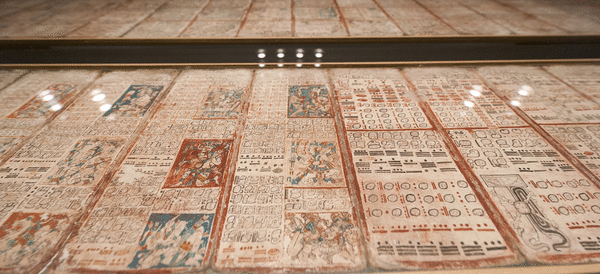
Although I founded and run an initiative that promotes endangered languages, I actually agree with the premise of a recent New Yorker article titled “ Sometimes It’s O.K. to Let a Language Die.” It is not practical for millions of people to learn their ancestors’ languages. This is true in California — which is home to dozens of endangered languages — and around the world.
Even so, the impending death of thousands of languages — caused by genocide, repression and other factors — represents an urgent situation. In fact, I spend much of my time trying to convince Jews to care about Jewish Malayalam, Algerian Jewish Sign Language and the many other Jewish languages that are now critically endangered.
I encourage people to care — but I do not assume the outcome of caring will be fluent language use by all or even many group members. Different communities will respond differently to language endangerment, and their own priorities should determine the extent to which a language is kept alive or allowed to die.
Some might pursue what linguists call revitalization, which might use language immersion schools, “master-apprentice programs” and other interventions to reinstate intergenerational transmission. An alternative approach, known as reclamation, has more varied goals, depending what the group wants, as Native American linguist Wesley Leonard has explained.
Even if there were significant funding (which is never the case), most communities with endangered language communities would be hard-pressed to find enough members to commit to the thousands of hours and emotional labor necessary to learn and transmit a language. Elders might be eager to share their language, or they might prefer to impart other cultural knowledge in their remaining years. Young families may welcome immersion schools, or they may be content with symbolic language use during ceremonies. All of this is reclamation if it reflects communal priorities.
In the diverse communities connected to various endangered Jewish languages, we see the distinction between revitalization and reclamation in the approaches to Ladino and Kashi.
Ladino, also known as Judeo-Spanish, is endangered because of the Holocaust, migration and adoption of dominant languages among Sephardic Jews from Greece, Turkey and the Balkans. Despite reports of its death decades ago, Ladino is attracting new speakers thanks to revitalization efforts such as forums for written and spoken communication, language classes, a master-apprentice program, tools for transforming rooms in the home into “language nests” and even a chatbot.
A growing network of young language learners is making use of this infrastructure. College student Benny Ginsberg-Margo has learned Ladino well enough to create cooking videos, and he hopes to impart the language to his future children. This interest is fueled by “post-vernacular engagement” — using the language in symbolic ways beyond everyday communication, such as social media, music and children’s books.
There is much less interest in Kashi, also known as Judeo-Kashani, one of several regional languages Jews spoke in Iran before government policies promoting Standard Persian (Farsi) accelerated the decline of minority languages. (Most Jews in Kashan left for Tehran in the 1940s and then migrated to Israel or the U.S. after the 1979 Iranian Revolution.)
Widespread interest, however, is not a key ingredient in language reclamation. Sabrina Hakim, who is Iranian Jewish and works in real estate in Los Angeles, contacted the Jewish Language Project from the hospital room where her father was dying. She had learned Kashi from him as he descended into dementia and reverted to his childhood language. When he had a stroke, his frailty drove home for her that he was one of Kashi’s final remaining speakers. Now, she is honoring her father’s memory by working on our Kashi dictionary.
Hakim’s goal is not to create a new generation of speakers but to ensure that her father’s culture is not erased — and to give future generations access to their linguistic heritage.
Most young Iranian-American Jews do not even know that their grandparents spoke languages other than Persian, but this is changing thanks to social media. Even so, there is little interest in learning these languages — and few classes. The efforts around Kashi are reclamation, not revitalization.
For both Ladino and Judeo-Kashani, the community responses to language endangerment are valid, and both deserve support.
In my work at the Jewish Language Project, when I work to “save” languages, I take the reclamation approach. This entails two things: documentation and post-vernacular engagement.
Documentation means recording native speakers, transcribing and translating videos, compiling dictionaries, and describing the language system. When communities do this work while native speakers are still alive, future generations will have access to the language. Post-vernacular engagement involves community members engaging with the language by learning about its history and linguistic features and celebrating it through song, media, food and heritage words. This engagement leads to some community members seeing enough value in the language to document it and even learn it.
So far, few have opted to learn Kashi. But because of the work of a committed few, resources are now available for the future. Perhaps someone in 2070 will start a Kashi language program, inspired by Daryl Baldwin, a citizen of the Miami Tribe of Oklahoma who brought the Myaamia language to new generations of Miami Tribe children and adults. Even if that does not happen, I will consider our language reclamation work a success if future generations have the resources to engage with Jewish languages on their own terms.
Some language activists argue that anything short of creating new fluent speakers amounts to surrender. I understand that impulse. But for communities with few elders, limited resources or different priorities, success may look different.
We should learn about the historical acts that led to thousands of languages becoming endangered, some of which are heinous. In the case of Jewish languages, this includes genocide, migrations, expulsions, discrimination, assimilation and nationalistic language policies. Governments should take responsibility for past linguicidal acts and support community efforts to reclaim or revitalize their ancestral languages. Companies and foundations can help, as we see in the Ojibwe language and culture app supported by Motorola and the Lenovo Foundation. Linguists within and outside the community should offer their services to document the languages and give the community the tools to learn the language if they wish.
What communities do with those tools — and the extent to which to try to keep a language alive, if at all — should be a communal decision, not an expectation imposed by outsider activists. Endangered language communities do not owe the world linguistic revival; they owe themselves the future they choose.
____
Sarah Bunin Benor is a professor of contemporary Jewish studies and linguistics at Hebrew Union College. She directs the Jewish Language Project and hosts the Heritage Words podcast.
©2026 Los Angeles Times. Visit at latimes.com. Distributed by Tribune Content Agency, LLC.


















































Comments