Allison Schrager: Why bowl together when you can scroll alone?
Published in Op Eds
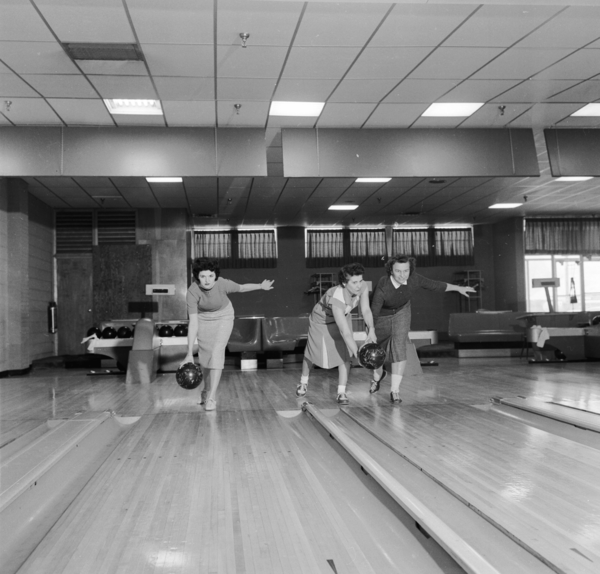
Bowling has seen better days. Lucky Strike Entertainment Corp., the dominant player in the business, has lost nearly half of its market value in the past year and had the rating on its debt cut further into junk territory.
Higher borrowing costs and iffy consumer sentiment are factors, but Americans also just don’t seem to want to bowl that much anymore. And it’s not just bowling. Demand for other social forms of leisure is on the decline, too. Dave & Buster’s Entertainment Inc.’s disappointing earnings and country clubs’ declining membership are cases in point. There may be a boom in exclusive members’ clubs in big cities. But for most Americans, the places that provide outlets for in-person connection, such as recreation and senior centers or the grocery store, are closing.
It reflects a long-running trend in how we socialize, or don’t socialize at all. Americans are spending much more time alone and on their screens. A less social nation not only portends big economic shifts, so-called “third spaces” closing and businesses running into trouble, but also impacts our mental health and well-being, while robbing us of the connections that in the past led to fresh interests and professional opportunities.
This isn’t a new lament. As far back as 2000, Harvard University political scientist Robert D. Putnam wrote in his famous book "Bowling Alone" that the decline of bowling leagues represented a degradation of community and social capital. After years of further decline, leisure activities that involve neighbors, families and colleagues interacting now seem at existential risk.
Bowling was once popular among all income groups because it offered a relatively low-cost and family-friendly way to socialize. People formed bowling leagues with friends or co-workers or just made the odd outing with other families.
League membership reached some 10 million in its heyday in the 1970s. It’s now down to about a million, with Lucky Strike noting that consumers prefer watching televised sporting events. Millions of Americans still bowl each year, more than play tennis or pickle ball. But the share of the population that bowls in a day has been trending down since even before the pandemic. America has lost one third of its bowling alleys since 2001.
Leisure trends come and go, of course, as our culture evolves and technology creates new interests and hobbies. Going to a Vaudeville show was a popular way to spend leisure time and budget in the 1880s. Movies and eventually television changed that. It could be that bowling has run its course and will soon be about as relevant as a croquet tournament.
Consumers these days have limited budgets that are being squeezed by high energy prices and inflation, so they are more price sensitive to the marginal elements of their spending, and bowling is marginal. Companies such as Lucky Strike and Dave & Buster’s are also land-intensive and carry lots of debt. The higher rate environment is forcing them to refinance at higher costs, cutting into their margins and hammering their ratings.
But the underlying worry is Americans growing less willing to gather like they used to — bowling is, after all, a social activity. Not all forms of entertainment are losing ground. Americans across income groups still spend lots on discretionary services. We spend a fortune, for example, on concert tickets and travel. No doubt budgets are tighter, but consumers are making choices that cut out community engagement.
What has replaced bowling isn’t just concert going or watching a football game, we spend more time on video games and scrolling videos of other people with a more active social life. Even when we go to concerts or the theater, we may be solo.
This has led to a striking decline in all kinds of third spaces, places where people socialized away from home, including bowling alleys, recreation centers or shopping malls. People used to congregate, connect, build friendships and foster community in these places. We’ve become less likely to entertain people in our homes, too.
A more anti-social economy has implications beyond the business landscape. It can have wider negative externalities because isolation could contribute to worse mental health and loneliness that spills over to less work. Community, in the past, was often how people learned about new jobs. Sending in one of thousands of applications to an online posting has lower odds of success, can prolong the job search and frustrate us.
Trends in leisure are transient and even re-cycle. Movie theaters, for example, are starting to make a comeback. And brands such as Tinder are launching new features designed to build community — in response to feedback from young people.
Perhaps an isolated Gen Alpha, hungry for more connection than Gen Z had, will shake things up and seek out social leisure again. We might find new third places, such as waiting in line for frozen yogurt (though I observe these lines and most people are on their phones). Or perhaps bowling will be discovered by influencers (Lucky Strike should invest in more flattering lighting), and our new third place will be waiting in line for bowling shoes.
____
This column reflects the personal views of the author and does not necessarily reflect the opinion of the editorial board or Bloomberg LP and its owners.
Allison Schrager is a Bloomberg Opinion columnist covering economics. A senior fellow at the Manhattan Institute, she is author of “Worth the Risk: The Seven Myths That Keep Us From Taking the Chances We Need to Take."
©2026 Bloomberg L.P. Visit bloomberg.com/opinion. Distributed by Tribune Content Agency, LLC.


















































Comments